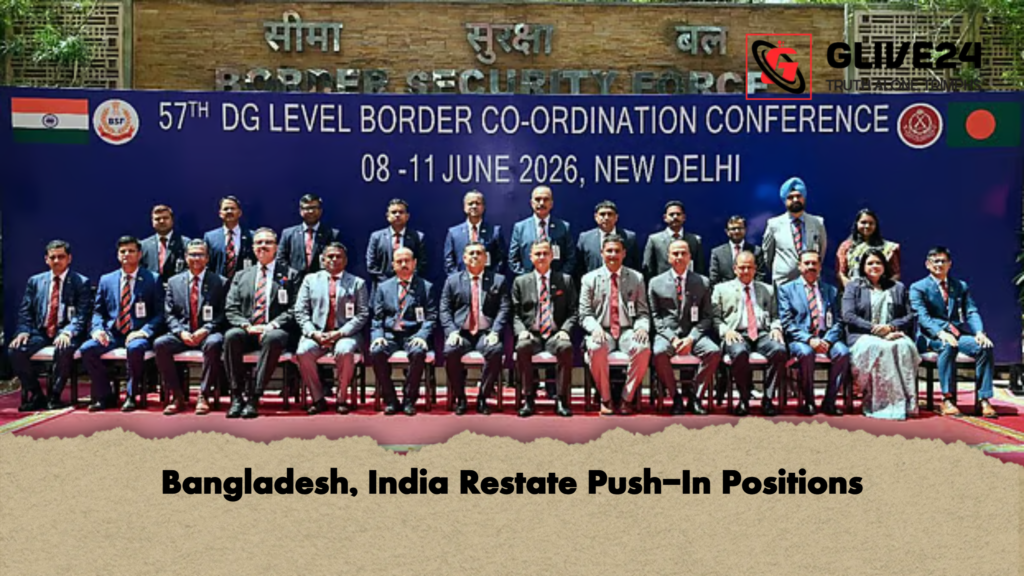
The contrasting positions of Bangladesh and India over the so-called “push-in” of individuals across the border have once again come into sharp focus during the Director General-level talks between the Border Guard Bangladesh (Border Guard Bangladesh) and the Border Security Force (Border Security Force), currently taking place in Delhi.
The issue featured prominently on the second day of the 57th DG-level border conference on Tuesday, where both sides presented their respective positions on a range of border-related concerns, including alleged push-in incidents, killings and injuries of unarmed Bangladeshi citizens, and broader security cooperation along the frontier.
The four-day conference is being held in the Indian capital, with the two sides scheduled to finalise a mutually agreed record of discussions on Wednesday. The meeting is expected to conclude on Thursday with a joint press briefing.
Table of Contents
Bangladesh and India positions
During the discussions, Bangladesh reiterated that the practice of pushing individuals into its territory is illegal, a violation of human rights, and inconsistent with international law. It further stressed that any repatriation process must strictly follow legal procedures, including confirmation of citizenship before return.
India, meanwhile, maintained that the deportation of illegal foreign nationals is being carried out in accordance with its domestic laws and established procedures. It also stated that existing bilateral mechanisms between the two countries are being followed when returning individuals identified as having crossed from Bangladesh.
According to Indian statements cited in the meeting, delays in the verification process on Bangladesh’s side—particularly in relation to lists of individuals—have been a recurring concern. The Indian side also referred to a five-year timeline regarding list submissions and processing.
Bangladesh, however, responded by reaffirming that unilateral expulsions without due verification are unacceptable and that any return of individuals must adhere to international humanitarian standards and legal frameworks. It also raised concerns about reports of nighttime push-in attempts along the border.
Figures presented in the talks
Bangladesh Border Guard (Border Guard Bangladesh) officials presented data covering recent months, while the Indian side also provided its own figures during the meeting.
| Category | Figure | Time period / context |
|---|---|---|
| Individuals pushed into Bangladesh (reported by BGB) | 2,479 | 7 May 2025 – 26 January (current cycle) |
| Indian nationals among them | 120 | Same period |
| Individuals handed over to BGB by BSF | Over 2,800 | As cited by Indian side |
| Alleged returnees claimed in West Bengal political context | 4,880 | Claimed in media statements |
The Border Security Force (Border Security Force) stated that its actions are being conducted under established legal procedures and in line with operational mechanisms agreed between the two countries.
Wider border agenda
Beyond the push-in issue, the agenda also included discussions on cross-border smuggling of narcotics, arms trafficking, human trafficking, violations of border regulations, and the construction of unauthorised structures, including fencing within 150 yards of the international boundary.
Both sides also reviewed broader cooperation mechanisms aimed at improving border management and reducing illegal activities along the frontier.
Political context and remarks
The discussions were also viewed in the context of developments in India’s West Bengal region, where a “Detect, Delete and Deport” campaign—reportedly targeting undocumented individuals identified as “so-called Bangladeshis”—has been underway, led by Suvendu Adhikari following a change in political administration.
Bangladesh’s adviser on information and broadcasting, Jahid ur Rahman, commented in Dhaka that the push-in issue had featured in West Bengal’s electoral discourse and should be understood partly in that domestic political context. He stated that while the issue has created some pressure on Bangladesh, he did not view it as an intentional move by the Indian government to create bilateral tension.
He further expressed confidence that both governments would seek to resolve the emerging situation quickly, noting that communication between the two sides had improved in the post–5 August political transition period and that there was mutual interest in stabilising the relationship.