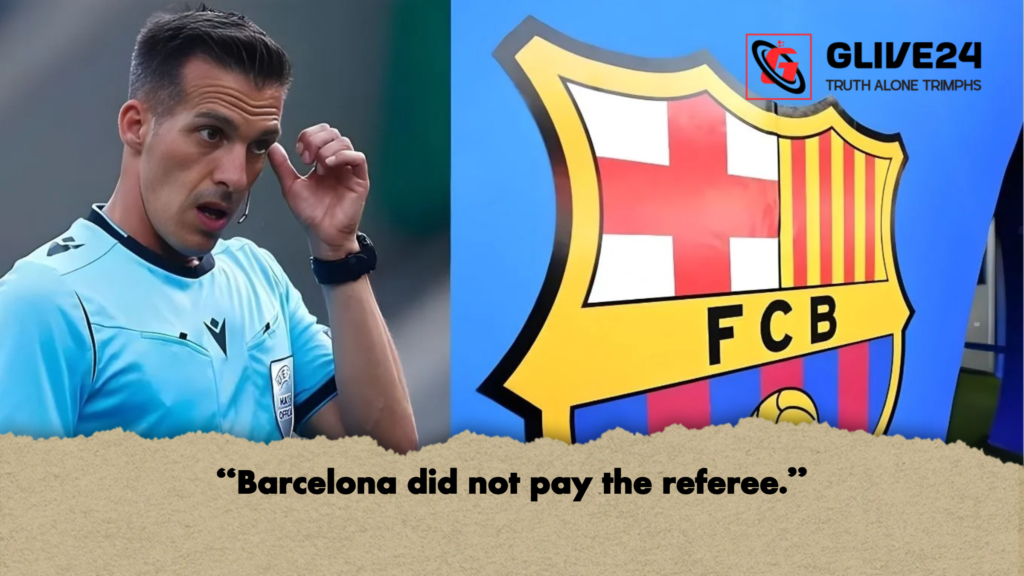
Spain’s so-called “Negreira case”, widely regarded as one of the most consequential investigations in the country’s football history, continues to cast a long shadow over Spanish football. At the centre of the controversy are allegations that FC Barcelona paid a senior refereeing official in a manner that may have influenced match outcomes. The Catalan club has consistently denied any wrongdoing, and now it has received public backing from Javier Tebas, president of La Liga.
The case revolves around payments made between 2001 and 2018 to José María Enríquez Negreira, who served as vice-president of the Spanish Referees’ Technical Committee (CTA). Prosecutors are examining whether these payments, reportedly totalling several million euros over nearly two decades, were intended to secure favourable treatment from match officials.
Barcelona maintain that the funds were paid for legitimate consultancy services, including technical reports on referees and scouting assessments related to players. The club insists there is no evidence whatsoever that money was paid to influence refereeing decisions or alter match results.
In an interview with Spanish broadcaster ABC, Tebas emphasised that Spain is governed by the rule of law and that the league’s authorities have acted accordingly. “We live in a country governed by law; rules are rules,” he stated, noting that the matter was referred directly to the Public Prosecutor’s Office rather than being pursued as a partisan dispute with rivals such as Real Madrid CF.
Tebas further remarked that, under Spanish sporting regulations, disciplinary proceedings are typically subject to a three-year statute of limitations. He suggested that such a time limit may be insufficient for cases of this gravity, advocating a longer period for prosecuting serious sporting offences.
Crucially, the La Liga president reiterated that there is no proof Barcelona paid referees to influence match outcomes. “It is clear that Barcelona did not pay referees to alter matches, as can be seen from a straightforward reading of the facts,” he asserted.
During the interview, Tebas also addressed comments attributed to Florentino Pérez, who reportedly suggested at a members’ meeting that controversial refereeing decisions — such as a debated penalty incident involving Vinícius Júnior in Pamplona — might be linked to the alleged payments. Tebas firmly rejected such claims, describing them as unfounded and unsupported by evidence.
Below is a summary of the key elements of the case:
| Aspect | Details |
|---|---|
| Investigation Period | 2001–2018 |
| Recipient of Payments | José María Enríquez Negreira (former CTA vice-president) |
| Nature of Allegation | Payments allegedly intended to influence refereeing decisions |
| Barcelona’s Position | Payments were for technical and scouting reports |
| Legal Status | Under judicial investigation |
| La Liga’s Stance | No evidence of match manipulation |
As judicial proceedings continue, the case remains under close scrutiny from Spanish authorities and the footballing world alike. While the reputational impact has already been significant, the final legal outcome will ultimately determine whether the affair represents administrative impropriety or one of the gravest scandals in modern European football.