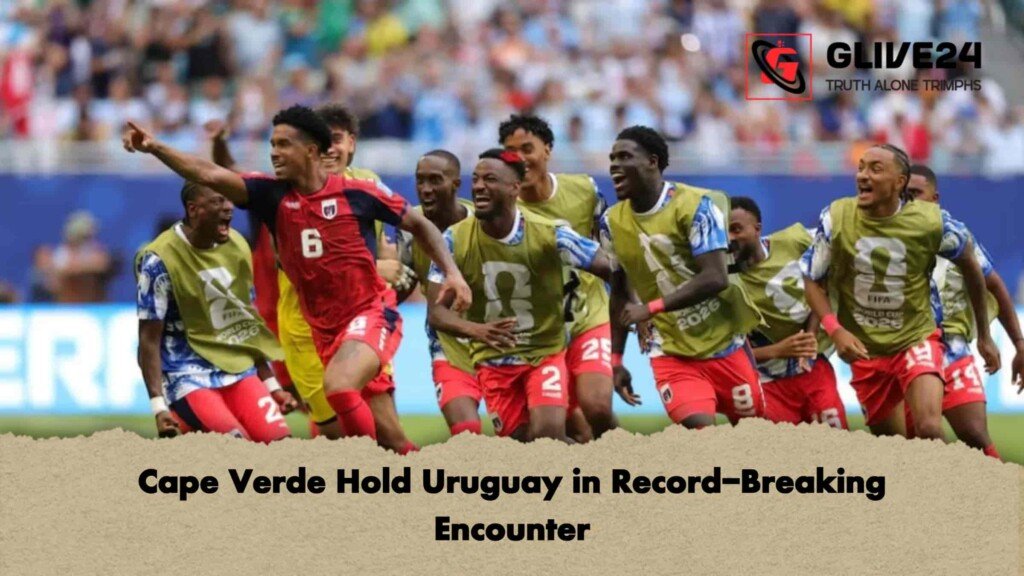
The Group H encounter between South American powerhouse Uruguay and the African island nation of Cape Verde at the Hard Rock Stadium etched its name into the FIFA World Cup record books. Beyond the tactical battle on the pitch, the fixture generated immense global interest due to the demographics of the competing nations, setting the official record for the lowest combined population between two opposing countries in World Cup history.
The collective population of both nations combined sits at a mere 3.9 to 4 million residents. Uruguay, the historic champions of the 1930 and 1950 tournaments, possesses a footballing legacy that far exceeds its domestic population of just under 3.5 million. In contrast, Cape Verde is participating in its first-ever World Cup, representing a home nation of only 530,000 citizens—approximately 120,000 of whom live in the capital city of Praia.
A Historic First-Half Exchange
Prior to kickoff, both sides sat level on one point each in the group standings, trailing Spain, who lead Group H with four points after securing a 4-0 victory over Saudi Arabia. Having already managed a resilient draw against Spain in their opening fixture, debutants Cape Verde maintained their momentum early in the match.
The breakthrough arrived in the 21st minute when Cape Verdean defensive midfielder Kevin Pina struck a powerful, low-trajectory direct free-kick from outside the penalty area to establish a 1-0 lead. The goal was historic on multiple fronts: it was Cape Verde’s inaugural World Cup goal, and it marked the first time Uruguay had ever conceded from a direct free-kick in World Cup history. The last time the South American nation conceded via a direct free-kick in a major tournament was 19 years earlier, against Venezuela during the 2007 Copa América. Pina also entered the record books as only the third African player to score from a direct free-kick at a World Cup.
Uruguay mounted a successful comeback late in the half. In the 44th minute, an aerial cross sparked a challenge in the box between two opposing players. With neither able to connect cleanly, the ball struck the post and deflected back out, allowing Uruguayan midfielder Maximiliano Araújo to convert the rebound and draw level.
Uruguay then took the lead deep into stoppage time. In the 45+6th minute, midfielder Agustín Canobbio anticipated a header from a teammate, using a quick flick of his foot to guide the ball into the net and secure a 2-1 advantage going into the interval.
Second-Half Misunderstanding Levels the Score
Cape Verde fought back in the second half, capitalizing on a significant defensive error in the 61st minute. A severe lack of communication between Uruguayan defender Mathías Olivera and goalkeeper Fernando Muslera left the defense exposed. Olivera failed to clear the ball decisively, whilst Muslera had moved far off his goal line. Hélio Varela quickly intercepted the loose ball and launched a long-range shot into the empty net to equalize at 2-2, marking his first international goal for Cape Verde.
The draw preserves Cape Verde’s aspirations of progressing to the second round of the tournament, completing a highly competitive encounter on the world stage.
Group H Tournament Context & Match Timeline
| Timeline / Statistic | Match Event & Data Details |
| Venue | Hard Rock Stadium |
| Demographic Record | Combined population of roughly 3.9M – 4M |
| Uruguay Profile | Population under 3.5M; World Cup winners (1930, 1950) |
| Cape Verde Profile | Population ~530,000; Tournament debutants |
| 21st Minute | Goal: Kevin Pina (Direct Free-kick) — Cape Verde 1-0 |
| 44th Minute | Goal: Maximiliano Araújo (Rebound) — Uruguay 1-1 |
| 45+6 Minute | Goal: Agustín Canobbio (Foot-flick) — Uruguay 2-1 |
| 61st Minute | Goal: Hélio Varela (Long-range strike) — Cape Verde 2-2 |
| Group H Overview | Spain leads with 4 points (defeated Saudi Arabia 4-0) |