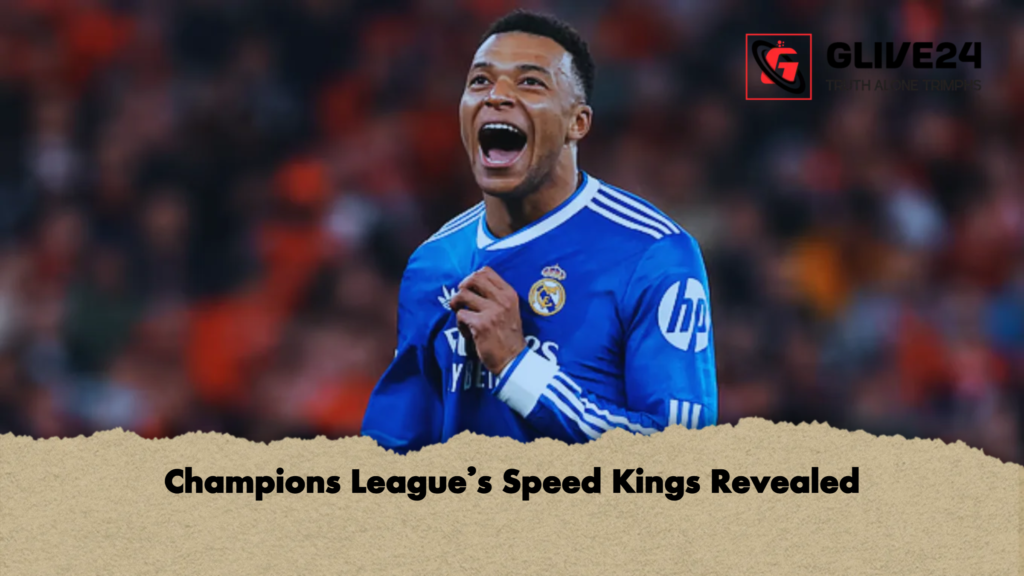
Who are the fastest players in this season’s UEFA Champions League? The latest positional speed rankings, published on Tuesday by the CIES Football Observatory, provide a compelling answer. The Switzerland-based research body, which specialises in performance analytics and player metrics, has identified the quickest footballers across defensive, midfield and attacking roles, highlighting the growing importance of pace in elite European competition.
Table of Contents
Defensive Acceleration
Among central defenders, the standout performer is Abdukodir Khusanov of Manchester City. The Uzbek international recorded a top speed of 35.8 km/h, underlining how modern centre-backs are now expected to combine positional intelligence with explosive recovery pace. In an era where defensive lines are often pushed high up the pitch, such acceleration can be decisive in countering rapid transitions.
Full-Back Dominance from Paris
The full-back category is dominated by Paris Saint-Germain. Moroccan international Achraf Hakimi leads the way with an impressive 36.4 km/h, while his team-mate Nuno Mendes follows closely at 36.1 km/h. Their pace reflects PSG’s tactical reliance on dynamic wide defenders capable of overlapping runs and rapid defensive recovery.
Midfield and Wide Threats
In midfield, Archie Gray of Tottenham Hotspur tops the list, clocking 34.8 km/h. Although midfielders traditionally prioritise stamina and distribution, Gray’s sprinting capacity illustrates the modern demand for box-to-box dynamism.
The fastest winger recorded in the study is Anthony Gordon of Newcastle United, who reached a remarkable 37.9 km/h — the highest figure among the highlighted players.
Centre-Forward Sprinting Power
Among centre-forwards, Kylian Mbappé of Real Madrid leads with 35.7 km/h. Renowned for his devastating acceleration over short distances, Mbappé continues to set the benchmark for attacking pace at the highest level.
Below is a summary of the leading performers by position:
| Position | Player | Club | Top Speed (km/h) |
|---|---|---|---|
| Centre-Back | Abdukodir Khusanov | Manchester City | 35.8 |
| Full-Back | Achraf Hakimi | Paris Saint-Germain | 36.4 |
| Full-Back | Nuno Mendes | Paris Saint-Germain | 36.1 |
| Midfielder | Archie Gray | Tottenham Hotspur | 34.8 |
| Winger | Anthony Gordon | Newcastle United | 37.9 |
| Centre-Forward | Kylian Mbappé | Real Madrid | 35.7 |
Movement Patterns Beyond Sprinting
The CIES report also analysed movement intensity. Among 100 ranked players, three centre-forwards covered the greatest proportion of their total distance at walking pace (below 7 km/h). Mbappé topped that category as well, walking 43.5% of his total match distance. He was followed by Victor Osimhen (41.9%) of Napoli and Luis Suárez (40.1%) of Sporting CP.
Conversely, three central midfielders recorded the lowest walking percentages, indicating sustained high-intensity involvement: Håkon Evjen (23%) of Bodø/Glimt, João Simões (24.1%) of Sporting CP, and Lucas Bergvall (25.2%) of Tottenham.
The Modern Game’s Physical Edge
These figures underscore how contemporary elite football increasingly hinges on athletic output as much as technical refinement. Speed is no longer a luxury confined to wingers; it is a prerequisite across all positions. In the Champions League’s unforgiving environment, marginal gains in acceleration and recovery can shape decisive moments — and, ultimately, define campaigns.