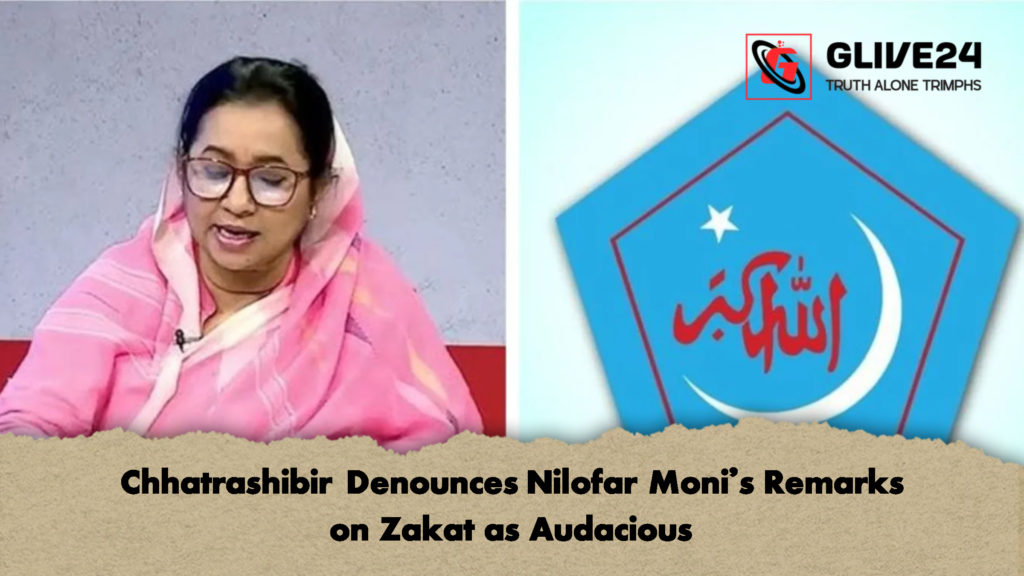
Bangladesh Islami Chhatrashibir has issued a formal statement expressing severe condemnation and protest regarding recent comments made by Nilofar Chowdhury Moni, a prominent leader of the Bangladesh Nationalist Party (BNP) and a former Member of Parliament. The student organisation characterised her remarks as “audacious” and a direct affront to the religious sentiments of the Muslim community.
In a joint statement released on Saturday, 2 May, the Central President of Chhatrashibir, Nurul Islam, and the Secretary General, Sibhagatullah, articulated their profound grievances. The leadership asserted that Moni’s discourse regarding Zakat—a fundamental pillar of Islam—was not only disrespectful but fundamentally misguided and unacceptable in its comparison to illicit activities.
Context of the Controversy
The dispute originates from a televised discussion broadcast on a private television channel. According to the Chhatrashibir leadership, Nilofar Chowdhury Moni presented the compulsory Islamic obligation of Zakat in a disparaging and trivialising manner. Most controversially, the organisation alleged that during her appearance, Moni suggested that extortion (locally referred to as chandabaji) was preferable to, or “better than,” the practice of Zakat.
Chhatrashibir leaders emphasised that such a comparison is inherently flawed and deeply offensive to the faith. They provided the following clarifications regarding the status and definitions of the two concepts:
-
The Sanctity of Zakat: As one of the five pillars of Islam, Zakat is a mandatory charitable contribution for those who meet the necessary wealth criteria (Nisab). Within Islamic jurisprudence, it is regarded as a divine mechanism designed to ensure the rights of the impoverished and to facilitate the equitable distribution of wealth, thereby systematically reducing socio-economic disparities within society.
-
The Nature of Extortion: Conversely, extortion is a punishable criminal offence under the laws of Bangladesh and is universally regarded as a symbol of injustice and social instability. It involves the illegal seizure of property or money through force, threats, or intimidation. The student organisation argued that equating a sacred duty with a criminal act is an unprecedented distortion of values.
Social and Political Implications
The statement further highlighted the broader societal context following recent political shifts in the country. The Chhatrashibir leaders noted that following the student-led mass uprising, the general populace harboured significant expectations that the nation would finally be liberated from the pervasive cultures of extortion and illegal occupation. However, they expressed grave concern that these predatory practices have yet to be fully eradicated from the social fabric.
By drawing a comparison between a sacred religious duty and a criminal act, the organisation argued that Moni’s rhetoric inadvertently validates or trivialises a culture of lawlessness. They maintained that such comments undermine the moral aspirations of the public, who are currently striving to establish a society based on justice and transparency.
Demands for Accountability and Legal Action
In light of the incident, the leadership of Bangladesh Islami Chhatrashibir has put forward several formal demands to address the grievance and ensure such rhetoric does not go unaddressed:
-
A Public Apology: They have called upon Nilofar Chowdhury Moni to formally withdraw her statements immediately and offer an unconditional apology to the nation for hurting religious sensitivities.
-
Party Clarification: The organisation urged the Bangladesh Nationalist Party (BNP) to clarify its official stance on the matter, questioning whether the leader’s personal views reflect the party’s broader position on religious obligations and social ethics.
-
Legal Investigation: They have requested that the administration and relevant law enforcement agencies conduct a thorough investigation into the remarks and take necessary legal measures in accordance with the law to prevent the incitement of religious tension.
The statement concluded by reiterating that no individual, regardless of their political stature or history, should be permitted to belittle the fundamental tenets of Islam or promote criminal activities as acceptable social alternatives. The organisation maintained that preserving the sanctity of religious provisions and upholding the rule of law are essential for maintaining social harmony in Bangladesh.