Serious allegations of systematic corruption and preliminary question paper leaks have emerged regarding the recruitment process for third and fourth-class employees within the Bangladesh Inland Water Transport Authority (BIWTA). Reports from credible inside sources indicate that an organized syndicate, allegedly connected with elements of the former Awami League administration, has been operating an illicit employment commerce network within the statutory body for a considerable duration. The syndicate reportedly secures the illicit passage of pre-selected candidates through written examinations by distributing leaked test materials prior to the commencement of the official assessments. Due to the highly secretive nature of these operations, the exact identities of all the primary perpetrators behind this intricate manipulation remain unverified.
Sources close to the matter reveal that candidates have allegedly been asked to pay between 800,000 and 1,000,000 BDT per person to secure employment contracts. This practice directly contradicts established regulatory frameworks. According to the Bangladesh Gazette Extraordinary, published on 8 November 1990, the recruitment guidelines for these specific categories mandate that appointments must be finalized solely through oral examinations. Conversely, the official recruitment committee maintains that the written tests were integrated into the process following specific administrative directives issued by the higher management of the authority.
Table of Contents
Severe Discontent Manifests Across Examination Centres
The controversy intensified significantly following the execution of the recruitment examinations on 16 May. The examinations were conducted between 3:00 pm and 4:30 pm across multiple prominent educational institutions in the capital, including the male and female sections of Mirpur Bangla School and College, as well as Mirpur Girls’ Ideal College. Investigative evidence compiled by the publication The Finance Today demonstrates that a complete copy of the examination answer key was obtained by the outlet at 2:54 pm, precisely six minutes before the official commencement of the test.
As news of the rapid information leak spread across the testing venues, widespread frustration and vocal protests erupted among the legitimate examinees. The candidates expressed profound disappointment regarding the glaring irregularities permitted by the management, stating that such compromised procedures completely undermine the principles of competitive merit.
In strict accordance with Section 23 of the 1990 Recruitment Rules, individuals applying for the positions of MLSS, guard, night watchman, customs guard, estate guard, gardener, bearer, sweeper, store helper, cleaner, helper, weighman, and ghat messenger must possess a minimum educational qualification of an eighth-grade pass. The statutory order explicitly dictates that these fourth-class operatives must be selected primarily on the basis of physical health and performance during oral interviews, rather than through complex written evaluation matrices.
Institutional Indifference and Call for Ministerial Intervention
Despite the publication of extensive investigative reports highlighting financial irregularities during similar recruitment drives in 2025, victims allege that associates of the deposed political regime remain deeply entrenched within the BIWTA infrastructure. Serious institutional complaints name the former executive committee president of the BIWTA Shramik League, Akhtar, and the former general secretary, Sarwar, as key coordinators who allegedly facilitate the fraudulent placement of candidates in exchange for substantial kickbacks.
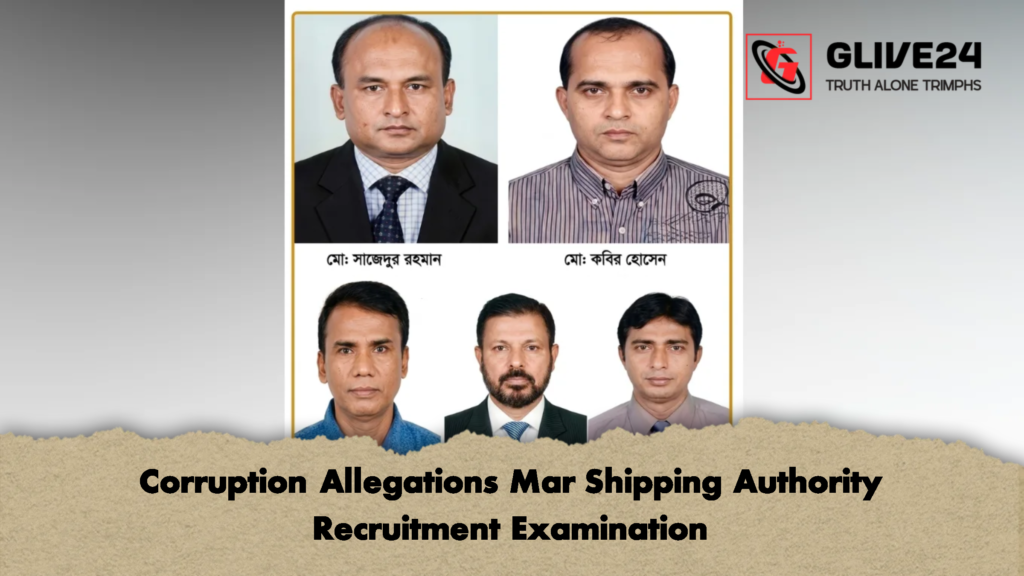
The officially constituted recruitment committee for the controversial 16 May assessment consists of senior BIWTA bureaucrats:
-
Chairman: Mohammad Sajedur Rahman, Joint Secretary (Member, Planning and Operation)
-
Member Secretary: Mohammad Kabir Hossain (Additional Director, Administration and Human Resources)
-
Committee Members: Gopal Babu (Director, Accounts), Mohammad Golam Faruq (Audit), and Mohammad Mizanur Rahman (Joint Director, Administration and Human Resources).
Historical data shows that this specific network has been highly active across previous political administrations. Reports indicate that Sarwar alone allegedly secured irregular employment for hundreds of individuals, including his immediate relatives from various districts, by leveraging direct connections with the former Shipping Minister, Shajahan Khan, and the former State Minister, Khalid Mahmud Chowdhury.
The fraudulent entry of unqualified personnel has systematically deprived meritorious candidates of legitimate career opportunities. Consequently, the affected examinees and their families have formally appealed for the immediate intervention of the Secretary of the Ministry of Shipping and the current Shipping Minister, Robiul Islam. They demand a complete suspension of the active selection list, a thorough independent inquiry, and the strict enforcement of the 1990 recruitment bylaws.
Technical Modalities of the Recruitment Fraud
Information shared by a senior BIWTA official, speaking on the condition of anonymity, confirms that the manipulation of the written examination is merely the initial phase of a multi-tiered fraudulent operation. The illicit process relies heavily on a sophisticated “proxy candidate” or “body change” system. Once an illegal financial contract is established, an educated proxy examinee is deployed to sit the written test. If the proxy secures a passing grade, the same individual is subsequently sent to complete the practical assessment stage. The final stage involves interview fraud, where the proxy comfortably completes the viva-voce phase due to a total lack of biometric verification at the venue.
The financial transactions governing this deception are strictly compartmentalized into three distinct phases: an initial 30 per cent payment upon passing the written exam, a secondary 30 per cent transfer following the practical test, and the remaining 40 per cent clearance upon the publication of the final selection list. Aggrieved examinees have publicly challenged the legitimacy of the results, noting that successful candidates were permitted to utilize mobile phones and digital devices during the test. They assert that if the passing candidates were subjected to an identical re-examination under independent supervision, they would fail to score above 30 per cent.
Furthermore, observers noted that invigilators entirely failed to cross-reference candidates’ physical features with their registered photographs or verify historical signatures on attendance sheets, which allowed dummy examinees to operate without detection. Reports also indicate that certain pre-selected candidates were irregularly accommodated in private spaces outside the designated examination halls.
Demands for Systemic Audit and Official Response
Crime analysts and public administration experts emphasize that the operational efficiency of an essential state enterprise like the BIWTA depends entirely on internal transparency, corporate governance, and strict institutional discipline. To unmask the full extent of the fraud, expert analysts have urged the authorities to conduct a comprehensive forensic audit of the examination scripts. This includes verifying the handwriting consistency across multiple high-scoring papers, checking for the mandatory signatures of hall invigilators, and matching the orthography of candidates’ names and personal details between the attendance registers and the answer script top-sheets.
When formally confronted with these extensive allegations, the Chairman of the Recruitment Committee, Mohammad Sajedur Rahman, explicitly denied all claims of administrative malpractice. Rahman stated that the total execution of the test, alongside the subsequent evaluation of the scripts, was completely outsourced to Meridian University. He argued that because the university held exclusive custody of the materials, the possibility of an internal question leak was entirely non-existent. Commenting on the statutory requirement for oral-only testing for fourth-class staff, Rahman dismissed the claim, asserting that the administration possessed the full legal authority to implement written testing models based on specific institutional choices. He concluded by stating that all procedures were conducted collectively by the five-member committee in accordance with standard administrative protocols.