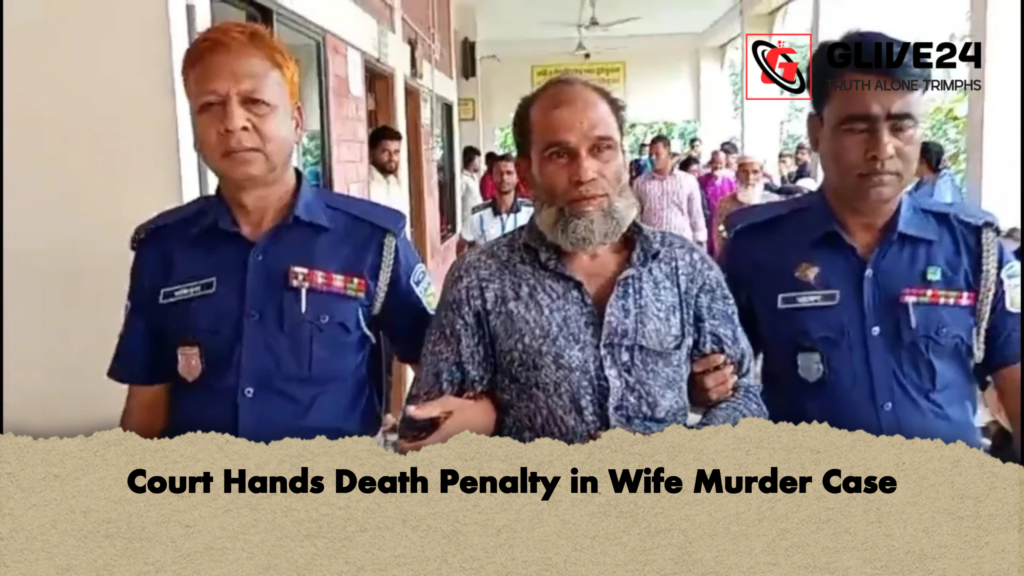
A Bangladeshi court has sentenced a 42-year-old man to death after finding him guilty of torturing and killing his wife in a case that has drawn significant public attention in the Netrokona district. The convicted man, identified as Shafikul Islam, was also fined 10,000 taka. In the event of non-payment, he will serve an additional six months of simple imprisonment.
The verdict was delivered on Wednesday afternoon by Judge A.K.M. Emdadul Haque of the Netrokona Women and Children Repression Prevention Tribunal. The courtroom was in session when the judgment was announced, with the accused present in the dock. Two other individuals named in the case, Torab Ali and Sakhina Khatun, were acquitted of all charges due to a lack of sufficient evidence.
According to court proceedings and case documents, Shafikul Islam married Parveen Akhter, a resident of Ratnapur village under Barhatta upazila, roughly a decade ago. The couple had two children together. Prosecutors told the court that the marriage, which began like many others in the region, gradually deteriorated amid repeated allegations of domestic abuse linked to dowry demands.
Approximately one month before the incident, Shafikul Islam allegedly demanded 100,000 taka from his wife. When she refused to comply, she was reportedly subjected to physical assault and returned to her parental home. Local community leaders later intervened in an attempt to resolve the dispute, and following mediation, she was sent back to her husband’s residence.
Tragically, on the night of 26 April 2019, Parveen Akhter’s family was informed of her death. Upon arriving at the house in Kolmakanda upazila, they discovered her body lying on a veranda. Relatives later alleged that visible injuries were present on the deceased, raising suspicions of violent assault. Police subsequently recovered the body and sent it to Netrokona Sadar Hospital morgue for post-mortem examination.
Following the incident, the victim’s brother, Abu Yusuf, filed a case at Kolmakanda Police Station under the Women and Children Repression Prevention Act, naming Shafikul Islam along with his parents as accused. The case proceeded through years of hearings, witness testimonies and evidence review before the tribunal ultimately reached its verdict.
Public prosecutors described the case as both serious and widely discussed, underscoring that the court’s decision was based firmly on witness statements and material evidence presented during trial. The prosecution expressed satisfaction with the ruling, calling it a reflection of judicial accountability in a case involving allegations of domestic violence and fatal abuse within marriage.