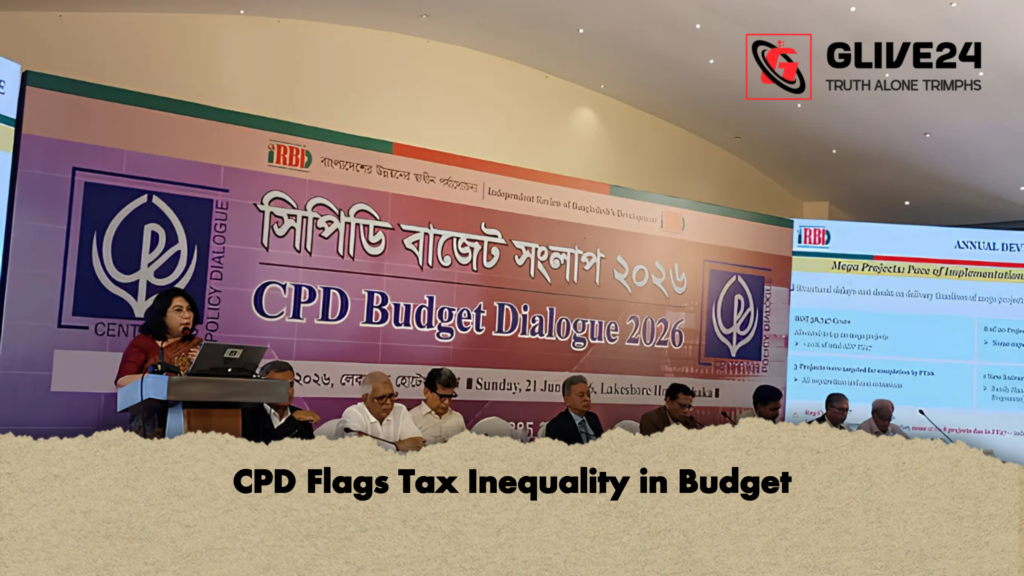
The Centre for Policy Dialogue (CPD) has stated that the proposed budget for the 2026–27 fiscal year reflects significant disparities in the personal income tax structure within the private sector. According to the research organisation, the new tax framework places a comparatively higher burden on lower-income taxpayers, while the increase in tax liability for higher-income groups remains relatively limited.
The observation was made on Sunday at a dialogue on budget analysis held at the Lakeshore Hotel in Gulshan, Dhaka. Finance and Planning Minister Amir Khasru Mahmud Chowdhury attended the event as the chief guest. The keynote paper was presented by CPD Executive Director Fahmida Khatun.
The session was chaired by CPD Distinguished Fellow Professor Mustafizur Rahman. Special guests included Planning State Minister Jonaid Ahmed Saki, while Akhtar Hossain, a Member of Parliament elected from the National Citizens Party (NCP), attended as an honoured guest.
Several other economists, business leaders, and labour representatives also participated in the discussion, including Hossain Zillur Rahman (Executive Chairman, PPRC), M A Razzaque (Chairman, RAPID), Anwar-Ul-Alam Chowdhury Parvez (President, Bangladesh Chamber of Industries), Inamul Haq Khan (Senior Vice-President, BGMEA), and Montu Ghosh (President, Garments Sramik Trade Union Kendra).
Table of Contents
Tax burden analysis
Presenting CPD’s findings, Fahmida Khatun stated that an analysis of the proportional increase in tax burden relative to income growth shows notable disparities. Individuals with taxable annual incomes between 6 and 15 lakh taka are expected to face an increase in tax liability ranging from 12.5 per cent to 16.7 per cent under the new budget. In contrast, for individuals earning above 30 lakh taka annually, the increase in tax liability is estimated at 7.6 per cent. According to CPD, this structure is inconsistent with principles of social equity and fairness.
Employment commitments and budget alignment
Fahmida Khatun also noted that the government’s election pledge to create 10 million new jobs within 18 months is not clearly reflected in the proposed budget. She stated that allocations for four key ministries—Labour, Expatriates’ Welfare, Industry, and Commerce—are either declining or remaining stagnant relative to total expenditure.
She further highlighted that several employment-oriented large-scale projects, including the Patuakhali Export Processing Zone (EPZ) and the Jamdani Village project, have remained stalled for years without significant progress.
According to CPD, without a clearly defined national employment programme and necessary structural reforms, the employment target risks remaining a “political aspiration” rather than a practical outcome.
Inflation target and macroeconomic outlook
The proposed budget sets an inflation target of 7.5 per cent. However, CPD noted that average inflation stood at 8.63 per cent up to May of the outgoing fiscal year. The organisation stated that achieving the target would require ensured food and energy supply stability alongside prudent monetary policy.
Fahmida Khatun also remarked that while the budget’s objective of economic recovery is commendable, several macroeconomic indicators appear overly optimistic. She added that although increased allocations for human capital development sectors such as education and health are positive, concerns remain regarding the effective implementation of these allocations.
Participants in the dialogue
| Category | Names/Institutions |
|---|---|
| Government representatives | Amir Khasru Mahmud Chowdhury; Jonaid Ahmed Saki |
| CPD officials | Fahmida Khatun; Mustafizur Rahman |
| MP (NCP) | Akhtar Hossain |
| Research organisations | CPD; PPRC; RAPID |
| Business organisations | Bangladesh Chamber of Industries; BGMEA |
| Labour representation | Garments Sramik Trade Union Kendra |
The discussion brought together stakeholders from government, research institutions, business associations, and labour organisations to review the proposed national budget framework and its expected socio-economic implications.