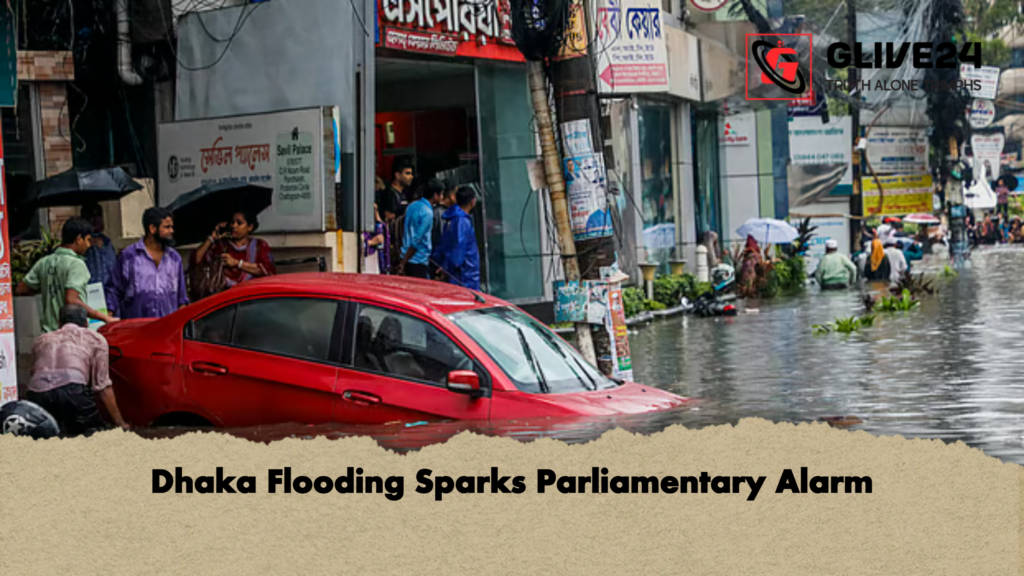
The National Parliament has expressed deep concern over the severe waterlogging crisis gripping Chattogram city, with the Prime Minister conveying heartfelt regret for the suffering endured by residents and assuring intensified government action to address the long-standing problem.
During a parliamentary session, Member of Parliament for Chattogram–10, Saeed Al Noman, raised the issue under a point of order, drawing attention to the worsening urban flooding situation. He informed the House that continuous heavy rainfall had left large parts of the port city inundated, effectively paralysing normal life. According to him, floodwaters had entered residential homes across multiple neighbourhoods, forcing residents to endure significant hardship and disrupting daily activities, transport, and essential services.
In response, the Prime Minister, Tariq Rahman, acknowledged that the situation had arisen from years of accumulated waterlogging problems. He noted that such entrenched urban drainage issues cannot be resolved overnight and require sustained, coordinated intervention. The government, he said, is actively working to reduce public suffering and is committed to accelerating ongoing measures aimed at restoring proper drainage in the city.
He further highlighted that Chattogram is not an isolated case. Similar waterlogging problems are increasingly affecting several urban centres across the country, including the capital. Rapid urban expansion, combined with inadequate drainage capacity, has intensified the problem, turning seasonal rainfall into prolonged urban flooding in many areas.
The Prime Minister also referred to earlier government initiatives involving the re-excavation of rivers and canals, which were undertaken to improve flood management and drainage capacity. He confirmed that the current administration has resumed and expanded such efforts, including renewed canal excavation and systematic cleaning of urban drainage networks. Some projects have already been implemented in selected areas, with further work underway.
However, he expressed concern over persistent public negligence in waste disposal practices. He noted that plastic waste, polythene bags, and bottles are frequently dumped into drains and canals, severely obstructing water flow and undermining government efforts. This recurring issue, he emphasised, quickly reverses progress made through infrastructural improvements.
The Prime Minister stressed that government action alone is insufficient. He called for stronger public awareness and civic responsibility, urging Members of Parliament to actively engage with communities to promote proper waste management practices. Without behavioural change alongside infrastructure development, he warned, a permanent solution to waterlogging would remain elusive.
Summary of Waterlogging Situation
| Aspect | Description |
|---|---|
| Primary cause | Blockage of drains and canals due to accumulated waste |
| Urban impact | Flooding of roads and residential areas |
| Public suffering | Disruption of mobility, services, and daily life |
| Government response | Canal excavation, drainage cleaning, infrastructure improvement |
| Key requirement | Public awareness and waste management discipline |
During the debate, lawmakers described Chattogram’s flooding as a chronic urban challenge rooted in decades of unplanned development. Experts have similarly attributed the worsening crisis to rapid and unregulated urbanisation, the filling of natural water bodies, and persistent weaknesses in municipal waste management systems.
Overall, while the government continues to pursue structural reforms to mitigate urban flooding, parliamentary discussions underscored that long-term success will depend equally on civic discipline and sustained public cooperation.