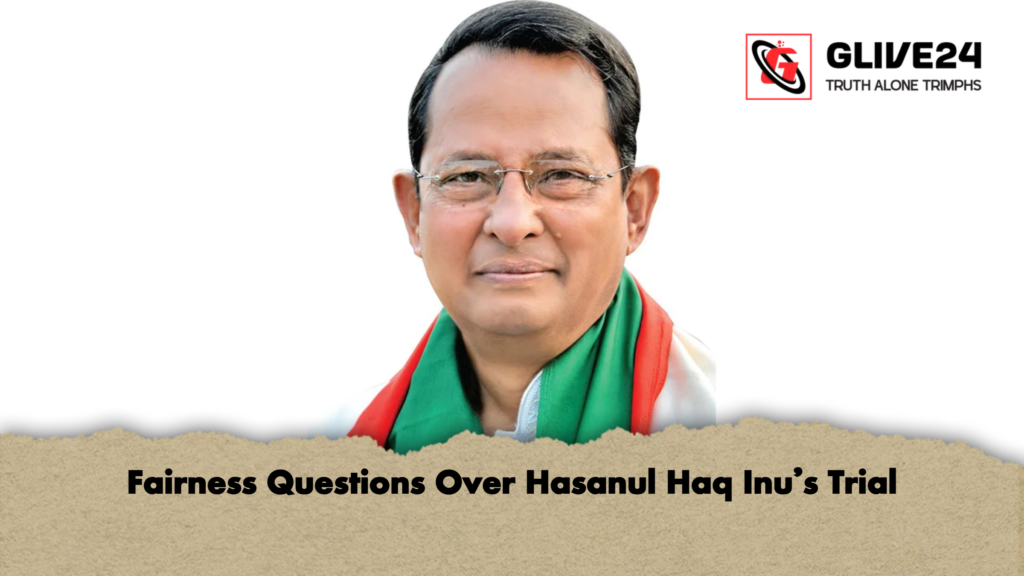
The International Crimes Tribunal (ICT) of Bangladesh is approaching the final stages of several cases linked to the political violence of July and August 2024. Among these, the trial of veteran politician and President of the National Samajtantrik Dal (Jasad), Hasanul Haq Inu, has concluded its hearings, and the court is currently deliberating on the final verdict. Inu remains in custody, whilst his family and defence team raise profound concerns regarding the fairness and structural integrity of the judicial proceedings.
Table of Contents
A Summary Trial and Procedural Timeline
Legal observers have categorised the proceedings as a “summary trial” due to the rapid conclusion of arguments within just nine working days. The timeline and procedural elements of the trial are detailed below:
| Judicial Stage | Commencement Date | Duration and Procedural Observations |
| Evidentiary Phase | 2 November 2025 | Defence counsel reported inadequate time to cross-examine witnesses and alleged unwarranted interference from the prosecution. |
| Closing Arguments | 2 April 2026 | Concluded within 9 working days. The defence was allocated only a single day (approximately three hours) to counter the state’s arguments. |
The defence team told Voice that hearings consistently commenced after 11:00 am and concluded by 2:00 pm, occasionally running concurrently with other tribunal matters. Furthermore, Inu was denied the opportunity to deliver an oral statement in court for his own defence.
Legal experts note that this compressed timeframe stands in stark contrast to historical ICT cases conducted under the International Crimes (Tribunals) Act 1973, such as the trial of Ghulam Azam, which featured extensive hearings and prolonged defence arguments. While the prosecution maintains that scheduling is strictly within the court’s procedural prerogative, critics argue this disparity undermines the principles of judicial depth and equity.
Jurisdictional Controversies and Casualty Data
The ICT was originally established to prosecute war crimes, genocide, and crimes against humanity committed during the 1971 Liberation War. Expanding its jurisdiction to encompass the 2024 political unrest has triggered intense constitutional debate. Numerous jurists argue that these events constitute conventional criminal offences that belong in ordinary criminal courts rather than a specialised international tribunal.
The scale of the unrest remains a subject of varying estimates:
-
Daily Prothom Alo: Reported approximately 200 fatalities up to the morning of 4 August 2024.
-
UN Human Rights Commission: Estimated around 1,400 fatalities up to 15 August 2024.
Sources indicate that the casualties were not exclusive to protesters. On 4 August, widespread anarchy occurred across the country, including attacks on police stations and prisons, which resulted in the escape of inmates. Law enforcement officials used lethal force to safeguard public property and protect their own lives. Concurrently, Awami League leaders and supporters faced targeted violence; some victims were killed and publicly hanged, with the acts broadcast live on social media to instill fear. Following the resignation and departure of Prime Minister Sheikh Hasina on 5 August after military intervention, the lawlessness intensified, with the United Nations noting that the majority of deaths occurred after the government collapsed.
Forensic Deficiencies and Legal Liability
Serious questions have emerged regarding the weaponry used during the riots. Brigadier (Retd.) Sakhawat Hossain, an adviser to the interim government led by Muhammad Yunus, stated that multiple casualties bore wounds from 7.62mm calibre ammunition—a calibre not utilised by the Bangladesh Police. Despite demands from the defence, no ballistic or forensic investigations were conducted into the origin of these weapons, nor were the arms looted from police stations systematically traced.
A central legal dispute in Inu’s case involves the concept of criminal liability through awareness. Under established international criminal law:
-
Mere knowledge of a crime does not automatically establish guilt.
-
The failure to prevent an act creates liability only when “effective control” is proven.
-
“Command responsibility” requires explicit proof of an operational or directive role.
The defence highlights that Inu held no ministerial or administrative office within the government or security apparatus during the 2024 events. As the leader of an independent political party within the Awami League-led coalition, he possessed no direct command over state forces or field-level actors. He was entirely absent from the locations where the killings occurred.
Defence Assertions and Political Context
The defence team revealed that a 68-page written statement prepared by Inu was barred from being presented in court, alleging that the prosecution relied on political rhetoric rather than forensic evidence.
As the tribunal simultaneously tries former Prime Minister Sheikh Hasina and other pro-Liberation political figures, observers express concern that the trial could set a dangerous precedent by reclassifying domestic political violence as international crimes. Lawyers contend that Inu—a freedom fighter who previously campaigned heavily for the prosecution of 1971 war criminals and fiercely criticised the arson attacks attributed to the BNP-Jamaat alliance—is facing a politically motivated, unilateral trial. Ultimately, observers emphasise that maintaining public confidence in the judiciary requires total transparency, strict adherence to international standards, and a clear distinction between state suppression and political factional conflict.
Author: Expatriate journalist and political analyst