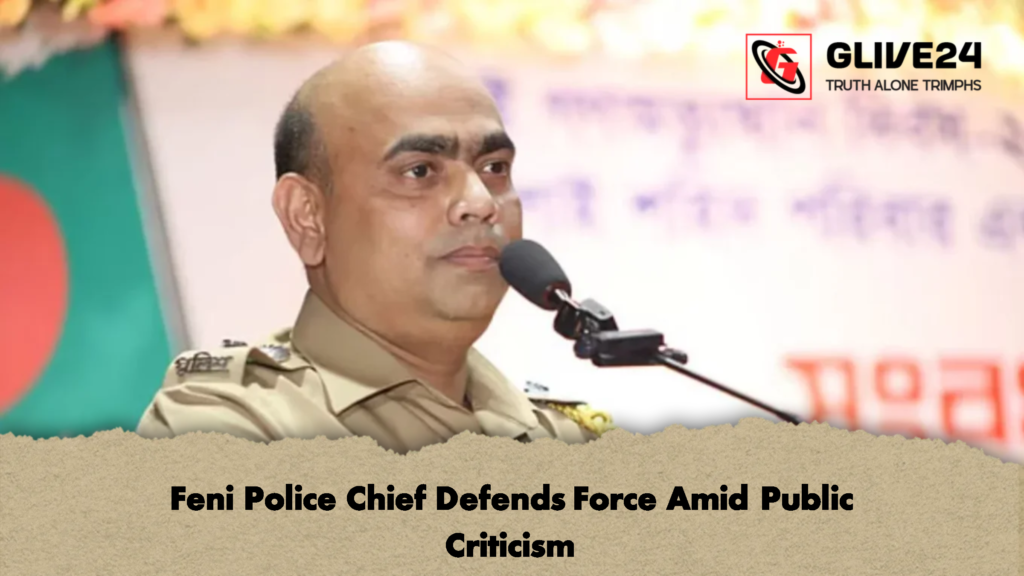
In a rare moment of candid public reflection, the Police Super of Feni, Protyush Kumar Majumder, expressed the deep-seated challenges faced by law enforcement officers, remarking that no matter how diligently they perform their duties, it seems impossible to satisfy everyone. He went on to describe the burden of police work, invoking a poignant sentiment: “It feels as though our very birth is our eternal sin.”
The police chief made these remarks during a reception organised by the Feni district administration to honour the families of martyrs and injured fighters of the July mass uprising. The event was held at the District Shilpakala Academy auditorium on Wednesday afternoon.
Majumder’s emotive statements came in response to sharp criticism voiced by members of the martyrs’ families regarding the role and actions of the police service during and after the anti-government uprising. Addressing the gathering directly, he sought to address public grievances while outlining the law enforcement response and ongoing judicial procedures in the region.
Clarifying the administrative timeline, Majumder pointed out that he had assumed office in Feni only six weeks prior, following two predecessors who held the position during and immediately after the tumultuous period. Despite the rapid transitions in leadership, he stressed that significant progress had been achieved in bringing suspects to justice. Out of 22 cases filed in Feni in connection with the July unrest, formal charge sheets have already been submitted in 14 cases. Law enforcement agencies have arrested more than 1,200 individuals implicated in these matters, though 860 of those suspects have subsequently secured bail from the courts.
The commemorative events marking July Mass Uprising Day began earlier in the morning at the July Martyr Memorial, situated in the Muktabazar area of the city. Proceedings opened with a solemn wreath-laying ceremony led by the Deputy Commissioner of Feni, Monira Haque, on behalf of the district administration. Official delegations from the police force, the local government division, the district council, and the office of the Civil Surgeon followed suit, alongside representatives from various political and social organisations who gathered to pay their respects.
The afternoon session at the District Shilpakala Academy auditorium served as the centerpiece of the day’s events, bringing together families who lost loved ones alongside individuals injured during the historic protests. While the reception aimed to offer recognition and honour to those affected, the dialogue underscored the lingering tension between the public and the security forces, as well as the police leadership’s plea for a nuanced understanding of their operational constraints.