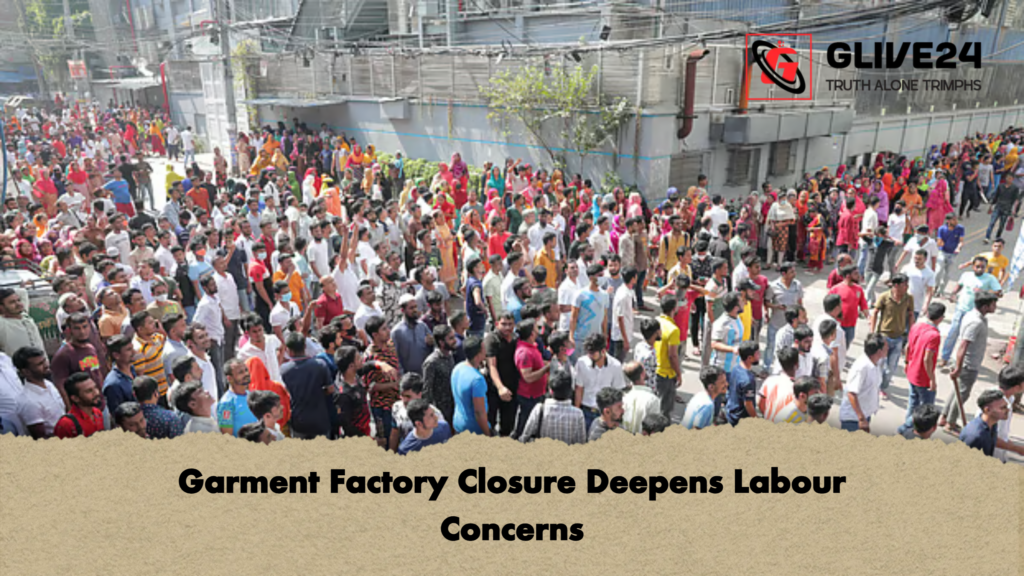
A garment factory in Gazipur employing around 8,000 workers has been shut indefinitely following days of labour unrest, raising fresh concerns over industrial relations in one of Bangladesh’s most important manufacturing hubs.
The management of Karoni Fashions Limited, located in Ratanpur under the Salipur area of Kaliakair upazila, announced that operations at its garments division would remain suspended for an indefinite period. The decision came into effect on Saturday under the provisions of the Bangladesh Labour Act, leaving thousands of workers uncertain about their immediate livelihoods.
According to police, workers and factory-related sources, tensions had been building inside the factory for several days before the shutdown. As the dispute escalated, the company issued a notice on Wednesday stating that production activities at the garments division would be suspended indefinitely because the prevailing situation had made normal operations impossible. The suspension formally took effect on Saturday.
Mezbaur Rahman Khan, Deputy Managing Director of Karoni Fashions Limited, said the factory had been struggling to maintain regular production because of persistent labour unrest. He explained that management decided to suspend operations temporarily in accordance with labour law to restore order and ensure workplace safety. He added that production would resume once the dispute was resolved and the working environment returned to normal.
The factory’s official notice stated that workers at the garments division abruptly stopped production from the afternoon of 8 July. Although employees reported to the factory the following morning, they allegedly declined to resume work. Management said repeated requests for workers to return to production went unanswered, prompting the company to invoke Section 13(1) of the Bangladesh Labour Act, 2006, and suspend operations from 11 July.
Workers, however, presented a markedly different account of the dispute. They alleged that salaries had not been paid in full or on schedule for several months. Instead, wages were reportedly being disbursed in instalments, creating severe financial hardship for employees and their families. Many said they were struggling to pay house rent, purchase daily necessities, finance their children’s education and meet other essential household expenses. They argued that repeated appeals to the management for a permanent solution had produced no meaningful outcome, leaving them with little option but to halt production in protest.
Labour representatives echoed many of those concerns. Shafiul Alam, President of the Gazipur Metropolitan branch of the Bangladesh Garments and Industrial Workers Federation, said workers had not received their outstanding dues and other legitimate payments in a timely manner. He claimed that instead of engaging in constructive negotiations over the workers’ demands, the factory authorities chose to suspend operations, a move he said had intensified uncertainty among thousands of employees.
Local law enforcement officials reported that the closure had not triggered any major disturbance. Officer-in-Charge Shahidul Islam of Kaliakair Police Station said the situation around the factory remained peaceful following the announcement. Police and other security agencies continue to monitor developments closely and remain prepared to respond should circumstances change.
The latest shutdown comes against the backdrop of growing labour unrest across Gazipur’s industrial belt. In recent weeks, several garment factories in the district have either suspended production or closed indefinitely amid disputes involving wages, benefits and working conditions. On 1 July, the operations of Islam Garments Limited (Unit-2) in the Konabari area were also suspended indefinitely. On the same day, five garment factories belonging to the Lithi Group in the Bagher Bazar area were similarly closed, leaving thousands of additional workers without employment.
Bangladesh’s ready-made garment industry is the country’s largest export-earning sector and provides employment to several million people. As a result, disputes over wage payments, production disruptions and factory closures carry implications far beyond individual workplaces. Prolonged industrial instability can affect workers’ livelihoods, supply chains, buyer confidence and the wider economy.
Industry observers believe many such disputes could be avoided through timely wage payments, transparent communication between employers and employees, and effective dialogue before tensions escalate. They argue that maintaining trust between factory owners and workers remains essential for ensuring both labour rights and the long-term stability of Bangladesh’s garment sector.