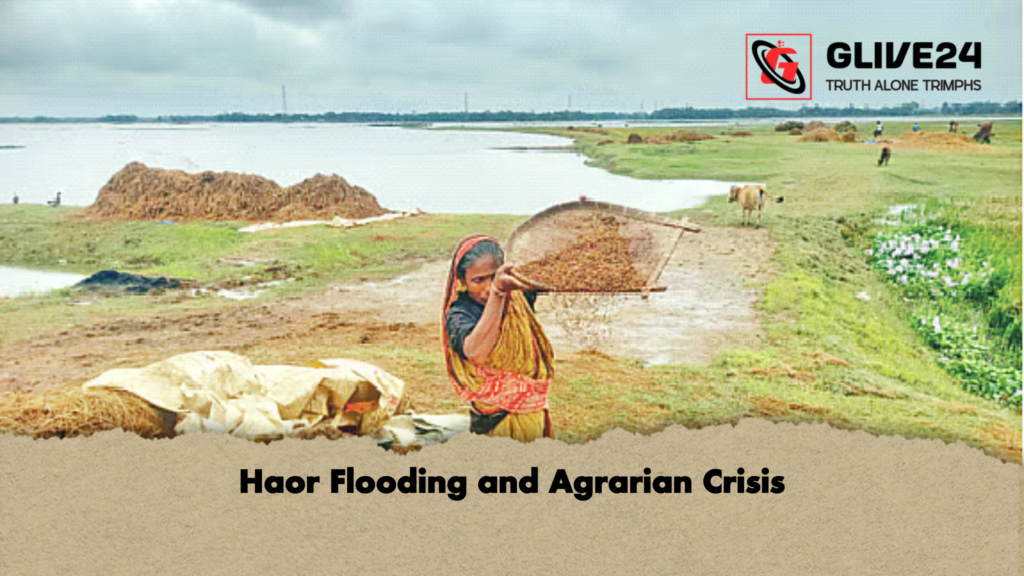
Bangladesh’s annual rice requirement is estimated at around 4.24 crore metric tonnes. Approximately 60 per cent of this demand is met during the Boro season, of which about 20 per cent comes from the Haor basin. In Sunamganj alone, roughly six lakh metric tonnes of rice enter the national food reserve from Boro cultivation after accounting for local consumption. However, between Falgun and Baishakh, varying intensities of rainfall have repeatedly submerged this key production zone, causing widespread damage to standing and harvested crops.
The Haor region, covering seven districts in north-eastern Bangladesh and constituting about one-sixth of the country, saw Boro cultivation across 9.63 lakh hectares in the current season. A significant portion of the harvest remains incomplete, while already-cut paddy is failing to dry properly. In many places, paddy is germinating on threshing yards, and decaying grain is affecting air quality. The government recently announced three months of assistance for affected farming households, while procurement of paddy from Haor areas is scheduled to begin on 15 May.
Agricultural Scale and Rainfall Records
| Category | Data |
|---|---|
| National annual rice demand | 4.24 crore metric tonnes |
| Boro season contribution | ~60% |
| Haor contribution to Boro output | ~20% |
| Sunamganj contribution to national reserve | ~6 lakh metric tonnes |
| Area under Boro cultivation (current season) | 9.63 lakh hectares |
Selected Rainfall and Flood Events in Haor Region
| Year | Location/Event | Rainfall Measurement |
|---|---|---|
| 1959 | Sylhet (June 19) | 336 mm |
| 2000 | Sylhet (June 12) | 362 mm |
| 2017 | Pre-monsoon flooding | Widespread Haor submergence |
| 2022 | Sylhet (June 17) | 282 mm |
| 2024 | Sylhet (June 9, few hours) | 220 mm |
| 2026 | Sunamganj (April 27) | Laurer Garh 133 mm; Dirai 205 mm; Chatak 76 mm; Sadar 137 mm |
Structural Pressures on the Haor System
The Haor crisis is described through three interlinked dimensions. The first is local: disputes over boundaries, lease irregularities, land encroachment, and infrastructural interventions influenced by local power structures and patronage. The second is national, shaped by state policy, administrative frameworks, and development practices affecting agriculture, wetlands, biodiversity, and water ecosystems. The expansion of infrastructure, market forces, and extractive resource management has intensified ecological vulnerability.
The third dimension is transboundary, involving upstream environmental degradation in Indian states such as Meghalaya and Assam, including deforestation, mining, dam construction, and hydropower development. These factors, combined with global climate pressures and structural inequality, have increased hydrological instability in the Haor basin.
Flood Types and Local Terminology
Three distinct flood types are identified in the region: seasonal monsoon flooding, sudden upstream flash floods locally known as udba, and prolonged rainfall-induced waterlogging during the Boro harvesting period. The latter is locally referred to as kachaira bochor, when continuous rainfall delays crop maturation and leads to prolonged submergence of fields and settlements.
Historical experience suggests that such abnormal rainfall cycles recur every 10 to 15 years. The current Bengali year 1433 is identified as one such cycle, with increasing incidence of waterlogging-type flooding since 2017.
Hydrological Change and Infrastructure Impact
Hydrological disruption is linked to river siltation, wetland degradation, and large-scale infrastructural interventions, including roads and embankments. Flood protection embankments are constructed using excavated soil, which in some cases is later deposited into rivers and beels during breaches and upstream flow. Between fiscal years 2023 and 2026, approximately 9,369,688 cubic metres of soil were reportedly used for embankment construction and repair in Sunamganj alone.
Agricultural Economics and Crop Resilience
Farmers in the Haor region report high cultivation costs, with expenses per kora of land reaching approximately 15,000 taka, including land lease and production costs. Yields range between 20 and 25 maunds per kora. At government procurement rates of 36 taka per kilogram, profitability remains limited.
Most farmers cultivate high-yield varieties such as BRRI-28, BRRI-29, BRRI-100, BRRI-92, BRRI-58, and hybrid varieties, which are less resilient to prolonged flooding compared to indigenous deepwater rice varieties. Historical research institutions once developed flood-resistant rice types such as Gachi, Rata, and others, but these have largely been replaced under modern agricultural programmes.
Conclusion
The Haor region’s flooding pattern is shaped by a combination of hydrological, infrastructural, and transboundary factors. While rainfall remains a natural phenomenon in one of the world’s highest rainfall zones, increasing waterlogging and flood duration suggest structural changes in drainage and river systems. The text underscores the need for coordinated water management, restoration of wetlands and rivers, and greater attention to indigenous agricultural knowledge systems.