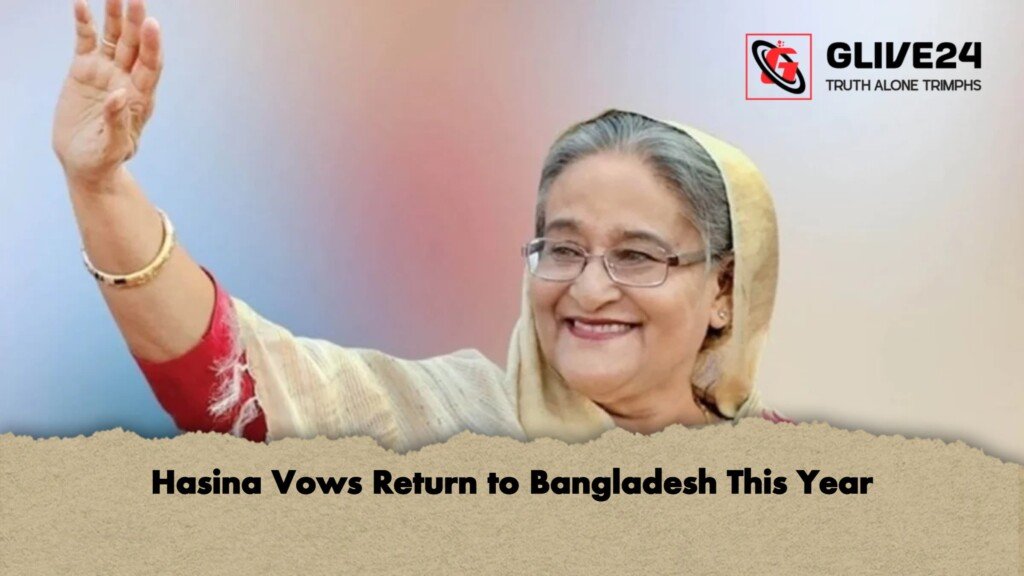
Bangladesh’s ousted Prime Minister and Awami League President Sheikh Hasina has declared that she will return to the country before the end of this year, despite what she described as political hostility, conspiracies and legal obstacles. In a special e-mail interview with Indian broadcaster NDTV, the former premier said she remained determined to return to her homeland, insisting that no challenge would prevent her from doing so.
Living outside Bangladesh for nearly two years, Hasina said her planned return was not driven by personal political ambition. Instead, she portrayed it as part of a broader struggle to restore the democratic rights of the Bangladeshi people, uphold the rule of law and preserve the ideals of the country’s Liberation War. She maintained that her political career had never been centred on holding office, but on fulfilling the vision of Bangabandhu Sheikh Mujibur Rahman by building what he described as a prosperous and just “Sonar Bangla” (Golden Bengal).
Reflecting on her political journey, Hasina said she had never been intimidated by the prospect of death. She referred to the 1975 assassination of her family members and the 21 August 2004 grenade attack, arguing that she had survived some of the darkest chapters in Bangladesh’s political history. She said those experiences had strengthened her resolve and expressed confidence that she would once again overcome the current challenges and return to the country.
Addressing the ban imposed on the Awami League and the present political climate, Hasina argued that the party was far more than a political organisation. According to her, the Awami League is deeply rooted in Bangladesh’s history, national identity and the aspirations of its people. She noted that throughout its 77-year history, the party had repeatedly faced periods of political repression and adversity but had recovered each time through public support.
Hasina also alleged that anti-Bangladesh forces had orchestrated a conspiracy that misled sections of the public and ultimately resulted in the change of government. Despite the current restrictions, she claimed it was impossible to erase the Awami League from the hearts of the people.
Commenting on the ban on her party and the large number of legal cases filed against its leaders and activists, Hasina said the Awami League’s political revival would not depend on the goodwill of any government. She claimed that spontaneous rallies and demonstrations in support of the party were taking place across different parts of Bangladesh, describing them as evidence that the organisation continued to enjoy public backing.
She also voiced concern over developments following 5 August, alleging that the country’s founding principles of nationalism, democracy and secularism had come under attack. Hasina claimed that the destruction of Liberation War memorials, the banning of the slogan “Joy Bangla”, and attacks on minority communities and cultural institutions formed part of a broader effort to weaken the country’s democratic and secular foundations.
Rejecting speculation about any secret understanding with the Bangladesh Nationalist Party (BNP) or other political forces, Hasina said the Awami League had no interest in political bargains. Democratic governance and the people’s right to vote, she argued, were constitutional rights rather than matters for behind-the-scenes negotiations.
Although she is currently staying in India, Hasina said her thoughts remain firmly with Bangladesh. She spoke emotionally about her father’s grave and the people of the country, saying they remained at the centre of her thoughts every day. Reaffirming her commitment to continue her political struggle, she expressed confidence that Bangladesh’s people would eventually regain democratic governance and that the Awami League would once again rebuild its position through public support.