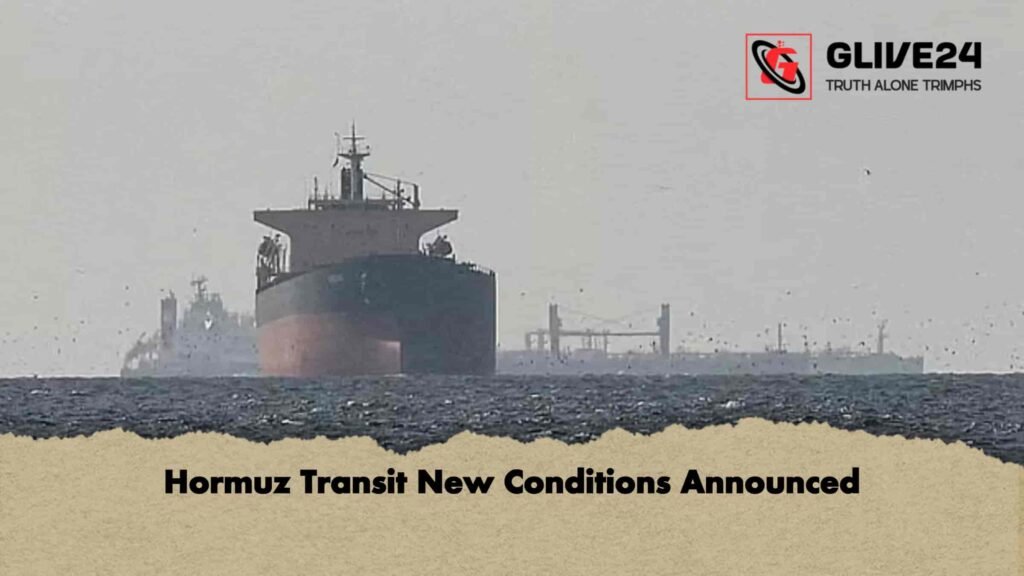
The Iranian Foreign Minister, Abbas Araghchi, announced via the social media platform X that the Strait of Hormuz has been reopened for commercial shipping. He stated that all vessels transiting the waterway must comply with previously issued Iranian directives concerning designated safe navigation routes.
The Strait of Hormuz, a key global shipping corridor through which a significant proportion of the world’s crude oil is transported, had been closed following military strikes attributed to the United States and Israel beginning on 28 February. The closure disrupted maritime traffic through one of the world’s most strategically important chokepoints.
A temporary ceasefire between Iran and the United States is currently in effect and is scheduled to continue until 22 April. However, the United States, led by President Donald Trump, has stated that its naval blockade of Iranian ports will remain in force until a broader peace agreement is concluded. Following the reopening announcement, Trump described the development as “a great and wonderful day for the world”.
Despite the formal reopening, maritime monitoring organisations report that only a small number of commercial vessels have resumed passage through the strait. Shipping operators are reportedly still evaluating navigational safety and operational risks in the region.
At the same time, a separate ceasefire has taken effect between Israel and Lebanon after earlier hostilities, marking the first full day of that arrangement coinciding with developments in the Strait of Hormuz.
In his statement on X, Abbas Araghchi confirmed that commercial shipping must follow coordinated maritime routes established by Iran’s Ports and Maritime Organisation. He indicated that these arrangements apply during the period of the ceasefire and are mandatory for all civilian vessels.
Further clarification was provided by Iranian state media citing a senior military official associated with the Islamic Revolutionary Guard Corps. The official confirmed that vessels are required to use the pre-designated route system when transiting the strait. It was also stated that passage of military warships through the Strait of Hormuz remains completely prohibited under the current arrangements.
The routing system is understood to correspond to a previously circulated navigational framework involving two defined maritime corridors, which had been publicised in Iranian media in the preceding week.
Iranian media outlet Tasnim News Agency, which is affiliated with the Islamic Revolutionary Guard Corps, criticised Araghchi’s announcement, describing it as incomplete. The agency stated that if United States sanctions and naval restrictions remain in place, the reopening would be considered void. Other Iranian media organisations have also called for clearer official clarification.
Iran’s Parliament Speaker, Mohammad Bagher Ghalibaf, rejected claims attributed to the United States president, stating that continued sanctions would mean the strait cannot be considered unconditionally open. He added that maritime passage depends on Iranian approval and compliance with designated routes.
Separately, Iranian Foreign Ministry spokesperson Ismail Baqai reiterated that all vessels must follow Iran’s predetermined navigation pathways. He further stated that Iran may take reciprocal measures if restrictions on its ports continue, while affirming that Iran considers itself the guardian of the Strait of Hormuz and may exercise flexibility where necessary.
Summary of Transit Conditions
| Category | Requirement or Position |
|---|---|
| Commercial vessels | Must follow Iran-designated safe routes |
| Military vessels | Completely prohibited from passage |
| Navigation authority | Subject to Iranian approval and oversight |
| Operational status | Limited traffic; safety assessments ongoing |
| Political condition | Tied to ceasefire and sanctions situation |
| Iranian stance | Potential reciprocal measures if sanctions persist |
The situation remains subject to ongoing political and maritime developments, with shipping activity in the region continuing at a cautious and limited level.