The sanctity of the SSC (Secondary School Certificate) examinations in Bangladesh has been plunged into controversy following a high-profile breach of protocol by a prominent legislator. Despite explicit, pre-emptive prohibitions issued by the Ministry of Education, Selim Bhuiyan, the Member of Parliament (MP) for Cumilla-2 (Homna-Titas), reportedly infiltrated an examination centre to conduct a live social media broadcast. The incident has ignited a fierce national discourse regarding the overreach of political figures and the selective enforcement of the Public Examinations (Offences) Act, 1980.
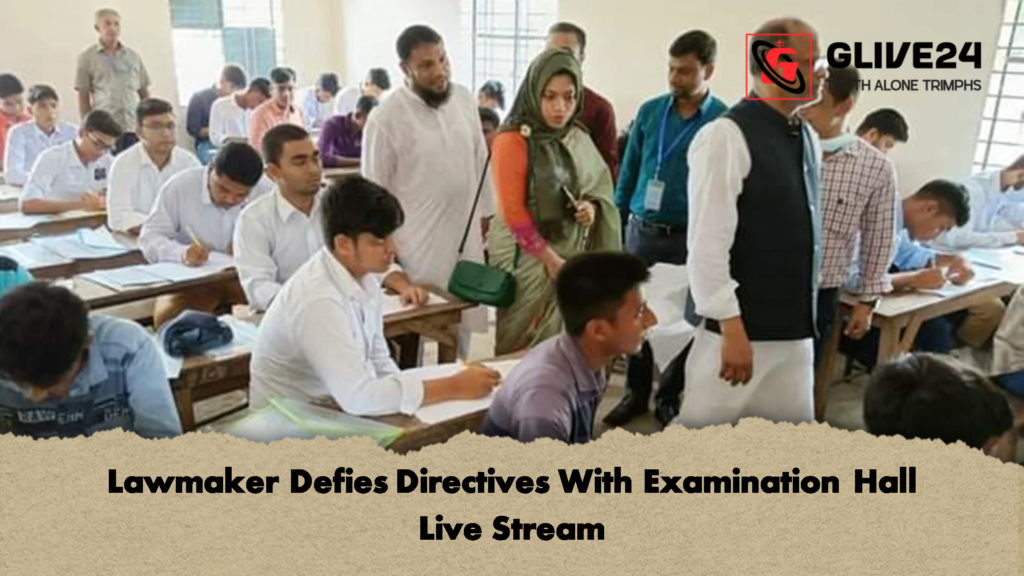
The breach unfolded on Tuesday morning at the Homna Government High School centre. Digital evidence reveals that the MP commenced a live stream on his personal Facebook account at approximately 10:10 AM, a critical period when students were deeply engaged with their question papers. The broadcast, spanning roughly nine minutes, captured the lawmaker navigating the school’s corridors and entering multiple examination rooms, where he engaged in direct, unsolicited interactions with the candidates.
Direct Defiance of Ministerial Mandates
The MP’s actions appear to be a flagrant disregard for the specific instructions laid down by the Education Minister, Dr A.N.M. Ehsanul Hoque Milan. Only days prior, on 12 April, the Minister had convened a strategic meeting with centre secretaries in Dhaka, where he issued a stern warning against such interference.
“Local MPs are strictly prohibited from visiting examination halls with an entourage or engaging in any conduct that might disturb the examinees,” the Minister had declared. He further clarified that there was no legal or administrative scope for such visits, placing the responsibility of maintaining a disturbance-free environment squarely on the shoulders of the centre secretaries.
Summary of the Protocol Breach
| Incident Component | Details of the Violation |
| Primary Location | Homna Government High School, Cumilla |
| Temporal Data | Tuesday, 21 April 2026, at 10:10 AM |
| Broadcast Length | Approximately 9 minutes (via Facebook Live) |
| Nature of Disturbance | Entering halls, questioning pupils, and giving directions |
| Statutory Breach | Public Examinations (Offences) Act, 1980 |
| Administrative Violation | Defiance of the 12 April Ministerial Prohibition |
Regulatory Backlash and Official Disquiet
The Inter-Education Board Coordination Committee has responded with palpable concern. Professor Dr Khandakar Ehsanul Kabir, Chairman of the Dhaka Education Board, confirmed that the breach was not taken lightly and has been escalated to the highest levels of the Ministry.
“The Minister’s directives were unambiguous: no public representative is permitted to enter a centre with a following or cause any distraction to the students. I have formally notified the Education Minister of this occurrence and am awaiting a definitive policy response to safeguard the remaining examination dates,” Professor Kabir remarked.
In Cumilla, the regional examination authorities expressed similar frustration. Runa Nathrin, the Controller of Examinations for the Cumilla Education Board, highlighted the “extreme sensitivity” of the examination environment. While MPs may occasionally attend general administrative briefings, Nathrin asserted that the actual examination room is a “sacrosanct space” where confidentiality and privacy are paramount. She condemned the live broadcast as “entirely unjustifiable,” noting that even official inspection teams must follow rigorous, non-intrusive protocols.
Implications for Academic Integrity
Social media footage of the event depicts MP Selim Bhuiyan approaching students’ desks—a move critics argue is highly intimidating. By asking students if the questions were “easy” and offering various verbal and physical cues, the MP effectively disrupted the concentration of hundreds of pupils during one of the most stressful periods of their academic lives.
The MP has consistently evaded requests for comment, failing to respond to numerous telephone enquiries. As the 2026 academic calendar continues, this incident serves as a significant litmus test for the government. The public is now watching closely to see if the Ministry will hold political figures to the same legal standards as ordinary citizens, or if the “quietude” of the examination hall will remain vulnerable to political theatrics.