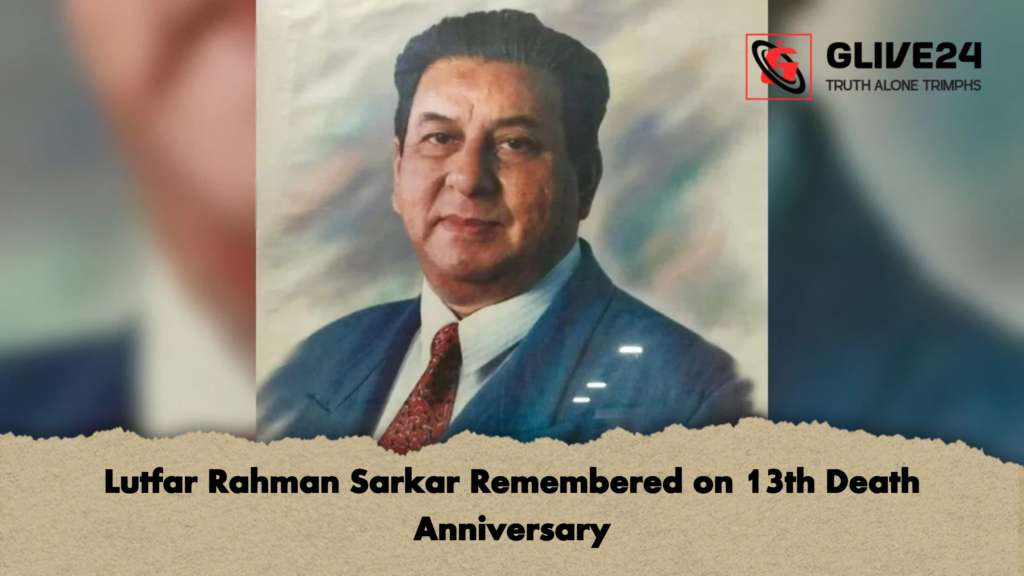
Lutfar Rahman Sarkar, widely regarded as one of Bangladesh’s most influential and reform-minded bankers, is being commemorated on his 13th death anniversary. His life and career remain closely associated with a transformative vision of banking that sought to prioritise social development, employment generation and financial inclusion alongside institutional growth.
Born on 1 February 1934 in Phulkot village under Shahjahanpur upazila in Bogura, Sarkar emerged from modest rural beginnings to become a defining figure in Bangladesh’s financial sector. He completed his Master’s degree in Political Science from the University of Dhaka in 1955 and began his professional journey at Radio Pakistan before transitioning into banking. Over the decades, he served in several major financial institutions, including Habib Bank, Standard Bank, Rupali Bank, Agrani Bank and Sonali Bank, where he ultimately held the position of Managing Director.
His tenure in the banking sector was marked by a distinctive philosophy. He consistently argued that banking should not merely function as a profit-driven enterprise but as an instrument for economic justice and human development. He famously criticised the structural bias of credit distribution, observing that financial systems too often favoured those already privileged, rather than extending meaningful support to those in need.
This conviction translated into practical reforms. While serving at Sonali Bank, he initiated the “University Employment Project (Bikalpa)”, aimed at addressing graduate unemployment by providing financial support and loan facilities to educated young people based on their academic qualifications. The initiative also incorporated education loans and part-time employment schemes, which gained significant attention for their social impact at the time.
He is also credited with pioneering early models of collateral-free small-scale lending in Bangladesh, a concept that would later evolve into modern SME financing. His approach extended to multiple sectors, including healthcare, where he supported doctors in establishing clinics and diagnostic centres through accessible credit facilities. In education, he worked to reduce dropout rates by introducing student loan schemes designed to assist underprivileged but talented learners.
Beyond banking, Sarkar maintained a deep commitment to literature, culture and intellectual life. He provided financial and institutional support to newspapers, literary magazines and cultural organisations, believing that creative expression was essential to national development.
His career was not without controversy or personal cost. During the military rule of Hussain Muhammad Ershad, he reportedly resisted efforts to appropriate his “Bikalpa” initiative under political influence. His refusal led to arrest and a two-year sentence by a military court, although he and his colleagues were later released amid public and student protests. He was also known for taking a firm stand against alleged banking irregularities involving powerful business groups, reflecting his reputation for integrity and institutional courage.
From 21 November 1996 to 21 November 1998, he served as the sixth Governor of Bangladesh Bank, where he continued to advocate for a more inclusive and development-oriented financial system. He also contributed to academia as a part-time lecturer in the Department of Finance and Banking at the University of Dhaka.
Lutfar Rahman Sarkar passed away on 24 June 2013 while undergoing treatment at Apollo Hospital in Dhaka, aged 80. His legacy endures in the evolving framework of Bangladesh’s financial sector, particularly in policies related to SME financing, education loans and socially responsive banking. His vision of a banking system rooted in inclusion and economic empowerment continues to resonate in contemporary discussions on financial reform.