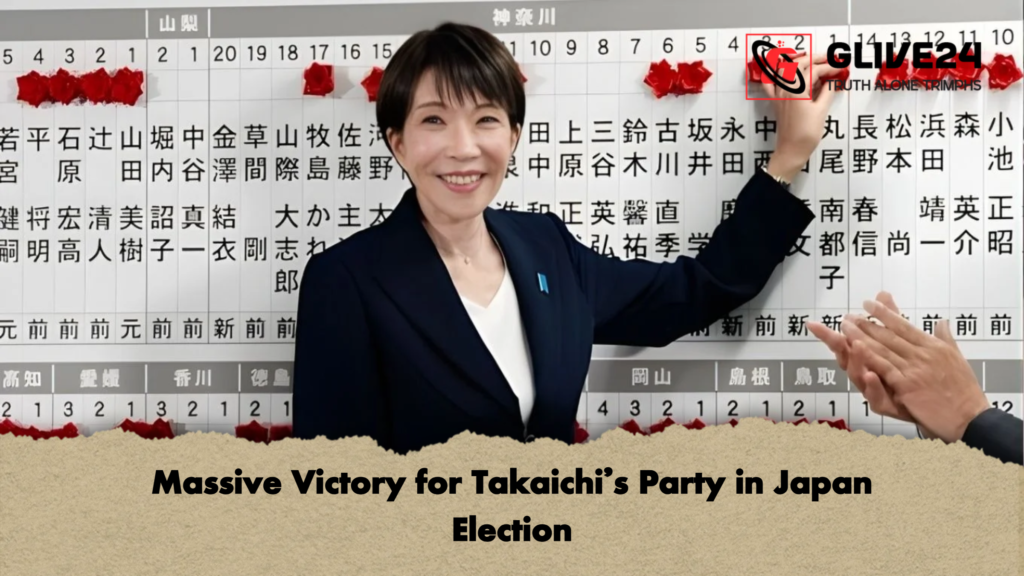
In Japan’s general election, Prime Minister Sanae Takaiichi’s Liberal Democratic Party (LDP) has secured a landslide victory, solidifying its dominance in the country’s lower house of parliament. According to early results compiled by the Japanese public broadcaster NHK, the LDP has won 352 out of 465 seats, well above the 233 seats required to form a majority. While the official results are yet to be formally announced, the outcome marks a decisive mandate for Takaiichi’s government.
Speaking to reporters after the apparent victory, Takaiichi emphasised her administration’s focus on economic stability. “We have consistently stressed the importance of responsible and proactive economic policies,” she stated. “Our priority will be to maintain fiscal sustainability while ensuring the necessary investments for future growth.”
Despite Takaiichi’s personal popularity, the LDP has faced significant challenges in recent years. Over the past seven decades, the party has largely dominated Japanese politics, but recent scandals involving financial irregularities and religious controversies had put its reputation under strain. Takaiichi called the early election just three months after assuming office, seeking a renewed mandate to stabilise the party’s political fortunes.
The move was widely reported by international media, including the BBC, which highlighted that Takaiichi became Japan’s first female Prime Minister only four months ago. By seeking public endorsement at an early stage, she aimed to consolidate both her leadership and her party’s parliamentary strength.
Analysts have contrasted her success with that of her two immediate predecessors, whose administrations lost LDP majorities amid corruption scandals and rising costs of living. In contrast, Takaiichi’s approval ratings have consistently remained above 70 per cent, reflecting her widespread popularity among voters.
Japan’s post-World War II political landscape has been characterised by long-standing LDP-led coalition governments, partly due to the lack of a strong opposition. Many observers initially considered the early election a risky strategy, particularly as the LDP had previously lost its upper house majority and its long-standing alliance with the Komeito Party had dissolved. Nevertheless, Takaiichi’s personal appeal appears to have delivered a significant advantage.
Preliminary Election Results – Japan Lower House (465 seats)
| Party | Seats Won | Majority Threshold | Notes |
|---|---|---|---|
| Liberal Democratic Party (LDP) | 352 | 233 | Landslide victory |
| Komeito | – | – | Alliance dissolved |
| Opposition Parties | Remaining seats | – | Yet to be fully counted |
The election underscores both Takaiichi’s individual popularity and the enduring influence of the LDP in Japanese politics, signalling continuity in policy direction while reaffirming her leadership on the national stage.