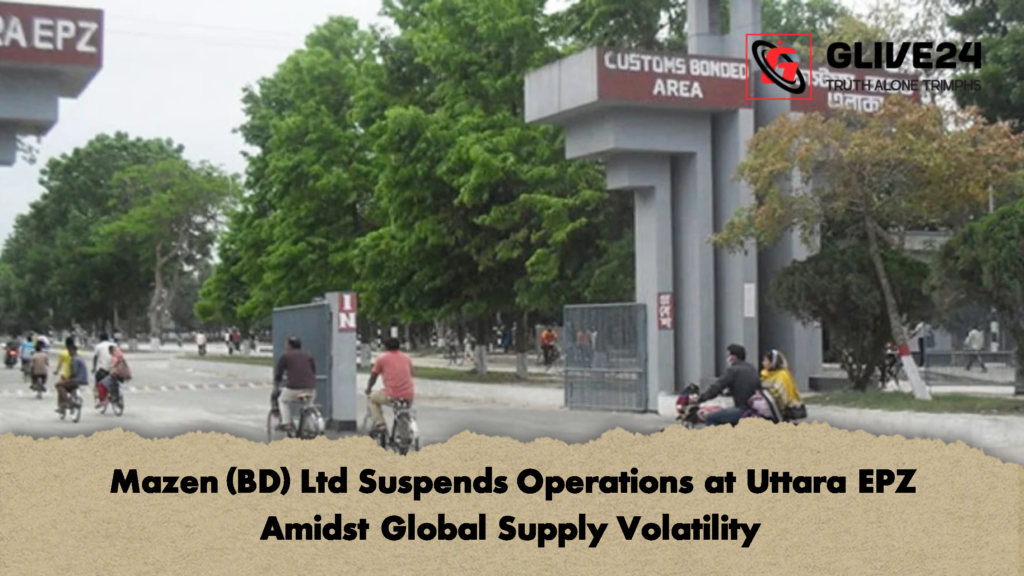
Mazen (BD) Limited, a major manufacturing facility specialising in eyewear and optical frames situated within the Uttara Export Processing Zone (EPZ) in Nilphamari, has formally announced an indefinite cessation of its industrial activities. The Chinese-owned enterprise disclosed this decision through a written notification released on the afternoon of Wednesday, 29 April, citing an increasingly untenable convergence of global economic and logistical pressures.
The factory management has attributed the suspension to a severe international deficit of essential utilities—specifically gas and electricity—coupled with a critical shortage of raw materials. These systemic hurdles have been further compounded by a sharp reduction in purchase orders from the international market, as fluctuating global consumer demand continues to impact export-oriented sectors.
Table of Contents
Procedural Suspension and Legal Justification
The official notice, bearing the signature of the Director of Operations, Eren Li, clarified that the current global landscape has severely impeded the consistent supply of raw materials. This disruption has rendered regular production cycles unsustainable, necessitating the formal declaration of a “lay-off” for the facility’s workforce.
The suspension has been enacted under Section 15 of the Bangladesh EPZ Act 2019. According to the directive, all work at the plant officially ceased on Thursday, 30 April, and will remain suspended until further notice. This specific legal provision allows industrial units within specialised economic zones to halt operations during periods of crisis while maintaining a regulated framework for labour rights and administrative compliance.
Impact on Personnel and Financial Commitments
The operational halt affects a substantial workforce. Mazen (BD) Limited currently employs a total of 4,361 labourers and officers. Within this group is a specialised team of 96 Chinese nationals who provide essential technical expertise and oversee administrative functions.
The company has explicitly advised all employees that they are not required to report to the factory premises during the period of the lay-off. To mitigate the impact on the livelihoods of its thousands of staff members, the management has outlined the following financial provisions:
-
Remuneration: In strict adherence to Section 15 of the 2019 Act, all workers and employees will receive their statutory salaries and allowances throughout the sanctioned lay-off period.
-
Eid Bonuses: In light of the forthcoming Holy Eid-ul-Adha, the company has pledged to disburse festive bonuses to its entire workforce. These payments are scheduled to be processed via electronic bank transfers between 7 May and 14 May.
Official Verification and Operational Outlook
Mohammad Abdul Jabbar, the Executive Director of the Uttara EPZ, confirmed the factory’s status on Thursday afternoon. He reiterated that the move by Mazen (BD) was a reactive measure necessitated by the depletion of essential raw materials and a decline in global buyer interest.
However, the Executive Director underscored that the suspension is intended as a temporary measure rather than a permanent closure. He noted that the facility is prepared to return to full production capacity as soon as the global supply chain stabilises and international purchase orders return to previous levels.
Regional Economic Significance
The temporary closure of Mazen (BD) Limited is a significant event for the Uttara EPZ, which acts as a vital economic engine for the northern districts of Bangladesh. As one of the premier exporters of optical products in the region, the factory’s reliance on international logistics highlights the susceptibility of the local export sector to global energy crises and supply chain fractures.
The Bangladesh Export Processing Zones Authority (BEPZA) is reportedly monitoring the situation to ensure the welfare of the 4,361 affected individuals. Given that Mazen (BD) is one of the zone’s most significant employers, the eventual resumption of its activities remains a priority for the economic stability of the Nilphamari region.