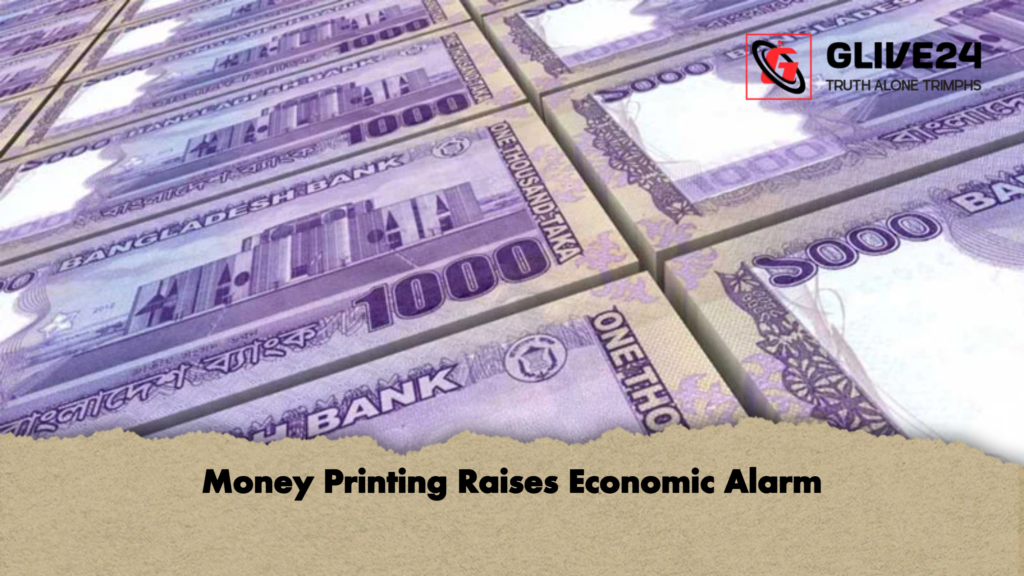
Economists and policy analysts have expressed deep concern over Bangladesh Bank’s growing reliance on financing government expenditure through money creation, warning that such practices could intensify inflationary pressures and place sustained strain on the broader macroeconomic framework.
At a recent seminar held at the Policy Research Institute’s office in Banani, Dhaka, experts highlighted that the trend of central bank financing is becoming increasingly pronounced amid fiscal constraints. According to data presented at the event, the government borrowed approximately 20,000 crore taka from the central bank in March alone. In monetary terms, this is classified as high-powered money, which directly expands liquidity in the economy.
Participants noted that weakening revenue collection has forced the government into greater dependence on both high-interest commercial borrowing and central bank support. This shift, they warned, risks undermining macroeconomic stability if not carefully managed.
Table of Contents
Concerns over financial stability
Chief economist of the Policy Research Institute, Ashikur Rahman, observed that the current recovery trajectory of the economy is resting on fragile foundations. He pointed to rising non-performing loans—estimated at nearly 30 per cent—and slowing private sector credit growth as key indicators of stress within the financial system. According to him, these vulnerabilities significantly reduce the economy’s capacity to absorb additional shocks.
Rahman further stated that quarterly growth has weakened considerably, with gross domestic product expansion falling to around 3 per cent in the second quarter of the current fiscal year—one of the lowest rates in recent periods. He attributed this slowdown to a combination of global headwinds, persistent energy price pressures, and ongoing disruptions in international trade flows.
Inflation and cost-of-living pressures
Representatives from the business community also voiced concern over sustained inflation. The president of the International Chamber of Commerce Bangladesh, Mahbubur Rahman, cautioned that prolonged price instability is already eroding household purchasing power. He warned that continued reliance on monetary expansion and elevated public spending could further aggravate inflationary trends, particularly affecting lower and middle-income groups.
Seminar chairperson Zaidi Sattar added that external factors, including geopolitical tensions and volatility in global energy markets, are compounding domestic economic challenges. He emphasised that without comprehensive structural reforms, achieving stable and sustainable growth would remain difficult.
Macroeconomic snapshot
| Indicator | Current Status |
|---|---|
| Central bank lending to government | ~20,000 crore taka |
| GDP growth rate | ~3% |
| Non-performing loans | ~30% |
| Private sector credit growth | ~6% |
| Key risks | Inflation, global uncertainty, rising energy costs |
Outlook and policy implications
Experts collectively stressed the urgency of fiscal and financial sector reforms. Strengthening revenue mobilisation, restoring discipline in the banking sector, and encouraging investment in productive industries were identified as essential priorities.
They cautioned that without timely and effective policy intervention, continued reliance on money creation could exacerbate inflationary pressures and weaken long-term economic resilience.