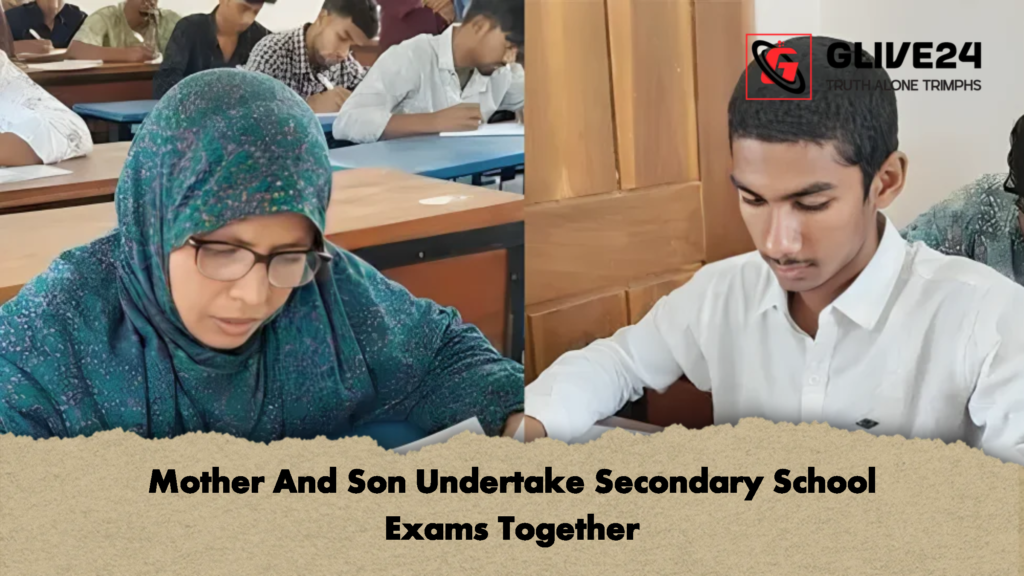
In a notable display of academic determination that has garnered significant public interest in the Lalpur Upazila of Natore, a mother and her son are currently sitting their Secondary School Certificate (SSC) examinations simultaneously. Fuljhuri Begum, a resident of Nawpara village within the Durduria Union, has returned to formal education after years of domestic responsibility to fulfil a long-held personal ambition. She is appearing for the SSC (Vocational) examinations alongside her son, Monirul Islam, marking a rare occurrence in the national education landscape.
Both Fuljhuri Begum and Monirul Islam are enrolled as students at the Mohorkaya Natunpara Secondary Technical Vocational Institute. For the ongoing examination cycle, they have been assigned to the Madhubari Dakhil Madrasa centre within the same Upazila. The sight of a mother and child sharing the same academic milestone has become a subject of widespread discussion and admiration among the local community, highlighting a shift in social perspectives regarding adult education.
A Journey of Resilience and Domestic Sacrifice
Fuljhuri Begum’s return to the classroom follows a life defined by socio-economic challenges and early domestic obligations. Married at a young age, her formal education was prematurely interrupted by the demands of managing a household and raising her children. Despite the passage of time and the complexities of rural life, her desire to attain a secondary education remained a persistent personal goal.
Her husband, Nazrul Islam, provides the primary financial support for the family through physically demanding labour. He manages the household expenses and the educational costs for his wife and son by alternating between operating a van and working as a daily wage labourer. Despite their limited financial means, the family has prioritised education as a vehicle for personal and collective advancement.
Reflecting on her experience at the examination centre, Fuljhuri Begum noted the dual nature of the public reaction:
“I could not continue my studies as I was married at a very young age. Managing the household took up all my time. However, I always harboured a dream of appearing for the SSC exams. While some in the village view this differently and make various comments, for me, this is a moment of great joy. I request everyone to keep us in their prayers.”
Familial Support and Mutual Encouragement
Monirul Islam has expressed profound pride in his mother’s decision to resume her studies. Far from being deterred by the unusual circumstances, he views her presence at the examination centre as a source of additional motivation. He noted that his mother’s dedication, despite the hardships she endured while raising the family, serves as an inspiration for his own academic efforts. He further stated his desire for her to continue her educational journey beyond the secondary level.
Supporting this sentiment, Nazrul Islam emphasised his belief in the importance of maternal education for the progress of society. He reiterated his commitment to supporting his wife’s academic aspirations regardless of the personal physical toil involved in earning the necessary funds. He maintained that as long as she possesses the will to study, he will continue to facilitate her education through his earnings as a labourer.
Recognition From Local Administrative Authorities
The local administration has officially acknowledged the significance of this event, categorising it as an exemplary model for the nation. Zulhas Hossain Sourav, the Upazila Nirbahi Officer (UNO) of Lalpur, lauded Fuljhuri Begum’s willpower, stating that age should never be considered a barrier to acquiring knowledge.
The UNO further commented that such instances serve to break social taboos surrounding adult literacy and vocational training. He confirmed that the Upazila administration remains committed to providing the necessary assistance to support her ongoing education. This institutional backing underscores a broader state policy aimed at encouraging lifelong learning and vocational skill development across all demographics in Bangladesh.
The case of Fuljhuri Begum and Monirul Islam serves as a factual testament to the evolving educational aspirations within rural communities, where individual determination occasionally overcomes deep-seated economic and social constraints. As the examination schedule progresses, the pair remains focused on successfully completing their vocational certification.