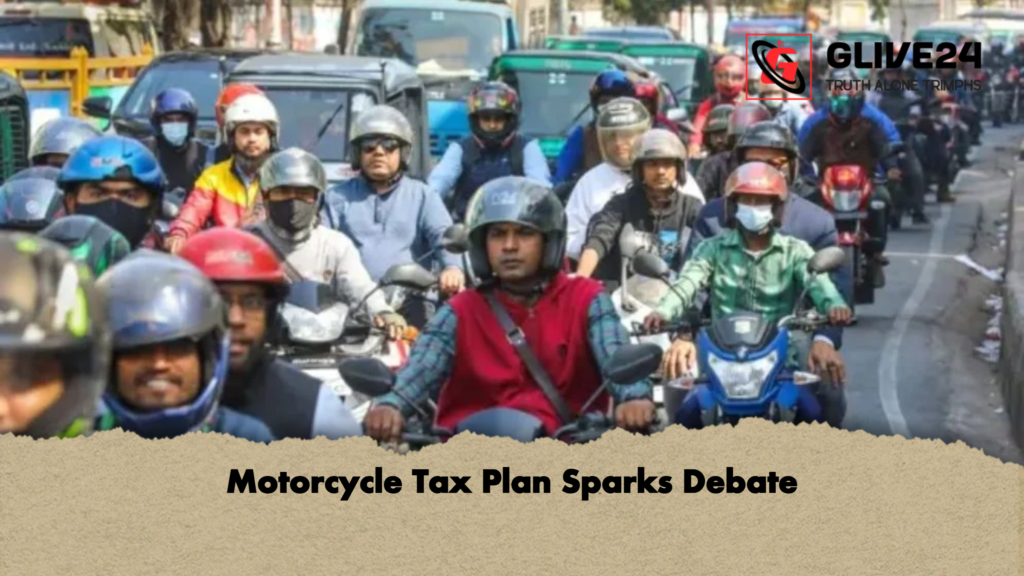
The proposed introduction of advance income tax on motorcycle ownership in Bangladesh has triggered widespread discussion among policymakers, economists and vehicle users, as the National Board of Revenue National Board of Revenue considers widening the tax net ahead of the upcoming national budget.
Officials of the revenue authority are reportedly examining a plan to impose advance income tax (AIT) on motorcycles and other transport vehicles that currently fall outside the formal tax framework. The proposal is expected to be placed in the forthcoming fiscal budget, which is scheduled to be presented in June by the Finance Minister.
Table of Contents
Rising Questions Over Implementation
The core issue under debate is how the tax will be collected, particularly as a significant proportion of motorcycle owners in Bangladesh do not possess Tax Identification Numbers (TINs). Many owners are outside the taxable income bracket, despite owning registered vehicles, creating administrative uncertainty for the tax authority.
At present, motorcycle owners are required to pay an annual tax token fee, which must be renewed each year. The proposed system would introduce an additional layer of taxation alongside this existing fee structure.
According to officials involved in budget preparation, one possible approach is to link AIT collection with TIN registration, effectively bringing more individuals into the formal tax system. However, another option under consideration is to collect the tax without requiring a TIN, using vehicle registration databases maintained by the Bangladesh Road Transport Authority Bangladesh Road Transport Authority.
A senior official noted that discussions are ongoing, but emphasised that integrating TINs could ultimately strengthen long-term tax compliance by expanding the number of registered taxpayers.
Proposed Tax Structure
Preliminary discussions suggest a tiered tax system based on engine capacity. While not yet finalised, the structure under consideration is as follows:
| Engine Capacity / Category | Proposed Annual AIT |
|---|---|
| Up to 110cc motorcycles | Under consideration (coverage included) |
| 111cc – 125cc | BDT 2,000 |
| Up to 165cc | BDT 5,000 |
| Above 165cc | BDT 10,000 |
| Battery-run auto-rickshaw (city areas) | BDT 5,000 |
| Battery-run auto-rickshaw (municipality) | BDT 2,000 |
| Battery-run auto-rickshaw (union level) | BDT 1,000 |
Officials have also indicated that the government is considering extending similar tax measures to auto-rickshaws, whose exact number in operation remains unverified.
Scale of Motorcycle Ownership
Current estimates suggest that Bangladesh has approximately 4.9 million registered motorcycles. The scale of ownership has made the sector an attractive target for revenue expansion, particularly as the government seeks to broaden its tax base.
In a recent meeting with senior officials, including discussions involving Finance Minister Amir Khasru Mahmud Chowdhury Amir Khasru Mahmud Chowdhury, proposals were reportedly placed on bringing motorcycles and auto-rickshaws under the AIT framework, alongside potential adjustments to existing tax rates for higher-capacity vehicles.
Mixed Reactions From Stakeholders
The proposal has already generated strong reactions from motorcycle users and transport workers. A group of riders staged demonstrations outside the headquarters of the National Board of Revenue in Agargaon, Dhaka, submitting a memorandum urging reconsideration of the plan.
Protesters argued that motorcycles are already heavily taxed relative to regional standards, and that many users depend on them for income through ride-sharing and delivery services. They warned that additional taxation could place financial strain on lower-income earners.
Speaking to the media in Dhaka’s Gulshan area, several riders expressed concern. One rider, Shahabuddin, stated that he already pays the annual tax token fee and views additional taxation as unfair. Another rider, Rafiq Ullah, noted that while hobby users might afford extra charges, for many, motorcycles are their primary source of livelihood.