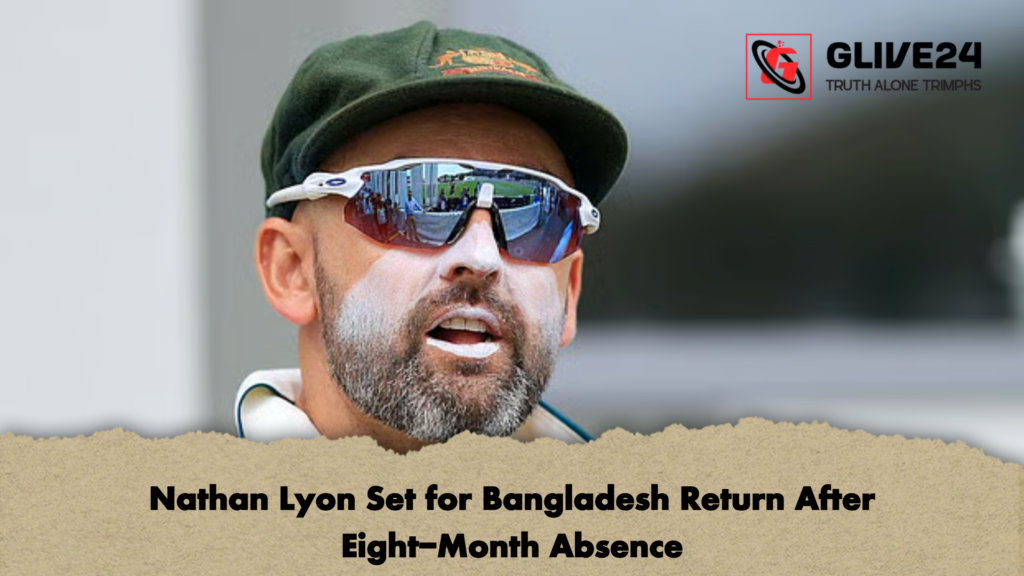
Nathan Lyon appears increasingly likely to make his return to international cricket when Australia face Bangladesh in the opening Test of their upcoming series in Darwin, with team-mate Travis Head offering an encouraging assessment of the veteran off-spinner’s readiness.
Lyon has been out of competitive cricket for almost eight months after suffering a hamstring injury during the Ashes Test in Adelaide last December. The 38-year-old has not played a competitive match since then, but his recent workload and participation in a match simulation in Brisbane have strengthened the belief that he is ready to resume his Test career.
Head provided perhaps the clearest indication of Lyon’s condition after facing him during Australia’s training session in Darwin on Monday. One delivery from Lyon passed the outside edge of Head’s bat, prompting some light-hearted exchanges between the team-mates. The incident nevertheless carried a serious message: Lyon appears to have retained the accuracy and threat that have made him one of Australia’s most dependable Test bowlers.
After such a lengthy absence, match fitness was always likely to be a key consideration. Lyon’s participation in last week’s match simulation in Brisbane was therefore significant. It gave him an opportunity to bowl for an extended period and test his body under conditions closer to those of a competitive fixture. The session also appears to have provided the spinner with greater confidence ahead of a possible return.
Head has suggested that Lyon is particularly eager to get back on the field. Having spent months recovering and working through rehabilitation, the veteran spinner is understood to be keen to resume the role he has occupied in Australia’s Test side for more than a decade. Positive indications from his team-mates and the coaching staff have also reduced concerns about whether he is physically prepared for the demands of Test cricket.
A return against Bangladesh would carry additional significance because Lyon has enjoyed some of the finest moments of his international career against them. During Australia’s 2017 tour of Bangladesh, he claimed 22 wickets in the two-Test series, still his highest wicket tally in a two-match Test series outside Australia.
That series also produced one of Lyon’s most memorable individual performances. After Bangladesh won the opening Test in Dhaka, Australia needed a strong response in the second match in Chattogram. Lyon delivered it emphatically, taking 13 wickets in the match to help Australia level the series. His performance earned him the player-of-the-match award and underlined his ability to influence games dramatically when conditions favour spin.
The conditions in Darwin could once again make Lyon a particularly important figure. Test cricket is returning to the northern Australian city after a long absence, and the character of the pitch will be closely watched. Darwin’s dry winter conditions could contribute to a surface that changes as the match progresses, potentially bringing spin into greater prominence.
Former Australian fast bowler Kane Richardson has suggested that the Darwin surface could offer a different challenge from the more familiar Australian Test venues. Rather than producing the pronounced pace and bounce traditionally associated with grounds such as the Gabba or Perth, the pitch may offer slower and lower bounce, potentially creating conditions with some similarities to those encountered in the subcontinent.
If that assessment proves accurate, Lyon’s experience could become a major asset for Australia. A dry surface that deteriorates over four or five days would give a high-quality off-spinner opportunities to exploit rough patches and changing bounce. Lyon’s ability to maintain pressure through long spells could also become increasingly valuable as the match enters its later stages.
For Bangladesh, Lyon’s possible return presents a significant tactical challenge. Their batters will need to manage not only his variations in pace and trajectory but also the pressure created by sustained spells from one end. His previous record against Bangladesh means he is unlikely to require much introduction to the opposition, while his familiarity with Test cricket’s long tactical battles makes him a particularly difficult bowler to contain once a pitch begins to deteriorate.
Australia, meanwhile, will have to balance Lyon’s experience against the risks associated with returning a player after such a lengthy lay-off. His match simulation will have provided useful evidence, but the intensity and duration of a Test match are considerably different.
Should he be named in the XI, Lyon’s comeback will therefore be one of the major storylines of the Darwin Test. For Australia, it could mean the return of an experienced match-winner at a venue where spin may become increasingly influential. For Bangladesh, it could mean confronting once again a bowler who has already produced one of the most damaging individual performances against them in recent Test history.