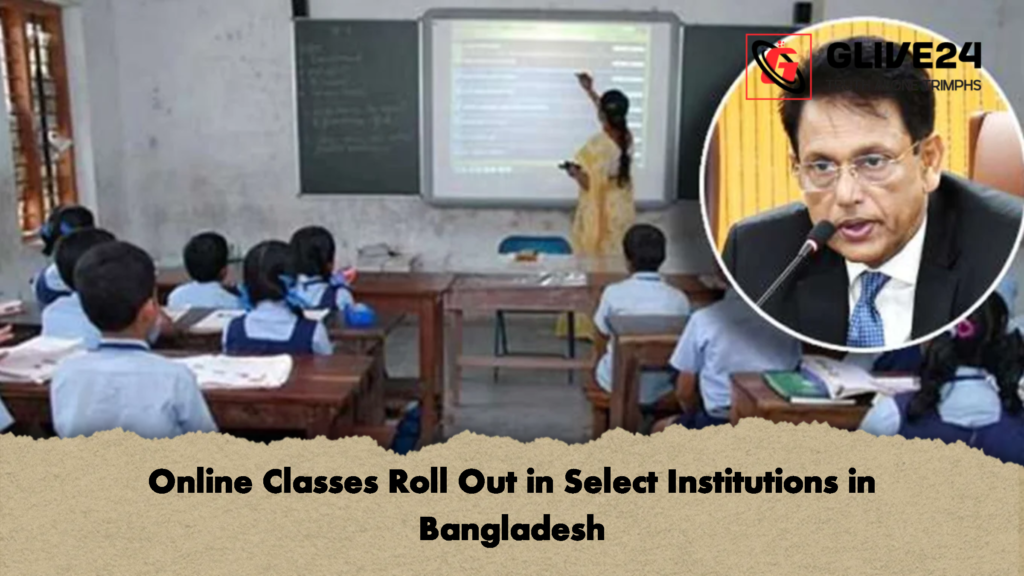
Online academic instruction is set to commence from Sunday, 12 April, in selected educational institutions across Bangladesh, marking a renewed effort to blend digital and in-person learning amid ongoing logistical and energy-related challenges. The move comes as traditional classes are temporarily suspended in parts of the country due to the Vaisabi festival, affecting both government and non-government primary and secondary schools.
Under the revised arrangement, only college-level students will initially participate in online classes, while primary and secondary institutions remain closed for the day due to the holiday calendar. The Ministry of Education has clarified that participation in online teaching is not mandatory for all institutions; rather, schools and colleges with adequate technological capacity are encouraged to implement the system independently.
Officials further stated that any institution requiring assistance in conducting online classes would receive support from the ministry, particularly in terms of coordination and digital infrastructure guidance.
Table of Contents
Early Implementation in Selected Institutions
The government had earlier indicated that a blended learning model would be introduced in phases, with selected institutions in Dhaka serving as pilot centres. According to Education Minister Dr A N M Ehsanul Haque Milon, the plan involves conducting classes three days a week online and the remaining three days through in-person teaching, as part of efforts to manage energy constraints and improve flexibility in academic delivery.
He had initially suggested that institutions such as Viqarunnisa Noon School and College, Residential Model School and College, Rajuk Uttara Model College, and a selected madrasa in Gazipur could be among the first to implement the hybrid system.
However, as of Saturday night, confirmation of full implementation has so far been limited. Only Viqarunnisa Noon School and College has officially issued notices confirming the commencement of online classes for its college section from Sunday.
Hybrid Class Schedule at Viqarunnisa Noon School and College
| Day Type | Mode of Instruction | Days |
|---|---|---|
| Physical classes | In-person learning | Saturday, Monday, Wednesday |
| Online classes | Digital learning | Sunday, Tuesday, Thursday |
According to a circular signed by acting principal Mazedha Begum, the institution will operate under a six-day academic cycle, alternating between in-person and online instruction. The online class schedules and joining links will be communicated through respective class teachers via designated student groups.
The circular also confirmed adjustments to the academic calendar. In a separate notice, the institution announced that the scheduled selection examination for the first paper of Class XII has been postponed due to the introduction of online classes. The examination, initially planned earlier, will now be held on 13 April (Monday) at the previously announced time.
Broader Policy Context
The introduction of online learning is part of a broader strategy by education authorities to modernise classroom delivery while addressing practical constraints, including energy shortages and infrastructure limitations. The blended learning approach is expected to help institutions maintain continuity in education without fully disrupting traditional classroom systems.
Education officials emphasised that the initiative remains flexible and experimental at this stage. Schools are not being compelled to adopt the system immediately, but those with sufficient technical readiness are being encouraged to participate in the pilot phase.
The government also indicated that feedback from early adopters will be used to refine the model before wider rollout. This includes assessing student engagement, teacher readiness, internet accessibility, and the effectiveness of digital teaching tools.
Mixed Response and Future Outlook
While some educational institutions have already begun preparing for the transition, others are still evaluating their capacity to support hybrid learning. The success of the initiative is expected to depend heavily on infrastructure availability and digital literacy among both teachers and students.
Education analysts suggest that if implemented effectively, the blended model could represent a significant shift in Bangladesh’s academic system, offering greater resilience against disruptions while expanding access to flexible learning formats.
For now, the rollout remains limited and experimental, with only a handful of institutions confirming active participation as the system begins its initial phase.