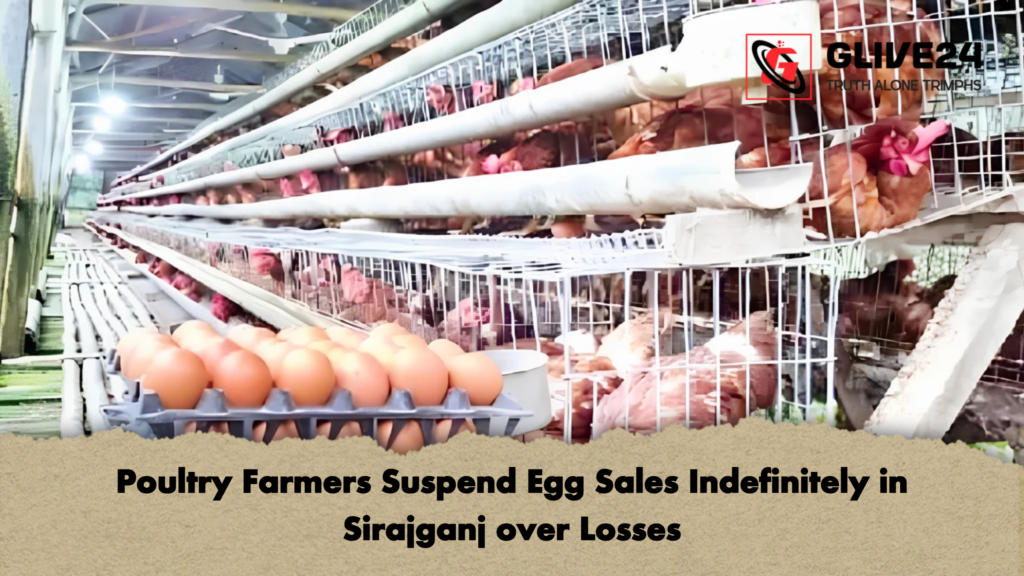
SIRAJGANJ — Local poultry farm owners in the Sirajganj district have declared an indefinite suspension of egg sales, citing an inability to secure fair market prices. Faced with spiralling production costs that outpace wholesale returns, farmers claim they have been forced into severe financial losses, leading to the dramatic halt. This collective boycott has immediately reverberated through local retail hubs, triggering sudden supply deficits across the district’s prominent marketplaces.
The decision follows a crucial strategic meeting held by local poultry producers in the Shialkol area of Sirajganj Sadar Upazila. Mostak Ahmed, the proprietor of Supto Poultry Farm and Feed, confirmed that the suspension officially came into effect on Sunday evening. The strike has halted the flow of eggs from rural commercial farms directly to urban distribution networks, leaving intermediate traders without fresh inventory.
Production Costs Versus Market Manipulation
According to disgruntled poultry farmers, the current baseline cost to produce a single egg stands at approximately 9 Taka. This figure accounts for a substantial rise in operational overheads, including escalated prices for commercial poultry feed, veterinary medicines, and hired labour. Despite these rising expenses, farmers allege that an unscrupulous syndicate of wholesale buyers and middlemen artificially depressed wholesale prices, capping them at just 7.70 Taka per egg.
“We bear all the physical and financial burdens of operating these farms, yet the pricing power rests entirely with a handful of influential wholesalers,” stated Lokman Hossain, a local farmer from Shialkol. He added that middle-tier traders systematically buy eggs cheaply at the farm gate only to distribute them to major urban centres at significantly inflated profit margins. Another affected farmer, Golam Mostafa, warned that multiple small-scale poultry businesses have already collapsed under the weight of mounting debts. Producers are now demanding immediate administrative intervention to dismantle these market cartels and guarantee price protection aligned with real production parameters.
Retail Supply Deficit and Consumer Impact
The supply blockade has rapidly destabilised local retail markets, where shopkeepers are struggling to meet daily consumer demands. Alauddin, an urban egg retailer, noted that daily deliveries from regional farms have effectively ceased. He explained that whilst consumer demand remains unchanged, purchasing stock from alternative wholesale warehouses has become prohibitively expensive, squeezing retail margins.
The sudden shortage has sparked concern amongst ordinary citizens, who rely heavily on eggs as an affordable source of protein. Local consumer Rashidul Islam stressed that eggs are a staple food item for low-income households, and any prolonged market instability risks worsening household budget pressures. He urged the government to mediate immediate tripartite talks between farmers, traders, and authorities to restore regular supply chains.
Addressing the friction, Dr A.K.M. Anowarul Haque, the Sirajganj District Livestock Officer, clarified that the state reserves the ultimate authority to regulate essential food prices, meaning independent traders cannot lawfully dictate market rates on a whim. However, he also observed that a temporary dip in broader seasonal consumer demand had contributed to the current lower price indexing. Market observers maintain that structural stability cannot return without a coordinated framework involving producers, corporate distributors, and the local administration.