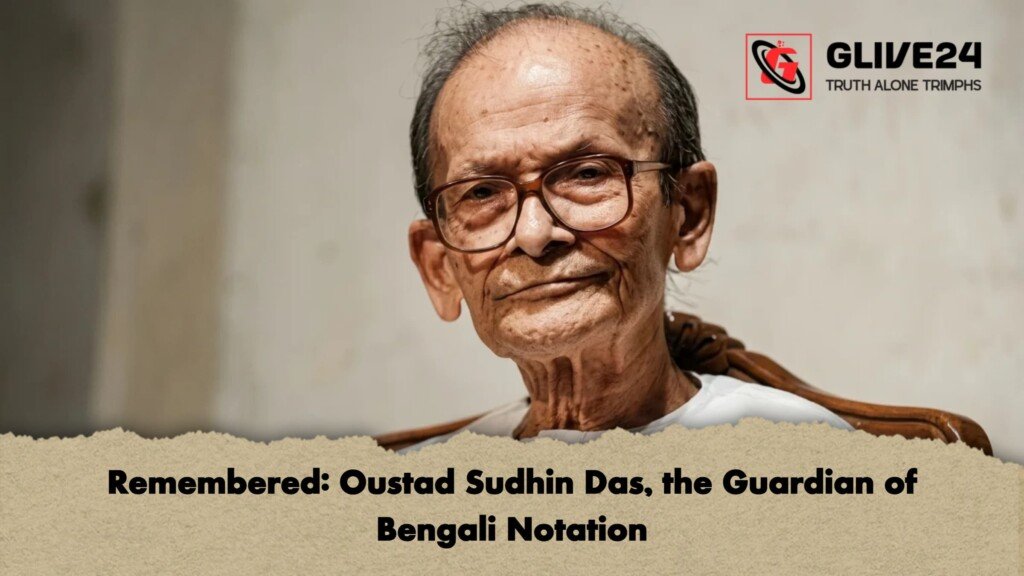
The history of the musical landscape of Bangladesh is punctuated by rare individuals whose contributions do not merely fade into the past but actively shape the future. Among these luminaries, the eminent subcontinent musicologist, researcher, composer, and educator Oustad Sudhin Das holds a position of singular reverence. He was far more than an accomplished artist; he functioned as a living institution, traversing every branch of music with a rare blend of profound knowledge, unflinching dedication, and a relentless pursuit of stylistic purity.
Born on 30 April 1930 in the cultural hub of Comilla, Sudhin Das was raised under the affectionate guidance of his parents, Nishikanta Das and Hemprava Devi. His initiation into the world of melody began at home under his elder brother, Suren Das. Recognizing the young boy’s innate potential, it was Suren who encouraged him to delve into the rigorous discipline of classical music—a decision that turned music from a youthful passion into a lifelong spiritual pursuit.
His professional journey commenced amidst the political transitions of 1947. Whilst studying at Comilla Victoria College, the young vocalist successfully passed an audition for the radio, marking the official beginning of his broadcasting career. By 1965, his influence expanded significantly as he joined hands with the newly established Bangladesh Television. Through television, he injected a fresh dimension into the national cultural sphere, spearheading music direction, academic research, and vocal training programmes that raised public broadcasting standards.
However, historical consensus views his work in musical notation as his ultimate legacy. In an era where traditional compositions risked distortion through oral transmission, Sudhin Das dedicated himself to the meticulous preservation of authentic Bengali music. His most monumental achievement was the systematic documentation of Nazrul Sangeet—the songs of the Rebel Poet, Kazi Nazrul Islam. To prevent these works from losing their original essence, he cross-referenced early gramophone records to capture the precise lyrics and ragas intended by the poet.
This monumental effort culminated in the publication of 21 authoritative volumes of Nazrul Sangeet notations. Of these, 16 volumes were published by the Nazrul Institute and five by the Nazrul Academy, creating an invaluable blueprint for future generations of vocalists. His preservation work did not stop there; he turned his attention to the mystical folk traditions of the region, becoming the very first scholar to publish a comprehensive book of notations for Lalon Geeti, ensuring that the philosophy of Lalon Shah could be sung accurately and preserved against the passage of time.
Total Notations Published: 21 Volumes of Nazrul Sangeet
• Nazrul Institute: 16 Volumes
• Nazrul Academy: 5 Volumes
• Plus: Groundbreaking first notation book for Lalon Geeti
Beyond his archival triumphs, Das was an influential institutional leader. He served as the external examiner for undergraduate and postgraduate music degrees at the University of Dhaka and acted as the chief judge of the gradation boards for both Bangladesh Betar and Bangladesh Television. His expertise led him to the presidency of the Bangladesh Notation Authentication Council, alongside leadership roles in almost every major music academy in the country. In 1970, he took up the mantle of Principal at the Pakistan Cultural Academy (later renamed the Bangladesh Cultural Academy) located at Road 6 in Dhanmondi, playing a pivotal institutional role during a crucial era of national identity formation.
The state recognized his monumental service to the nation’s cultural heritage in 1988 by conferring upon him the Ekushey Padak, one of the country’s highest civilian awards. This accolade was accompanied by numerous local and international honours over his long career, including the prestigious Channel i Lifetime Achievement Award.
Oustad Sudhin Das departed this world on 27 June 2017. Though his physical presence is gone, the framework he constructed remains unshaken. His exhaustive research, absolute precision in notation, and the legions of disciples he personally trained ensure that the foundational purity of Bengali music remains protected. Decades after his passing, his scholarly dedication continues to serve as a guiding beacon for the cultural evolution of the subcontinent.