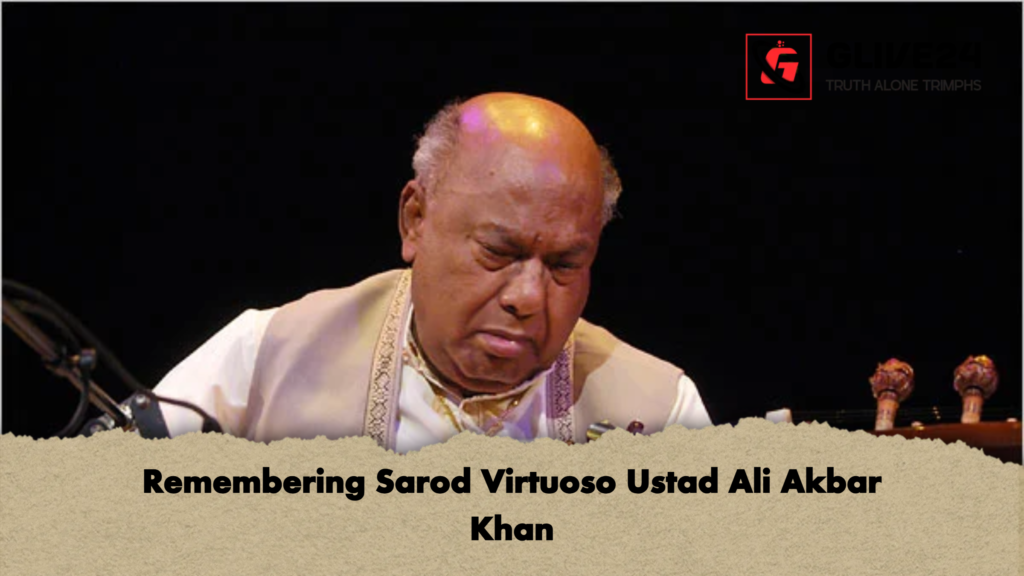
Ustad Ali Akbar Khan, one of the most accomplished sarod players of the 20th century and a global ambassador of Indian classical music, was born on 14 April 1922 in Shibpur village, within the Nabinarup upazila of Brahmanbaria district (in modern-day Bangladesh). His father, the legendary music maestro Ustad Allauddin Khan, served as the court musician for the princely state of Maihar. Consequently, Ustad Ali Akbar Khan spent his childhood and adolescence in Maihar under his father’s direct guidance. His musical education commenced at the remarkably early age of three through vocal training. Because his father was proficient in numerous musical instruments, the young Ali Akbar Khan received comprehensive instruction across various instruments from an early age.
At the age of nine, his father presented him with the sarod. Later, in 1933, his uncle Ustad Ayet Ali Khan gifted him a hand-crafted sarod, which became his lifelong companion in musical devotion. Reports indicate that he practiced for up to eighteen hours daily, showcasing his profound dedication to the art form.
Career and Global Proliferation of Classical Music
Ustad Ali Akbar Khan gave his debut public sarod performance in Allahabad at the age of thirteen. By the 1940s, his performances at various prominent music conferences established his reputation across the subcontinent. In 1938, he joined All India Radio as a music director. By 1943, he was appointed as the court musician for the State of Jodhpur, a tenure that lasted for six years. Moving to Mumbai in 1948, he began composing scores for the film industry. His notable cinematic works include the musical scores for Kshudhita Pashan and Jhinder Bandi.
In 1955, Ustad Ali Akbar Khan embarked on international tours, visiting England and subsequently the United States. He was a pioneer in introducing Eastern classical music to Western television audiences. During the same year, his long-playing (LP) record was released in New York, becoming one of the earliest and most influential recordings of Eastern classical music published in America.
The Concert for Bangladesh and International Acclaim
During the 1971 Bangladesh Liberation War, Ustad Ali Akbar Khan participated in the historic Concert for Bangladesh, organized by George Harrison at Madison Square Garden to raise global awareness and funds. Alongside Pandit Ravi Shankar and Ustad Alla Rakha, he performed the historic Bangla Dhun, a performance that remains landmarked in classical music history.
His extensive contributions earned him multiple accolades. The Government of India honoured him with the Padma Bhushan and the Padma Vibhushan. He was a two-time recipient of the President of India Award and achieved the distinction of performing as an invited artist at the inauguration ceremony of US President John F. Kennedy.
In 1974, the University of Dhaka conferred an honorary doctorate degree upon him, and Rabindra Bharati University awarded him a Doctor of Literature (D.Litt.). In 1991, the MacArthur Foundation in the United States awarded him the prestigious MacArthur Fellowship, popularly known as the “Genius Grant”. Between 1970 and 1998, he received five Grammy Award nominations, validating his global reach. The maestro passed away on 18 June 2009 in San Francisco, United States.
Key Milestones and Honours
The table below outlines the timeline of Ustad Ali Akbar Khan’s life, career milestones, and major institutional decorations:
| Year / Period | Milestone / Award | Description / Institutional Context |
| 1922 | Birth | Born on 14 April in Shibpur, Brahmanbaria. |
| 1933 | The Hand-Crafted Sarod | Gifted a custom-built sarod by his uncle, Ustad Ayet Ali Khan. |
| 1935 | Stage Debut | Performed publicly for the first time in Allahabad at age 13. |
| 1938 | Broadcasting Career | Appointed as a music director for All India Radio. |
| 1943–1949 | Court Musician | Served the princely court of the Jodhpur State. |
| 1948 | Cinema Compositions | Commenced film score composition in Mumbai (e.g., Kshudhita Pashan). |
| 1955 | Western Debut | Toured the UK and US; released a seminal LP record in New York. |
| 1961 | US Presidential Performance | Invited artist at the inauguration of President John F. Kennedy. |
| 1971 | Concert for Bangladesh | Performed Bangla Dhun at Madison Square Garden with Ravi Shankar. |
| 1974 | Honorary Doctorate | Awarded an honorary doctorate by the University of Dhaka. |
| 1991 | MacArthur Fellowship | Received the “Genius Grant” from the US-based MacArthur Foundation. |
| 1970–1998 | Grammy Nominations | Nominated five times for the Grammy Awards. |
| 2009 | Demise | Passed away on 18 June in San Francisco, United States. |