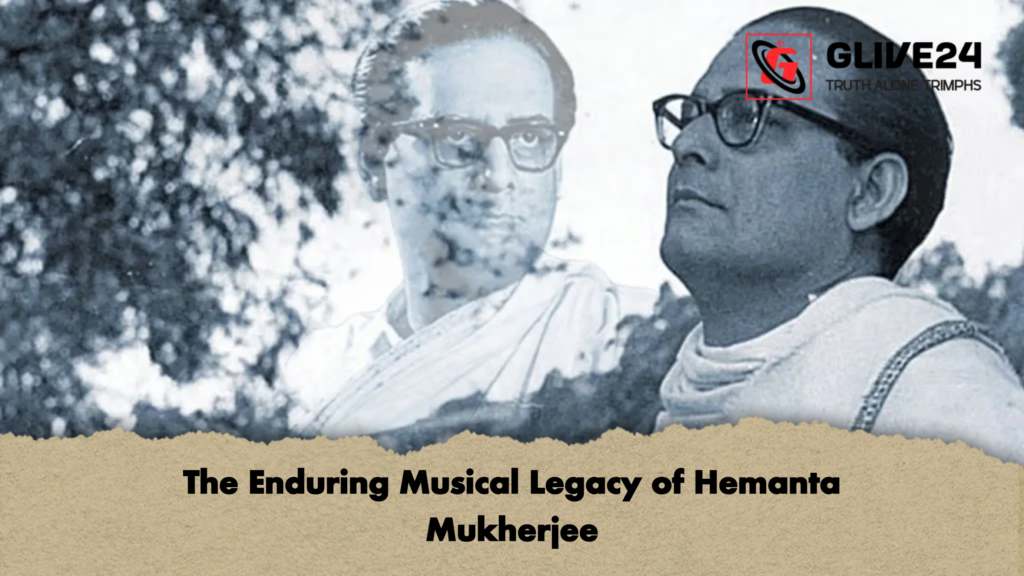
The timeless melodies of Hemanta Mukherjee, such as ‘Ei Raat Tomar Amar’, ‘Neer Chhoto Khoti Nei’, and ‘Muchhe Jawa Din Guli’, remain deeply embedded within the cultural fabric of Bengali society. Decades after their initial release, these tracks continue to transcend generational divides. Having transitioned from traditional radio broadcasts, gramophones, cassettes, and compact discs, they have seamlessly secured a prominent presence on modern digital streaming applications and social media platforms.
Mukherjee’s voice functions as an artistic accompaniment to various facets of daily life, from theatrical rehearsal spaces to solitary urban and rural settings. His annual birth anniversary on 16 June consistently prompts widespread tributes, archival sharing, and digital retrospectives globally, underscoring his position as a foundational figure in Indian and Bengali music.
Table of Contents
Early Life and Literary Ambitions in Benares
Hemanta Mukherjee was born on 16 June 1920 in Benares (now Varanasi, Uttar Pradesh, India). His family subsequently relocated to Calcutta, where he attended Mitra Institution in Bhawanipur. During his schooling, he developed close friendships with individuals who would later become prominent cultural and literary figures: the poet Subhash Mukhopadhyay and the author Santosh Kumar Ghosh.
Initially, Mukherjee did not aspire to a musical career; his primary interest lay in writing short stories. His literary works were even accepted and published in the highly regarded Bengali literary magazine Desh.
Despite a lack of formal, institutional training in classical music during his early years, Mukherjee possessed a keen auditory aptitude. He developed his musical sensibilities by listening to gramophone records at the residence of his friend, Shyam Sundar. A notable incident occurred during his school days when he was briefly expelled for singing in class with classmates. However, following student protests and a diplomatic intervention by his father, the disciplinary action was rescinded. The incident left a lasting impression on Mukherjee, fostering a characteristic humility and composure that defined his subsequent professional career.
Radio Debut and Early Professional Challenges
Subhash Mukhopadhyay played a pivotal role in redirecting Mukherjee towards music. In 1935, at his friend’s insistence, Mukherjee auditioned for the Indian Broadcasting Corporation (which later became All India Radio). He performed ‘Aajo Pore Go Mone’, a track originally sung by the popular artist Santosh Sengupta, and successfully secured selection. Although his father initially expressed reservations about music being pursued as a career, family consent was eventually obtained. For his debut radio broadcast, Subhash Mukhopadhyay penned the lyrics for ‘Amar Ganete Ele Noboruphe Chirantoni’.
Securing commercial recording opportunities, however, proved difficult. Prominent record labels of the era, including Senola, Pioneer, Megaphone, and HMV, initially declined to sign him. His breakthrough occurred through the intervention of a family friend, Shanti Basu, who introduced him to the renowned composer Shailesh Duttagupta. In 1937, Mukherjee recorded his debut gramophone disc, featuring the tracks ‘Janite Jodi Go Tumi’ and ‘Bolo Go Bolo More’, composed by Duttagupta with lyrics by Noreshwar Bhattacharya.
Key Milestone Chronology
| Year / Period | Significant Professional Events and Achievements |
| 16 June 1920 | Born in Benares, British India. |
| 1935 | Successfully auditioned and debuted at the Indian Broadcasting Corporation. |
| 1937 | Released his first commercial gramophone record through HMV/Columbia. |
| 1944 | Composed and released his first self-directed modern hit, ‘Kotha Koyo Nako, Shudhu Shono’. |
| 1948 | Collaborated with Salil Chowdhury on the seminal six-minute narrative track ‘Kono Ek Gayer Bodhur Kotha’. |
| 1951 | Relocated to Mumbai (Bombay) to compose for the Hindi film Anand Math. |
| 1954 | Won the prestigious Filmfare Award for Best Music Director for the box-office hit Nagin. |
| 1955 | Initiated the legendary cinematic partnership with actor Uttam Kumar in the film Shapmochan. |
| 1972 | Directed and performed tracks for the international Hollywood feature film Siddhartha. |
| 26 September 1989 | Passed away in Calcutta, West Bengal, India. |
Artistic Independence and the Salil Chowdhury Era
During the initial phase of his career, Mukherjee’s vocal style drew frequent comparisons to the legendary singer Pankaj Mullick, earning him the sobriquet ‘Chhotto Pankaj’ (Little Pankaj). He systematically worked to establish an independent artistic identity, which became distinct with his 1944 self-composed releases, ‘Kotha Koyo Nako, Shudhu Shono’ and ‘Amar Biroho Akashe Priya’. The restrained emotional delivery and precise diction of these songs marked a shift in modern Bengali music.
In the late 1940s, through his association with the Indian People’s Theatre Association (IPTA), Mukherjee began a historic collaboration with the avant-garde lyricist and composer Salil Chowdhury. Their 1948 release, ‘Kono Ek Gayer Bodhur Kotha’—a six-minute narrative song detailing rural struggles against the backdrop of the Bengal famine—challenged the prevailing convention of romantic themes in popular music. This was followed by a series of socially conscious, rhythmically complex tracks, including ‘Runner’, ‘Obak Prithibi’, and ‘Palkir Gaan’, which cemented Mukherjee’s status as a voice capable of articulating structural socio-political realities.
Cinema of Bengal, Bollywood, and Hollywood
In the domain of cinema, the professional partnership between actor Uttam Kumar and playback singer Hemanta Mukherjee remains one of the most successful in Indian film history. Beginning with the 1955 film Shapmochan, Mukherjee’s deep, baritone voice became inextricably linked with Kumar’s on-screen romantic persona. This partnership yielded iconic soundtracks for landmark films such as Harano Sur, Saptapadi, Mayamriga, Indrani, and Jiban Trishna.
Simultaneously, Mukherjee achieved significant success in the Hindi film industry (Bollywood) after moving to Mumbai in 1951 at the invitation of director Hemen Gupta. Operating under the screen name Hemant Kumar, he composed the musical score for Anand Math (1952) and won the Filmfare Award for Best Music Director for Nagin (1954). As a playback singer in Hindi cinema, his renderings of songs like ‘Yeh Raat Yeh Chandni Phir Kahan’, ‘Hai Apna Dil To Aawara’, and ‘Na Tum Hamen Jano’ attained widespread national popularity.
His work reached international audiences in 1972 when he served as a music consultant and playback singer for Conrad Rooks’ English-language Hollywood film Siddhartha, which featured his classic Bengali compositions ‘O Nodi Re’ and ‘Pother Klanti Bhule’.
Popularising Rabindrasangeet and Later Years
Mukherjee made a profound contribution to Rabindrasangeet (the songs composed by Rabindranath Tagore). While strictly maintaining the structural integrity of Tagore’s compositions, he introduced a direct, accessible, and deeply emotional delivery that brought these songs out of exclusive institutional enclaves and into mainstream middle-class households. His renditions of tracks like ‘Amar Aar Hobe Na Deri’ and ‘Purano Sei Diner Kotha’ remain benchmark interpretations within the genre.
Hemanta Mukherjee passed away on 26 September 1989 in Calcutta. Alongside contemporary musical stalwarts such as Manna Dey, Kishore Kumar, and Mohammed Rafi, his distinct vocal intimacy ensures that his extensive body of work remains an essential element of South Asian musical heritage.