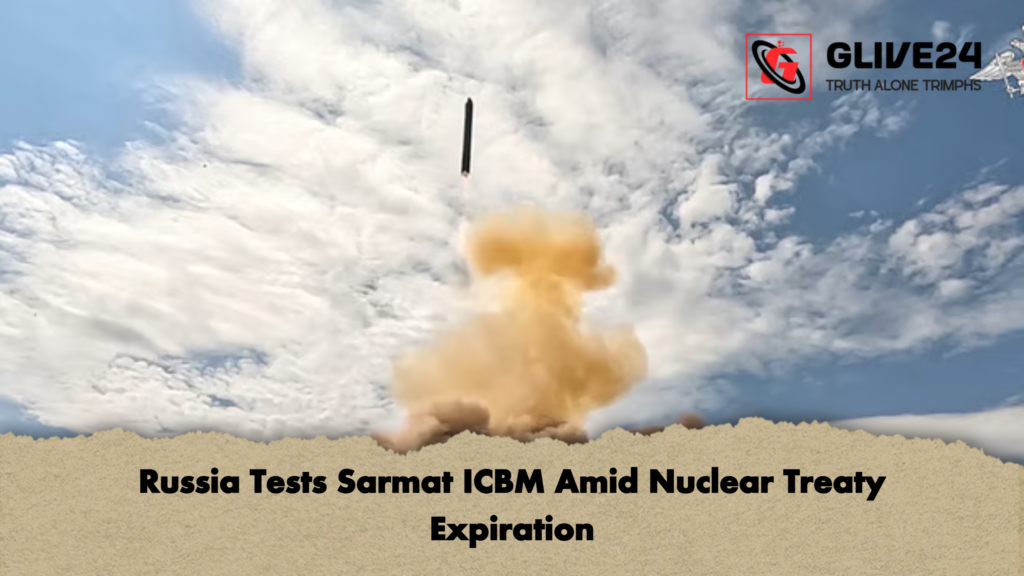
Russia has officially conducted a successful test-launch of its latest long-range missile system, the RS-28 Sarmat. This advanced weapon, classified as an Intercontinental Ballistic Missile (ICBM), is engineered to strike targets at a distance of up to 35,000 kilometres. Capable of carrying nuclear payloads, the Sarmat represents a significant escalation in strategic military technology. The test was carried out on Tuesday, marking a critical phase in Russia’s modern weaponry development.
Following the successful trial, President Vladimir Putin addressed the significance of the achievement, describing the Sarmat as the most powerful missile system in the world. He asserted that the hardware is capable of carrying a payload four times more potent than any comparable system currently held by Western military forces. According to the President, the Sarmat is scheduled to be deployed on “combat duty” by the end of the current year.
Technical Specifications of the RS-28 Sarmat
The Sarmat is intended to replace the ageing R-36M2 Voevoda missiles. Its design focuses on bypassing modern missile defence systems through high-speed atmospheric entry and unpredictable flight paths.
| Feature | Specification Details |
| Classification | Intercontinental Ballistic Missile (ICBM) |
| Maximum Range | Up to 35,000 Kilometres |
| Warhead Capability | Multiple Independently Targetable Re-entry Vehicles (MIRVs) |
| Operational Status | Scheduled for deployment by year-end |
| Propulsion | Liquid-fuelled rocket engine |
The Collapse of the New START Treaty
The timing of this missile test coincides with a period of heightened diplomatic tension regarding global nuclear disarmament. The New Strategic Arms Reduction Treaty (New START), the final remaining nuclear arms control agreement between the United States and Russia, expired last February. Under the original terms of this treaty, both Washington and Moscow were mandated to limit their stockpiles of deployed strategic nuclear warheads and launchers.
With the expiration of the treaty, the legal framework that once constrained the expansion of nuclear arsenals has dissolved. Consequently, neither nation is currently bound by international obligations to limit the quantity or development of their strategic nuclear assets.
Geopolitical Standoff and Future Negotiations
While both nations initially expressed a willingness to engage in high-level military dialogue following the treaty’s expiration, prospects for a formal renewal remain dim. A primary obstacle is the shift in American diplomatic strategy. The United States has indicated a preference for a new, trilateral agreement that would include the People’s Republic of China, citing Beijing’s growing nuclear capabilities as a reason for their inclusion.
However, the Chinese government has explicitly rejected participating in such negotiations. Beijing maintains that its nuclear arsenal is significantly smaller than those of the United States and Russia, and therefore, it has no obligation to join a restrictive arms control framework at this stage. This deadlock leaves the international community without a clear successor to the New START agreement, even as Russia moves forward with the deployment of its most advanced ICBM technology.