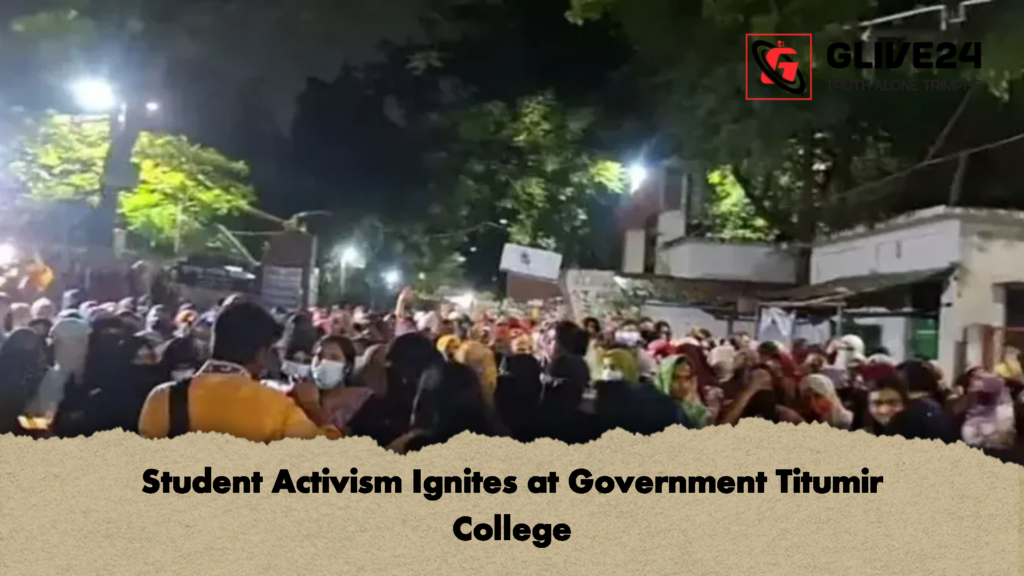
Female residents of Government Titumir College staged a large-scale demonstration on the night of Tuesday, 5 May 2026, calling for a total prohibition of political activities within the institution. The protest, which began in the female residential halls, saw hundreds of students bypass security gates to congregate at the entrance, expressing a collective rejection of the entrenched influence that partisan organisations exert over the student body and administrative operations.
During the demonstration, the air was filled with rhythmic chanting as students articulated their grievances through targeted slogans. Notable amongst these were: “Residential halls are not the property of any individual’s father; student politics must end,” and “Break the black hands of the administration.” These declarations underscore a deepening rift between the general student population and the college executive, whom the protestors accuse of facilitating political interference in academic life.
Table of Contents
The Inciting Incident: Political Committee Formation
The current wave of unrest was specifically triggered by the recent announcement of a new residential hall committee by the Jatiyatabadi Chhatra Dal (JCD), the student wing of the Bangladesh Nationalist Party (BNP). The formation of such units within the dormitory system is a contentious practice in Bangladesh, often perceived as a method for political parties to exert control over the daily lives of students.
In many government-run institutions, hall committees have historically been accused of usurping administrative functions. These include:
Seat Allocation: Arbitrarily deciding which students occupy dormitory rooms, often prioritising political loyalty over academic merit or financial need.
Forced Attendance: Coercing residents into participating in political rallies or demonstrations under the threat of eviction.
Resource Control: Managing hall canteens and common rooms to serve organisational interests.
Allegations of Retaliatory Discipline
The tension escalated into an open revolt following reports that the college administration had penalised dissenters. Rumours circulated rapidly across the campus and social media indicating that three students had been targeted for expulsion or suspension. These students were reportedly identified as those who had vocally opposed the newly appointed JCD committee.
While a formal confirmation of these disciplinary actions has not been released by the Office of the Principal, the perceived victimisation of student activists acted as a catalyst for the evening’s protest. The demonstrators contend that the administration is employing “shadow tactics” to intimidate those who advocate for a neutral, politics-free campus, thereby enabling political cadres to maintain a stronghold within the residential halls.
Administrative Accountability and Historical Context
The administration of Government Titumir College, located in the prominent Mohakhali district of Dhaka, is legally responsible for ensuring that residential halls are governed by the Provost and professional house tutors. However, the protestors’ use of the term “black hands” suggests a belief that a symbiotic relationship exists between college officials and political heavyweights.
Titumir College has long been a focal point for student activism due to its significant student enrolment and its proximity to the capital’s political and commercial centres. This latest protest is symptomatic of a wider national movement. Following similar agitations at the Bangladesh University of Engineering and Technology (BUET) and other major universities, students are increasingly demanding that educational institutions remain strictly focused on academic and research pursuits, insulated from the volatility of national partisan politics.
Current Stalemate and Security Situation
As of the early hours of Wednesday morning, 6 May 2026, the protest remained active, with students refusing to return to their quarters until their demands were met. Their primary requirements include:
Written Assurances: A formal guarantee that no student will face academic or residential repercussions for opposing political organisations.
Dissolution of Committees: The immediate disbanding of all non-official political committees within the residential halls.
Administrative Neutrality: A commitment from the Principal to reclaim administrative control of the dormitories from external factions.
Local law enforcement agencies were deployed to the campus gates to monitor the situation. While the presence of police added to the evening’s tension, the students maintained a peaceful but resolute assembly. Student leaders have indicated that if the administration fails to address these concerns by the following morning, they will escalate their efforts into a comprehensive boycott of all academic activities, potentially involving the wider student body across the entire college.