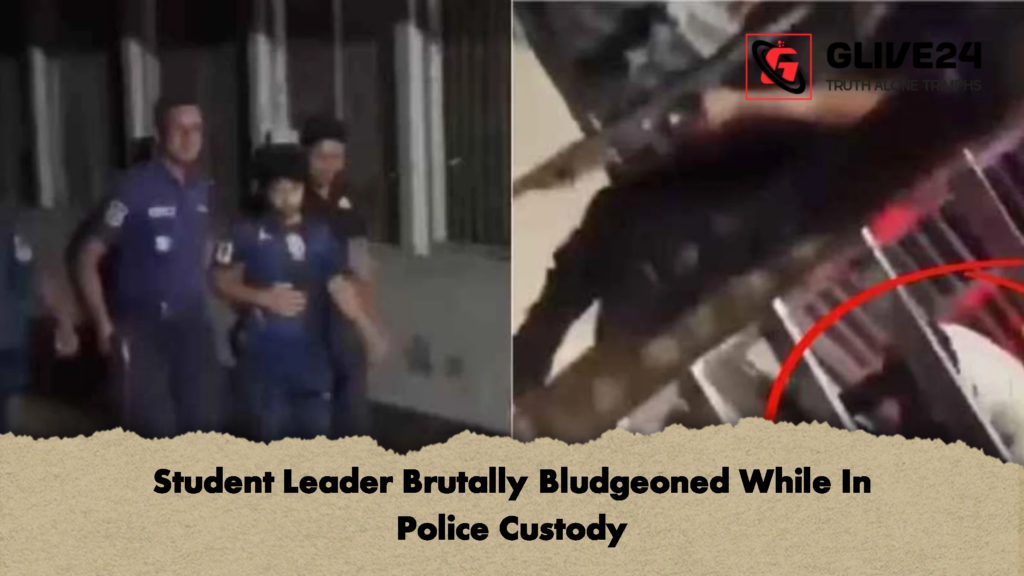
In a chilling escalation of campus violence that has sent shockwaves through the academic community, Amanullah Muaz, a prominent leader of the Jatiyatabadi Chhatra Dal (JCD) at Mymensingh Medical College (MMC), is currently battling for his life at the National Institute of Neurosciences & Hospital. The assault, which transpired on Friday, 17 April 2026, occurred in broad daylight at the main gates of the Baghmara Hostel, under circumstances that have raised serious allegations regarding police complicity or gross incompetence.
Leaked video footage obtained by The Daily Campus provides a harrowing account of the incident. The visual evidence confirms that Muaz, a third-year medical student, was in the custody of four police officers—two in official uniform and two in plain clothes—when he was forcibly seized by a rival faction leader and subjected to a barbaric physical assault.
Analysis of the Violent Conflict
The confrontation began as a factional dispute within the JCD, the student wing of the Bangladesh Nationalist Party. As tensions flared, the local police intervened to secure the area. The video clearly depicts four officers escorting Muaz out of the hostel gates, presumably to safety or for further questioning.
However, as the party reached the threshold of the hostel, Nafiul Islam, a classmate of the victim and a leader of the opposing JCD faction, launched a sudden and vicious ambush. In a staggering display of audacity, Nafiul managed to snatch Muaz from the officers’ grasp. Rather than reasserting control or protecting the individual in their care, the footage shows the officers backing away as Nafiul proceeded to strike Muaz repeatedly in the head with an industrial hammer.
| Incident Parameter | Details of the Mymensingh Medical College Assault |
| Primary Victim | Amanullah Muaz (3rd Year Student / JCD Leader) |
| Accused Aggressor | Nafiul Islam (3rd Year Student / JCD Leader) |
| Weapon Utilised | Industrial Hammer |
| Location | Main Gate, Baghmara Hostel, Mymensingh |
| Medical Status | Critical condition; under intensive neurological care |
| Police Response | One arrest made; allegations of negligence under investigation |
Allegations of Institutional Negligence
The most distressing aspect of the footage is the apparent passivity of the law enforcement officers on the scene. As Muaz was thrown to the pavement and bludgeoned, the four individuals tasked with his protection were seen retreating several paces, offering no physical resistance to the assailant. Subsequent clips show the road stained with blood as Muaz lay unconscious, while the attacker was permitted to linger momentarily before finally being apprehended.
The Officer-in-Charge (OC) of the Mymensingh Kotwali Police Station, Mohammad Shibirul Islam, has faced intense scrutiny following the release of the video. In his initial statement, the OC appeared to downplay the breach of custody, focusing instead on the subsequent medical evacuation.
“Our officers acted to recover two seriously injured individuals and ensure they reached medical facilities immediately,” the OC told reporters. “A formal case has been filed, and we have arrested Nafiul Islam in connection with this brutal act. We expect to provide more comprehensive details once the suspect is produced before the court tomorrow.”
Medical and Political Fallout
Sources at the National Institute of Neurosciences have described Muaz’s condition as “extremely precarious,” noting that the blunt force trauma from the hammer has caused significant intracranial damage. The medical team is currently monitoring him for internal haemorrhaging, and he remains on life support.
The incident has ignited a firestorm of criticism across social media and student political circles. Many are questioning how a student in police custody could be snatched and nearly killed while four officers stood by. The Mymensingh Medical College authorities have yet to issue a formal statement regarding the disciplinary future of the students involved, though a campus-wide protest is scheduled for Sunday morning.
The brutal nature of the attack—utilising a hammer as a primary weapon—highlights a terrifying shift in the intensity of student-led political violence. As the judiciary prepares to hear the case, the focus remains firmly on the police, whose failure to protect a man in their custody has been captured in a digital record that cannot be ignored. The public now awaits a transparent inquiry into whether the officers involved will face departmental action for their perceived dereliction of duty.