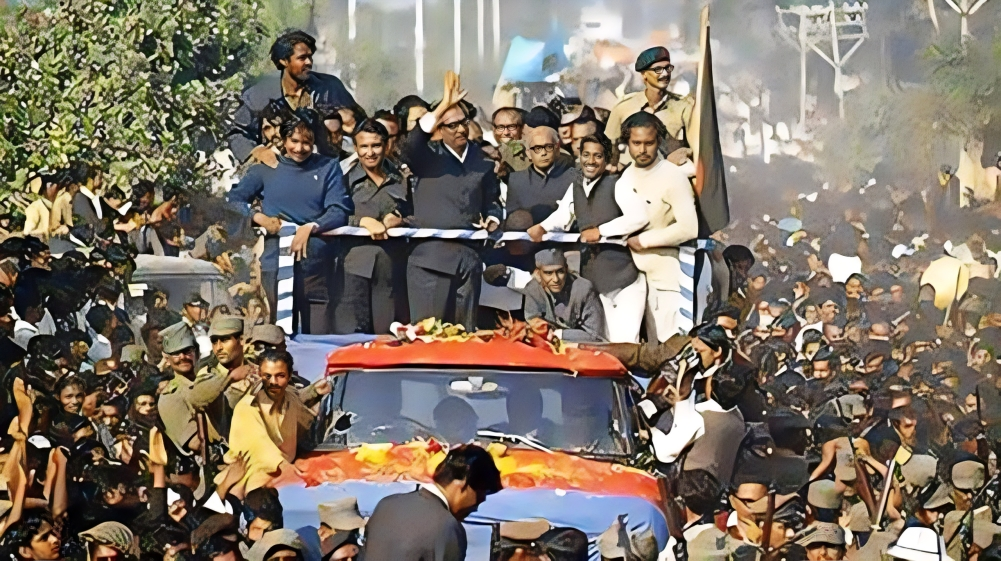
Students from various universities across Bangladesh have expressed their deep admiration for the ideology of Father of the Nation, Bangabandhu Sheikh Mujibur Rahman, as they pay tribute to him during the Month of Mourning. They recognise his lifelong struggle for people’s rights and his enduring legacy of leadership and courage.
Tributes from University Students in the Month of Mourning
Students from various universities across Bangladesh have expressed their deep admiration for the ideology of Father of the Nation, Bangabandhu Sheikh Mujibur Rahman, as they pay tribute to him during the Month of Mourning. They recognise his lifelong struggle for people’s rights and his enduring legacy of leadership and courage.
Md Fahinur Alam Ovy, a final-year student of Dhaka University, highlighted Bangabandhu’s role as a global icon of struggle and justice. “Bangabandhu devoted his entire life to establishing the rights of the people. His leadership transcended regional boundaries, making him an emblem of struggle for the exploited worldwide,” he remarked.
Ovy further stated that independent Bangladesh would not have been possible without Bangabandhu. “His ideology, based on strong moral values and remarkable leadership, will always serve as a source of eternal inspiration for us,” he added. He emphasised that the dream of “Sonar Bangla” (Golden Bengal) could be realised if everyone remained committed to Bangabandhu’s vision of an equal and just society.
Tasmia Mehrin, a master’s student from Jahangirnagar University’s Public Administration Department, described Bangabandhu as a “symbol of infinite courage and a fearless hero.” She quoted his historic declaration: “From today, the name of the eastern province of Pakistan will be only Bangladesh instead of East Pakistan.” She added that it was Bangabandhu who instilled in the Bengali people the dream of freedom through struggle.
Reflecting on his contributions from the 1952 Language Movement to rebuilding a war-torn nation, she stated: “Bangabandhu taught us that there is no alternative to fighting for freedom from oppression.” In an emotional reference to his tragic assassination, she said, “Bangladesh is now independent, but how much happier we would have been if only we could wake up to the news that Bangabandhu had not died.”
Another Jahangirnagar University student, Mehedi Mamun, praised Bangabandhu’s unwavering stand against injustice. “To me, he is a towering figure against suppression and oppression,” he said.
Mamun noted that Bangabandhu recognised educational disparity as a primary tool of oppression. He recalled that on 28th October 1970, during a televised speech before the general elections in then-undivided Pakistan, Bangabandhu spoke about these disparities. “One of his earliest initiatives after independence was to form the National Education Commission, headed by eminent educationist Dr Qudrat-e-Khuda, on 26th July 1972,” Mamun added.
Md Roni Molla, a student at Bangladesh University of Engineering and Technology (BUET), described Bangabandhu as a leader who fearlessly raised his voice against all forms of injustice. “His powerful voice remains the greatest inspiration and pride of our nation. He is an idol to us,” he affirmed.
Naim Hasan, a final-year student of Dhaka Medical College, recalled Bangabandhu’s directives to physicians in independent Bangladesh. “Bangabandhu instructed doctors to serve the rural population to alleviate their suffering,” he said. Naim pledged to uphold this vision in his own medical career, adding, “With our dedication, we will transform our country into Bangabandhu’s ‘Sonar Bangla.’”
Ivy Akhter, a final-year student of Dhaka University, acknowledged Bangabandhu’s charisma and extraordinary leadership. “His ability to inspire people was unparalleled,” she remarked. She highlighted how he guided the peace-loving Bengali people to take up arms against the Pakistani military junta and achieve independence.
The students’ reflections underscore the profound and lasting impact of Bangabandhu’s ideology on today’s youth. His unwavering commitment to justice, equality, and national progress continues to inspire future generations in their pursuit of a prosperous and just Bangladesh.