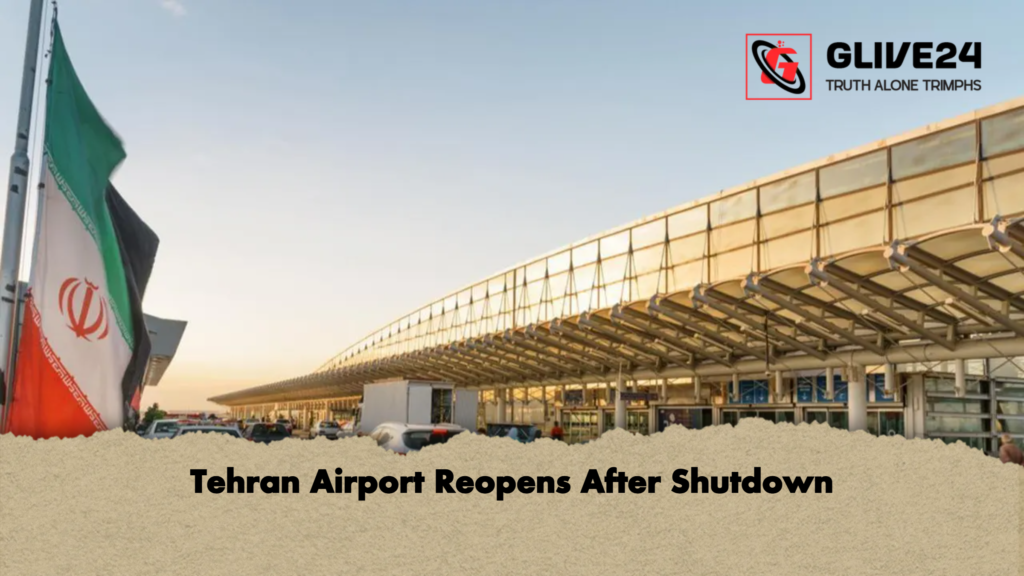
Iran’s main international gateway, Imam Khomeini International Airport in Tehran, has resumed operations after remaining closed for 57 days amid heightened regional tensions and security concerns. The reopening marks a cautious step towards restoring the country’s disrupted air connectivity, which had been severely affected by recent geopolitical instability.
According to official sources, the temporary closure was enforced as part of broader precautionary measures taken during a period of intensified military tensions involving the United States and Israel. Iranian authorities had restricted national airspace to mitigate potential risks, resulting in the suspension of operations at the country’s busiest international airport. While several regional airports continued to function on a limited basis, the prolonged shutdown of Tehran’s primary aviation hub significantly disrupted both passenger and cargo transport networks.
Under normal circumstances, Imam Khomeini International Airport handles between 100 and 150 flights daily, serving as a critical hub for international travel and trade. However, during the period of instability, flight activity across the facility dropped dramatically to approximately 10 to 15 flights per day at its lowest point. Authorities now report that operations are gradually increasing as security conditions stabilise and aviation services are carefully restored.
The impact of the conflict extended beyond international routes. Domestic aviation infrastructure also suffered considerable strain. Mehrabad Airport, Tehran’s secondary aviation hub primarily serving internal flights, was reportedly affected by repeated disruptions, forcing airlines to operate under restricted conditions. Similarly, airports in Tabriz and Urmia sustained varying degrees of damage, further compounding logistical challenges across the country’s regional air network.
Restoration efforts are currently underway across multiple facilities. Engineers and aviation authorities have been working to repair infrastructure, enhance safety systems, and ensure compliance with operational standards before returning to full capacity. At Imam Khomeini International Airport in particular, essential maintenance and safety upgrades have been prioritised to support the phased resumption of services.
The current operational status of key Iranian airports is summarised below:
| Airport Name | Location | Current Status | Notes |
|---|---|---|---|
| Imam Khomeini International Airport | Tehran | Partially operational | Reopened after 57-day closure; limited flights resumed |
| Mehrabad Airport | Tehran | Damaged and partially operational | Restricted domestic services ongoing |
| Tabriz Airport | Tabriz | Damaged | Reconstruction work in progress |
| Urmia Airport | Urmia | Damaged | Under repair and security assessment |
Aviation analysts suggest that Iran’s air transport system is expected to gradually return to full capacity, provided that regional stability continues to improve. However, they caution that comprehensive recovery will depend on sustained security assurances and the completion of significant infrastructure rehabilitation projects. The phased reopening of airports is therefore seen as a measured approach aimed at balancing operational normalisation with ongoing safety considerations.