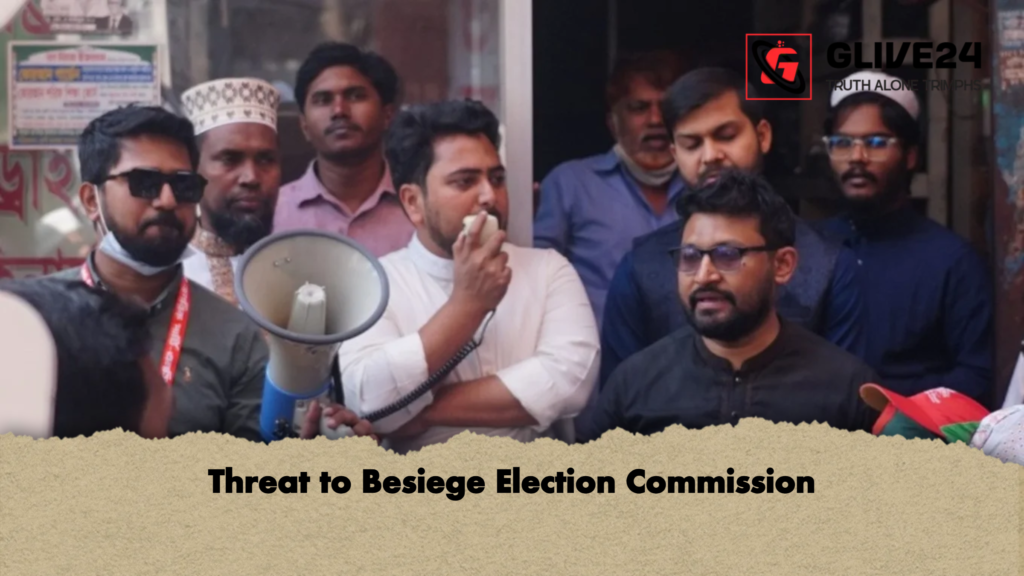
Political tensions have intensified ahead of Bangladesh’s 13th National Parliamentary Election and the accompanying referendum, after the Election Commission (EC) imposed a restriction on the carrying of mobile phones within 400 yards of polling stations. The decision has prompted a sharp warning from Nahid Islam, Convener of the National Citizens’ Party (NCP), who has threatened to besiege the Commission if the directive is not withdrawn by the evening.
Addressing a campaign rally at Mohammadpur Eidgah Ground in the capital on Monday (9 February), Mr Islam criticised the measure as excessive and potentially discriminatory. He said the Commission had issued a notice stating that no one would be permitted to carry a mobile phone within a 400-metre radius of polling centres on election day. “If this regulation is not amended by this evening, we shall lay siege to the Election Commission tomorrow,” he declared before party supporters.
Mr Islam further alleged that any sign of bias on the part of the Commission would have grave consequences. Referring to previous controversial electoral administrations, he warned that a partisan approach could lead to an even more severe public backlash than witnessed in earlier periods of disputed governance.
The restriction was formally communicated on Sunday (8 February) through a directive signed by Md Shahidul Islam, Senior Assistant Secretary of the Election Commission, to all Returning Officers. The order stipulates that during voting for the parliamentary election and referendum scheduled for 12 February, no individual shall ordinarily be permitted to enter within 400 yards of a polling station carrying a mobile phone.
Election officials have defended the decision as a security measure designed to protect the secrecy of the ballot, prevent vote-buying, deter the photographing of ballot papers, and minimise the risk of misinformation or disturbances. Similar restrictions have been implemented in varying forms in other electoral jurisdictions, particularly where concerns over voter intimidation or digital interference have arisen.
However, the breadth of the 400-yard exclusion zone has raised practical and political questions. In densely populated urban areas, such a radius may encompass marketplaces, residential buildings and public thoroughfares, making enforcement complex.
The key elements of the directive are summarised below:
| বিষয় | বিবরণ |
|---|---|
| Election Date | 12 February |
| Affected Area | 400-yard radius of polling stations |
| General Voters | Prohibited from carrying mobile phones within the zone |
| Presiding Officers | Exempt |
| Officer-in-Charge of Police | Exempt |
| Two designated Ansar/VDP members using the “Election Security 2026” app | Exempt |
| Purpose of Restriction | Safeguarding ballot secrecy and maintaining order |
Political analysts suggest that while phone restrictions inside polling booths are not uncommon, extending the prohibition to a wide perimeter represents a more stringent approach. Critics argue that voters increasingly rely on mobile devices for communication and personal security, and that abrupt enforcement could cause confusion on polling day.
As campaigning intensifies, the controversy has added a fresh layer of uncertainty to an already closely watched electoral process. Whether the Commission will revise its directive or stand firm in the face of political pressure remains to be seen. The coming days are likely to test both the resilience of electoral institutions and the broader commitment to a peaceful and credible vote.