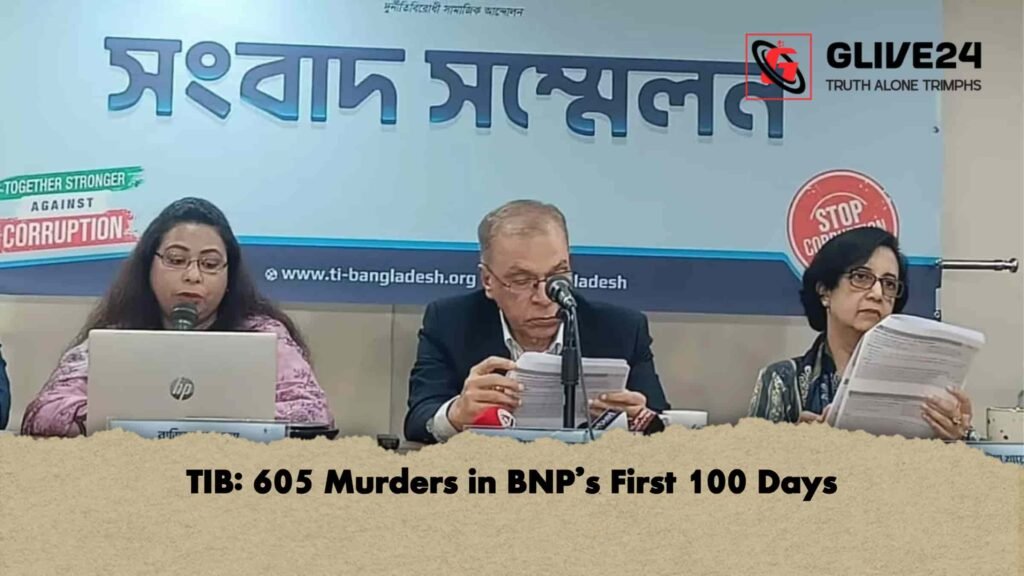
The newly formed Bangladesh Nationalist Party (BNP) administration has overseen an alarming rise in serious offences—including homicide, extortion, armed robbery, and kidnapping—during its initial 100 days in office. These findings were compiled and published in a monitoring report by Transparency International Bangladesh (TIB), an independent anti-corruption watchdog.
The comprehensive research project, entitled “The First 100 Days of the Government Following the 13th National Parliamentary Election: Delivering on Commitments to Good Governance and Anti-Corruption”, analysed public security, governance, and institutional integrity under the new legislative tenure. According to data authenticated by the civil society body, at least 605 murders and 196 abductions were verified across the country during this post-electoral transitional phase.
Internal Security Concerns and Administrative Review
The evaluation was formally released during a media briefing at the central office of Transparency International Bangladesh, situated in Dhanmondi, Dhaka. The statistical indicators focused heavily on a noticeable decline in public safety during the months of March and April, which aligned with the initial months of the executive administration.
Dr Iftekharuzzaman, the Executive Director of TIB, addressed the assembled journalists to clarify that the domestic security environment across the state had entered a highly unstable period. He maintained that the uninterrupted frequency of severe violations directly obstructed systemic state-reform promises.
“The law and order situation during the first 100 days of the current government was considerably fragile,” Dr Iftekharuzzaman observed. “Incidents of murder, robbery, theft, mugging, rape, and violence against women and children, alongside looting and general lawlessness, have continued unabated.”
Detailed Indicators of Domestic and Human Rights Violations
Beyond lethal crimes, the research data gathered by TIB underscored an expanding wave of human rights breaches and widespread public vulnerability. Statutory law enforcement frameworks encountered direct structural friction, illustrated by 129 documented instances of violent attacks targeting deployed police officers.
Furthermore, domestic statistics revealed a steep rise in gender-based violence and crimes directed at vulnerable minors. Aggregated instances of violence against women and children stood at 3,496 specific cases for the period under review. The analytical tables inside the report noted that between 78 and 102 adults suffered sexual assault, whilst recorded instances of gang rape fluctuated between 30 and 36 occurrences. Over the exact same timeframe, the data verified that between 49 and 71 children were victims of sexual violence.
TIB noted that despite early rhetorical assertions of political intent from the executive cabinet to enhance national governance, the lack of a cohesive, structured administrative operational map has enabled a partisan “retribution” culture to take root locally. This political environment has failed to suppress the spread of extrajudicial mob justice, unlawful land seizures, and organised financial extortion networks across domestic local authorities.
Data Appendix: Overview of Verified Offences
The specific data points from the TIB statistical appendix, titled “Overview of Crime and Human Rights Violations”, document the following occurrences during the two-month period:
| Documented Offence / Violation | Total Recorded Cases (March–April) |
| Homicide and Murder | 605 incidents |
| Abduction and Kidnapping | 196 incidents |
| Theft and Larceny | 2,214 incidents |
| Mugging and Street Hijacking | 294 incidents |
| Armed Robbery | 90 incidents |
| Physical Assaults on Police Personnel | 129 incidents |
| Violence Against Women and Children | 3,496 cases |
| Rape Cases (Adults) | 78 to 102 victims |
| Gang Rape Cases | 30 to 36 victims |
| Rape Cases (Minors and Children) | 49 to 71 victims |