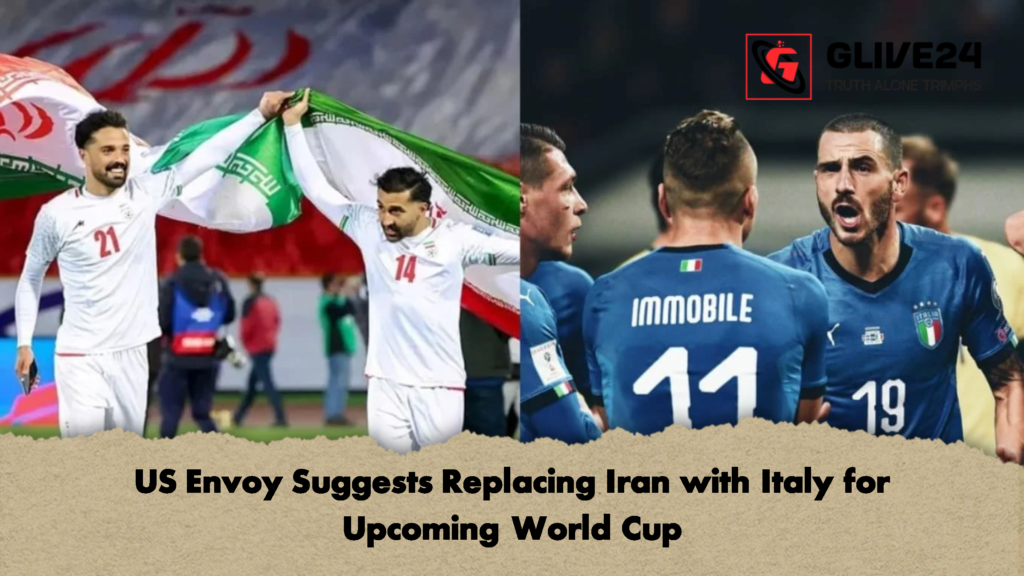
A senior diplomatic official within the administration of United States President Donald Trump has proposed a controversial restructuring of the upcoming FIFA World Cup line-up. Paolo Zampolli, the President’s Special Envoy for Global Partnerships, has suggested that Italy should be granted a place in the tournament in stead of Iran. The remarks were made during a comprehensive interview with the Financial Times, sparking significant debate across the sporting and diplomatic communities.
Zampolli, an Italian-American diplomat, posited that the presence of the “Azzurri” would be of immense benefit to the tournament. Highlighting Italy’s prestigious history as four-time world champions, he asserted that seeing the team compete in a World Cup hosted by the United States would be a “dream” for the organisers and the global footballing public.
Geopolitical Friction and Diplomatic Reparations
The timing of Zampolli’s proposal is inextricably linked to a volatile geopolitical climate. Observers have noted that the suggestion appears designed to serve as a diplomatic olive branch to Rome. Relations between the Trump administration and the Italian government, led by Prime Minister Giorgia Meloni, have been strained recently following the President’s vocal criticisms of Pope Leo regarding the administration’s stance on the Iranian crisis.
Furthermore, the relationship between the United States and Iran has reached a nadir following recent American military actions. In response to these hostilities, the Iranian Football Federation has formally petitioned FIFA on multiple occasions to relocate their scheduled matches from United States territory to Mexico. Iran has accompanied these requests with a formal ultimatum: should the venues remain unchanged, the nation intends to boycott the tournament entirely.
Principled Rejection from Italian Authorities
Despite the potential for a “wildcard” entry, the Italian government and its sporting bodies have reacted to Zampolli’s suggestion with firm disapproval. The Italian stance remains anchored in the principle of sporting merit, particularly after the national team suffered the ignominy of failing to qualify on the pitch in March 2026—marking their third consecutive absence from the world stage.
Prominent members of the Italian cabinet have been swift to distance themselves from the proposal:
-
Andrea Abodi, the Italian Minister for Sport, categorised the idea as “impossible and inappropriate,” reinforcing the sentiment that qualification must be earned through competition.
-
Giancarlo Giorgetti, the Minister of Economy and Finance, expressed even stronger condemnation, labelling the concept as “shameful” and an affront to the integrity of the sport.
FIFA’s Commitment to the Status Quo
While Washington explores unconventional diplomatic avenues, FIFA has remained steadfast in its adherence to established protocols. Gianni Infantino, the President of FIFA, recently visited the Iranian national team during their training camp in Turkey. During this visit, he confirmed that all matches are scheduled to proceed as planned, effectively rebuffing any notion of a forced substitution of teams.
Infantino’s presence at the Iranian camp was interpreted as a significant gesture of institutional neutrality, signalling that the governing body intends to keep the tournament insulated from host-nation political pressures. FIFA’s statutes strictly prohibit government interference in the management of footballing affairs; as such, a host nation’s envoy possesses no formal authority to dictate the participation or exclusion of a qualified sovereign state.
Institutional Silence and Regulatory Reality
As of late April 2026, neither the White House nor the Italian Football Federation (FIGC) has issued an official communique regarding Paolo Zampolli’s personal suggestion. Without an official policy shift or a catastrophic withdrawal by the Iranian federation, the regulatory framework of the tournament remains unchanged.
The 2026 World Cup, co-hosted by the United States, Canada, and Mexico, continues to prepare for the inclusion of all teams that successfully navigated the continental qualifying cycles. For Italy, despite the high-level diplomatic lobbying from Zampolli, the prospect of participating in the 2026 tournament remains non-existent, leaving the “Azzurri” to wait for the 2030 cycle.