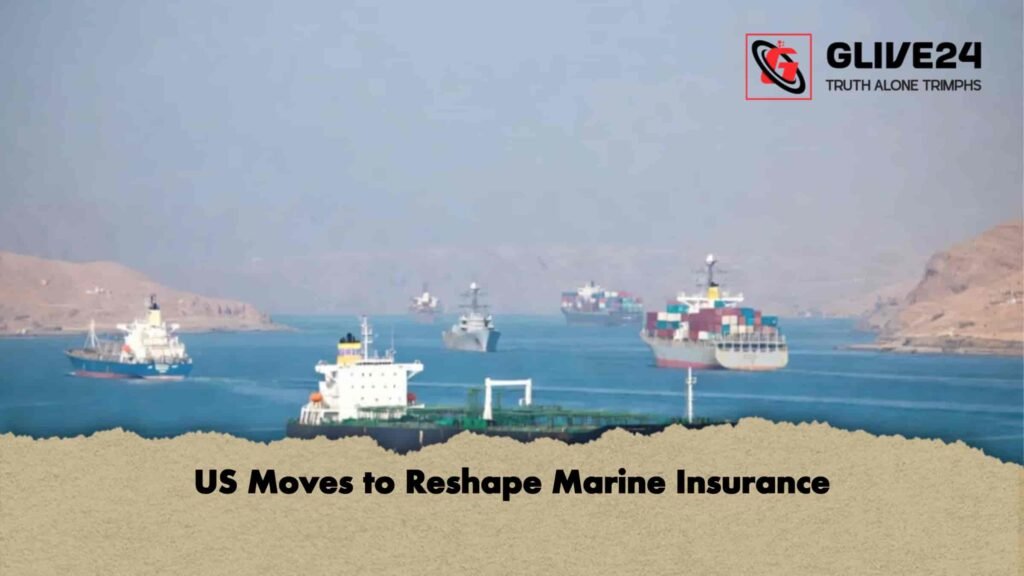
The United States has launched an initiative aimed at reshaping the global marine and war-risk insurance market, directly challenging the long-standing dominance of the United Kingdom, particularly the London-based insurance sector, in underwriting high-risk maritime trade.
In March 2026, the US administration directed the United States International Development Finance Corporation to establish a government-backed reinsurance facility valued at 20 billion US dollars. The proposed mechanism is intended to provide coverage across several categories, including hull insurance, cargo protection, and political risk cover, with a particular focus on vessels operating in strategically sensitive waters such as the Strait of Hormuz and the wider Persian Gulf region.
The policy framework sets out an objective of offering insurance at lower premium levels compared with prevailing market rates. In addition to financial coverage, the initiative also includes consideration of operational support measures, including the potential deployment of United States Navy escort arrangements for commercial shipping transiting high-risk maritime corridors.
The development represents a direct challenge to the established position of the Lloyd’s of London, which has maintained a central role in global marine and war-risk insurance for more than three centuries. The market has recently faced criticism from industry participants, who have pointed to rising premium costs and tighter underwriting conditions, particularly in response to heightened security risks affecting commercial shipping routes.
As part of the proposed structure, the United States is also exploring collaboration with private insurance providers, including Chubb Limited, to support underwriting capacity and expand distribution channels within a blended public–private insurance framework.
The stated policy aims include reinforcing confidence in international maritime trade, maintaining stability in critical energy transport routes, and redirecting portions of global insurance flows towards US-supported financial institutions.
Lloyd’s of London has indicated that it regards the initiative as a constructive development and has expressed willingness to cooperate with new market entrants. At the same time, it has maintained that its role in global marine and war-risk insurance remains firmly established, supported by its underwriting network and international market infrastructure.
Industry analysts have noted that, should the US facility achieve large-scale operational capacity, there may be a redistribution of certain insurance contracts away from London-based markets. However, they also emphasise that Lloyd’s is expected to retain a substantial position within the sector due to its longstanding experience, extensive global reach, and established risk assessment capabilities.
At the same time, questions remain regarding the implementation framework, capacity deployment, and operational scope of the proposed US facility, which analysts identify as key factors influencing its long-term market impact.
Structure of the Proposed Facility
| Element | Description |
|---|---|
| Lead institution | United States International Development Finance Corporation |
| Total size | 20 billion US dollars |
| Mechanism | Government-backed reinsurance facility |
| Insurance coverage | Hull, cargo, and political risk protection |
| Geographic focus | Strait of Hormuz and Persian Gulf region |
| Private partners under consideration | Including Chubb Limited |
| Additional measure under review | Possible US Navy escort for commercial vessels |
| Core objectives | Lower premiums and enhanced maritime trade stability |
The initiative marks a significant development in the interaction between state-backed financial instruments and global maritime insurance markets, with potential implications for established insurance centres such as London.