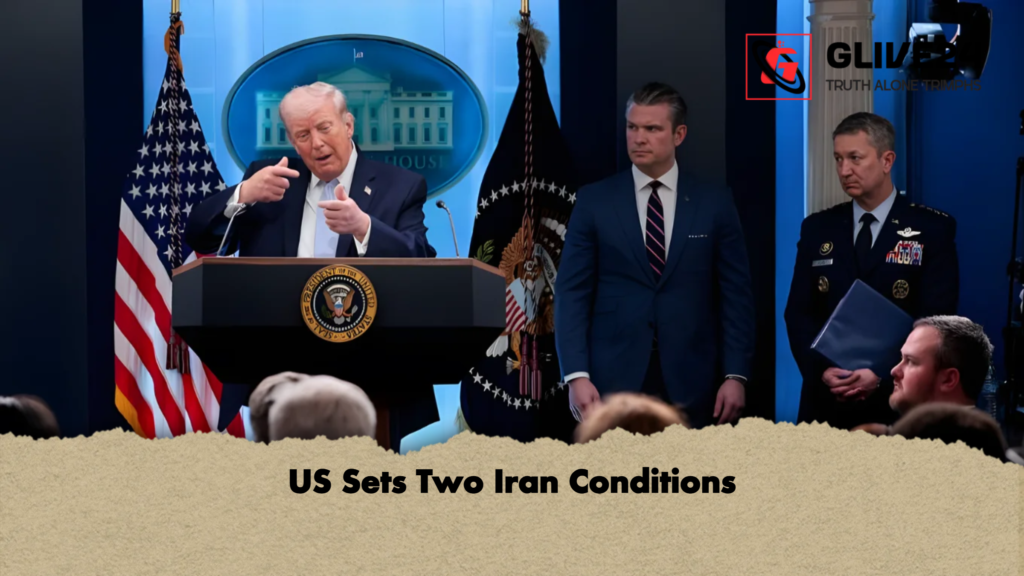
Following the failure of talks in Islamabad, the possibility has re-emerged of renewed negotiations between the United States and Iran. However, before any new round of discussions can begin, Washington has reportedly set out two conditions for Tehran.
US President Donald Trump stated that a fresh round of talks with Tehran could resume within two days. He further claimed that “appropriate and suitable individuals” have already made contact with Washington and have expressed interest in reaching an agreement. These remarks were presented as an indication that diplomatic engagement may restart in the near term, following the breakdown of the previous meeting in Islamabad.
Despite this, the United States has attached specific preconditions to the resumption of negotiations. The first condition concerns the Strait of Hormuz, a strategically significant maritime passage. According to diplomatic sources cited by several Israeli media outlets, Washington insists that the Strait must remain fully and uninterruptedly open for international navigation. The United States has also maintained a position based on reciprocity, meaning that if Iran obstructs the passage of ships and oil tankers through the Strait, then the movement of Iranian vessels and tankers may likewise be restricted or halted.
The second condition relates to the composition and authority of the Iranian negotiating delegation. Washington has reportedly insisted that any Iranian delegation involved in talks must have full approval from the Islamic Revolutionary Guard Corps (IRGC), ensuring that any agreement reached can be formally concluded. In addition, the United States seeks confirmation that any potential agreement reached in Islamabad or elsewhere would carry the consent of all senior Iranian officials, thereby ensuring full internal authorisation on the Iranian side.
Iran has not yet issued any formal response to these reported conditions. Furthermore, Tehran has rejected claims that negotiations are about to restart. Iranian officials have repeatedly stated that they do not trust the United States in the context of diplomatic negotiations, maintaining a consistently cautious stance regarding renewed engagement.
The broader context of the current tensions includes earlier military developments linked to Iran’s nuclear programme and missile activities. According to the information provided, a joint military operation conducted by the United States and Israel began on 28 February. This period of confrontation lasted for 40 days. Following this, a ceasefire was implemented between the United States and Iran starting on 7 April, lasting for 14 days.
The reported conditions and responses reflect ongoing differences between the two sides regarding both strategic maritime access and the structure of diplomatic engagement. At present, no confirmation has been issued that formal negotiations will resume.
Reported US Conditions for Talks
| No. | Condition | Details |
|---|---|---|
| 1 | Strait of Hormuz access | The Strait must remain fully open and free for navigation; reciprocity principle applies, meaning restrictions on Iranian vessels may follow any obstruction |
| 2 | Delegation approval and authority | Iranian negotiating team must have full approval from the Islamic Revolutionary Guard Corps (IRGC) and ensure all senior Iranian officials consent to any agreement |