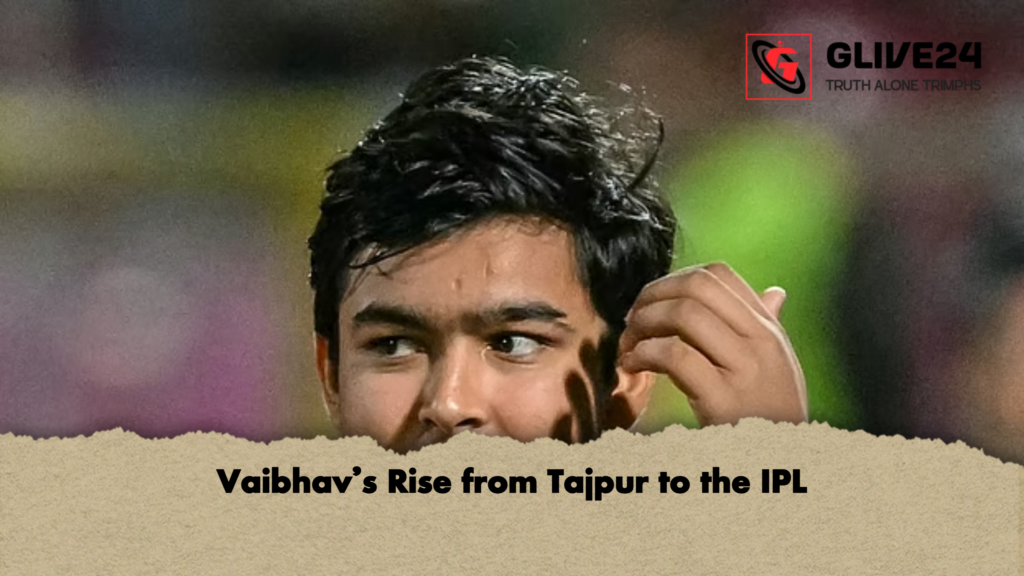
That was the instruction delivered by Zubin Bharucha to the management of Rajasthan Royals during a cloudy afternoon in November 2024, as preparations intensified for the Indian Premier League mega auction in Saudi Arabia. The proposal immediately raised eyebrows. Bharucha was not requesting the budget for an established international star or even a proven domestic performer, but for a 13-year-old boy from an obscure village in Bihar with limited cricketing infrastructure.
The management’s initial reaction was unsurprising: they questioned whether the recommendation was serious.
Bharucha’s confidence, however, came from a first-hand assessment. During a trial session at the Royals Academy in Talegaon, Maharashtra, he observed a left-arm fast bowler from Karnataka bowling at considerable pace. Standing at the crease was the young batter from Bihar. By conventional expectation, the angle and late movement should have troubled him significantly.
Instead, the teenager dispatched the delivery over extra cover for six.
Bharucha later recalled being unable to believe what he had just witnessed. The moment reminded him of his first impressions of Yashasvi Jaiswal, who had struck a boundary off his opening ball during a trial at DY Patil Stadium, and Sanju Samson, who had pulled a bouncer onto the indoor stadium roof during a training session in Jaipur.
According to Bharucha, some players distinguish themselves immediately, often from their very first ball.
After the group trial, all participants were dismissed except the Bihar youngster, identified as Vaibhav Suryavanshi. He was then subjected to further testing against specialist sidearm throwers capable of replicating deliveries at 157–158 km/h. A 6 ft 4 in bowler was also instructed to attack him with pace.
Bharucha warned him that the ball would arrive much quicker. Vaibhav reportedly smiled and replied, “Yes sir, no problem.”
After initially leaving several deliveries with composure, he then struck a short ball travelling at 157 km/h straight over the sightscreen. Bharucha described the shot as highly unusual, particularly given that it came within only his fourth or fifth ball against that level of pace.
He subsequently informed the franchise management: “He is Jaiswal multiplied by two.”
The Royals eventually secured Vaibhav in the auction for ₹1.1 crore, significantly below the ₹10 crore budget Bharucha had initially advised.
Early IPL impact
Vaibhav made an immediate impression in the 2025 IPL season. He hit a six off the first ball he faced and later scored a century against Gujarat Titans at the age of 14 years and 32 days. His 35-ball hundred became the second-fastest century in IPL history after Chris Gayle.
| Category | Details |
|---|---|
| Full name | Vaibhav Suryavanshi |
| Home town | Tajpur, Samastipur, Bihar |
| IPL franchise | Rajasthan Royals |
| Auction price | ₹1.1 crore |
| Age at IPL century | 14 years, 32 days |
| Century balls faced | 35 |
Background and development
To understand Vaibhav’s rise, attention must turn to Tajpur in Bihar. The region is largely agriculture-based, and opportunities in organised cricket have historically been limited.
His father, Sanjiv Suryavanshi, had once aspired to become a cricketer himself, but Bihar cricket lacked recognition from the Board of Control for Cricket in India during his playing years. He later worked various jobs in Mumbai, including as a nightclub bouncer and in a shipping yard, before returning to manage the family jewellery business.
On Vaibhav’s fourth birthday, Sanjiv gifted him a Kashmiri willow bat.
By 2018, after recognising his son’s growing ability, Sanjiv began driving him every alternate day to the Gen Next Academy in Patna, covering approximately 200 kilometres for each round trip. The routine involved early morning departures and extensive practice sessions.
Coach Manish Kumar Ojha stated that Vaibhav regularly faced at least 600 balls a day and rarely showed signs of fatigue.
Before joining that academy, Vaibhav had spent three years training under coach Brajesh Jha in Samastipur. Even at nine years old, local coaches reportedly observed maturity in his batting beyond his age group.
Record-setting performances
Vaibhav models aspects of his batting on Brian Lara, despite having never watched him live. He reportedly studied Lara’s batting videos online to refine his backlift.
Ahead of the Under-19 World Cup final against England, he told Bharucha that he did not feel satisfied unless he scored at least one century regularly. In the final, he made 175 runs from 80 balls, including 15 sixes, setting multiple youth one-day records. Across the tournament, he accumulated 444 runs at a strike rate of 162.
Vaibhav had already made his Ranji Trophy debut at 12 years and 284 days, later becoming Bihar’s vice-captain.
His emergence has also transformed cricket culture in his hometown. Coaches in Samastipur report that more than 60 children aged between four and seven now attend daily training sessions, inspired by his achievements.
From a quiet village in Bihar to the IPL spotlight, Vaibhav Suryavanshi’s progress has been rapid, measurable, and increasingly influential within Indian cricket.