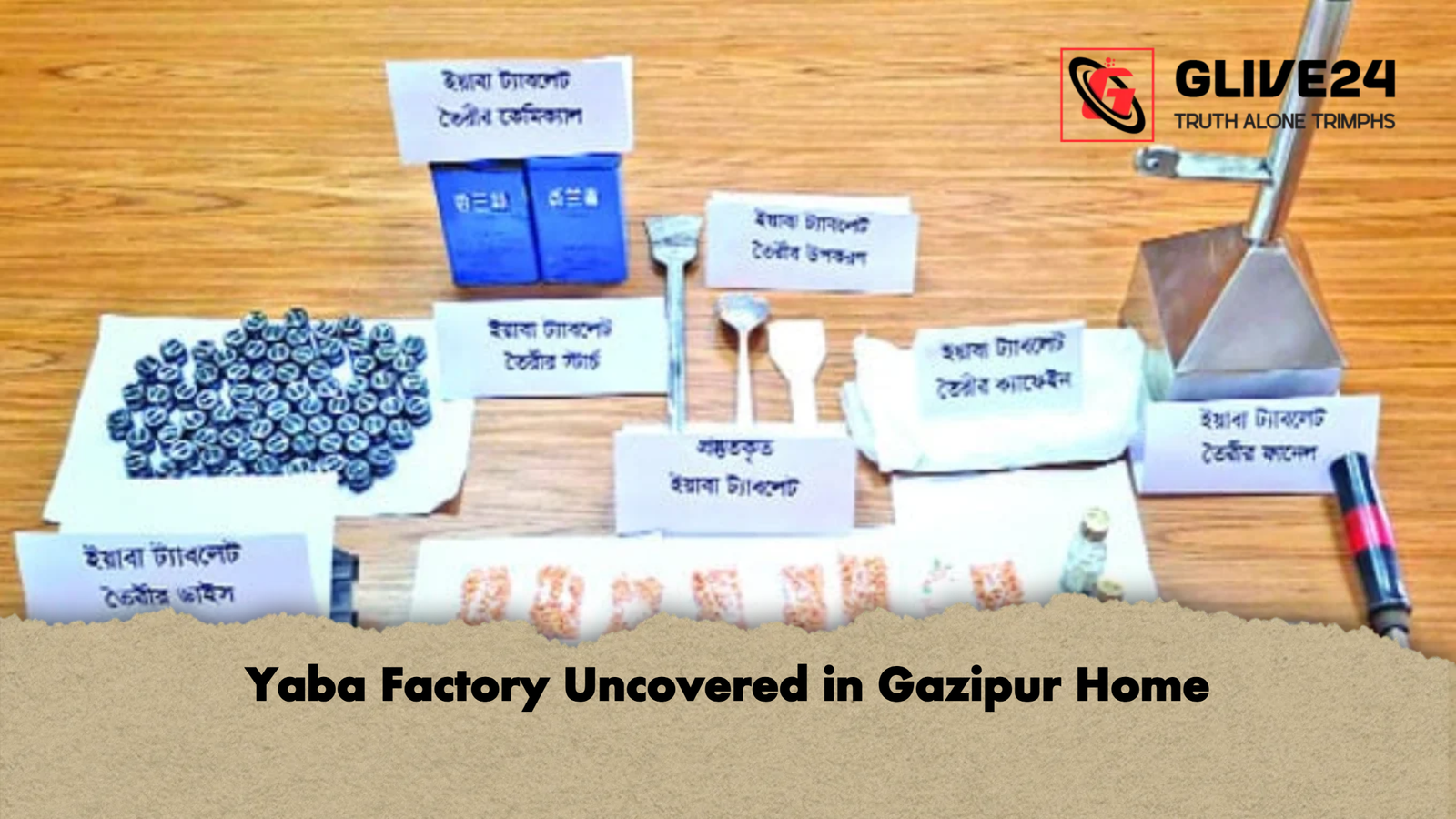
A clandestine yaba manufacturing facility operating from within a residential house has been uncovered in Gazipur, highlighting a troubling evolution in illicit drug production methods in Bangladesh. The operation was dismantled by the Department of Narcotics Control (DNC), which seized approximately 4,500 yaba tablets along with a substantial quantity of raw materials and manufacturing equipment.
During the raid, law enforcement officials arrested 32-year-old Touhidul Islam, a resident of Borobari Kazibari Purbo Para under Gazipur Chowrasta Police Station. Authorities have filed a case under the Narcotics Control Act 2018 at Tongi Police Station, with Sub-Inspector Md Abu Naser acting as the complainant.
According to DNC officials, the operation was conducted between the night of 19 February and the early hours of 20 February, following specific intelligence reports. Deputy Director Mehedi Hasan of the DNC’s Dhaka Divisional Intelligence Office described the seizure as “startling,” noting that what appeared to be an ordinary residence had, in fact, been converted into a fully functional small-scale laboratory for drug production.
“Upon entering the premises, we discovered an organised setup complete with tablet moulds, chemical mixing tools, and packaging equipment,” he said. Initially, officers recovered 100 yaba tablets from two zippered polythene packets. A further search revealed an additional 4,400 tablets stored across 22 separate packets, bringing the total seizure to 4,500 tablets weighing approximately 489 grams.
Investigators reported that the seized yaba—commonly a combination of methamphetamine and caffeine—was being produced using both imported and locally sourced ingredients. A portion of the chemical precursors was reportedly smuggled in from Myanmar, while the rest were procured from domestic markets.
Preliminary interrogation of the suspect revealed a production method that maximised output even under constrained supply conditions. When raw materials ran low, Touhidul allegedly recycled approximately 500 yaba tablets into powdered form, which could then be reprocessed into as many as 5,000 new tablets. Authorities estimate that the seized materials alone could have produced at least 20,000 tablets if the operation had continued uninterrupted.
The following table summarises the seized items:
| Category | Details |
|---|---|
| Yaba tablets recovered | 4,500 (approx. 489 grams) |
| Additional production capacity | Approximately 20,000 tablets (estimated) |
| Raw materials | Large quantity of chemical substances |
| Equipment | Tablet moulds, mixers |
| Packaging tools | Polypackets, sealing materials |
| Digital weighing scale | 1 unit |
| Mobile phones | Multiple devices |
| Cash | Unspecified amount |
Officials have indicated that efforts are ongoing to identify and apprehend other individuals linked to the operation, suggesting the possibility of a wider distribution network.
Experts warn that the emergence of such small-scale, home-based drug production centres represents a new challenge for law enforcement agencies. Unlike large trafficking networks, these decentralised setups are harder to detect and can rapidly proliferate within densely populated urban areas.
The DNC has reiterated its commitment to intensifying intelligence-led operations and urged the public to remain vigilant, as the fight against narcotics continues to pose a significant law enforcement and public health challenge across the country.