
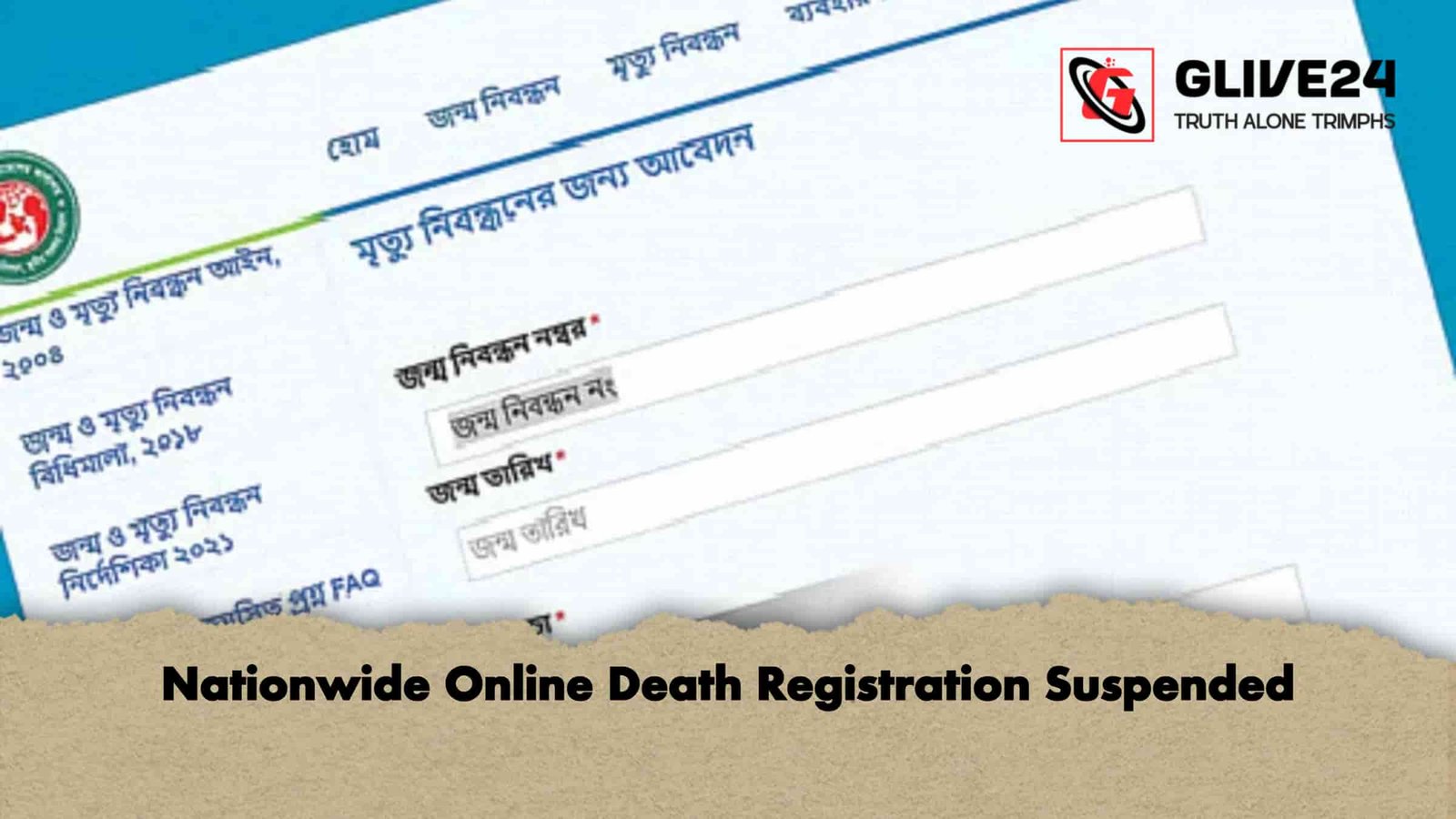
Online applications for death registration have been temporarily suspended across the country since 21 November, following concerns over data security within the registration system operated under the Local Government Division. The suspension has now entered its third month, disrupting three core services: submission of new online applications, printing of application forms, and reprinting of certificates.
Although the official portal remains accessible, its principal functions have been rendered inactive. As a result, citizens are compelled to attend relevant offices in person to complete procedures that were previously handled digitally. For many families already coping with bereavement, this has introduced additional administrative and financial strain.
Table of Contents
Growing Public Hardship
The disruption has been particularly burdensome for those residing away from their place of permanent address. One such case involves Shiuli Akter, originally from Rajshahi but currently employed in Dhaka. Following her mother’s death, she was required to travel back to Rajshahi with supporting documents to complete the registration process. Previously, applicants could submit documents online and collect certificates from designated offices with relative ease. That facility is now entirely unavailable.
Citizens living far from their hometowns are facing increased travel expenses, time loss, and procedural complications. In rural areas, applications must be submitted at Union Parishad offices, where administrative officers or secretaries act as assistant registrars, with final approval granted by the chairman. In city corporation areas, regional offices oversee the process.
Security Concerns Behind the Suspension
According to responsible sources, intelligence reports raised concerns over the potential misuse and illicit sale of sensitive personal information contained within death registration records. Particular vulnerabilities were identified in cases where deceased individuals had no prior birth registration. In such instances, a birth record must first be created before issuing a death certificate, adding an additional layer where unauthorised data access could occur.
As a precautionary measure, the online death registration portal was suspended pending security enhancements. However, online birth registration services remain operational.
Fee Structure for Registration and Correction
The official fee schedule remains unchanged and is outlined below:
| Timeframe for Registration | Fee |
|---|---|
| Within 45 days of death | Free of charge |
| Between 45 days and 5 years | 25 Taka |
| After 5 years | 50 Taka |
| Information correction | 100 Taka |
Administrative Importance and Recent Data
A death registration certificate is indispensable for determining inheritance, distributing property, processing pensions and allowances, and executing land transfers. The current suspension has therefore heightened pressure on grieving families seeking to complete essential legal formalities.
The Office of the Registrar General has announced preparations to introduce stronger identity verification measures, including a one-time passcode system linked to the applicant’s mobile number. Officials believe this step will significantly reduce the risk of unauthorised access.
Recent figures indicate that on 29 January alone, 4,210 death registrations were completed nationwide through in-person procedures, including 36 applications for data correction. Authorities have expressed optimism that, once security upgrades are finalised, online applications will be reinstated promptly, easing public inconvenience and restoring digital access to this critical civic service.