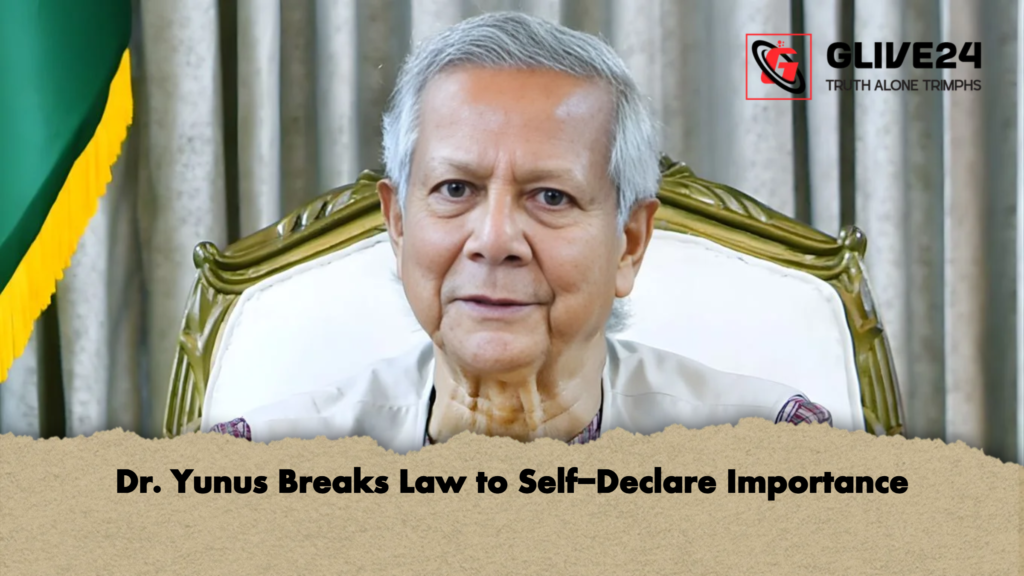
Former interim government chief adviser, Professor Dr. Muhammad Yunus, controversially declared himself a “Highly Important Person” (HIP) for a full year following the handover of his official duties. This designation ensures that even after leaving office, Dr. Yunus continues to enjoy heightened protection under the Special Security Force (SSF).
The confidential notification, signed by Md. Saifulla Panna, then Secretary of the Chief Adviser’s Office (now attached to the Ministry of Public Administration), was issued on 10 February but has only recently come to public attention.
According to the notification, under the authority granted by the Special Security Force Act, Dr. Yunus was formally declared an HIP for one year following his departure. Legal experts have condemned this act, arguing that Dr. Yunus exploited his position to bypass legal norms and pursue personal advantage.
Historically, the 29 October 2006 decree (SRO No. 285) allowed the President, Prime Minister, and the Chief Adviser of a caretaker government, as well as the opposition leader in Parliament, to be designated as HIPs for a maximum of three months within Bangladesh. The decree did not grant discretionary power to extend this period for individual benefit.
| Detail | Information |
|---|---|
| Individual Involved | Professor Dr. Muhammad Yunus |
| Position | Chief Adviser, Interim Government |
| Notification Issued | 10 February 2026 |
| Authority | Special Security Force Act |
| Self-Declared Period | 1 year |
| Historical Legal Limit | 3 months (SRO 285, 2006) |
| Office Issuing Notification | Chief Adviser’s Office (Secretary: Md. Saifulla Panna) |
Critics note that while the decree’s original intent was to provide temporary security for top officials, Dr. Yunus’s unilateral extension represents both a constitutional violation and an ethical lapse. Had he applied the extended period to all eligible officials, some rationale might have existed, but declaring himself the sole beneficiary for a full year highlights clear self-interest.
Dr. Yunus’s tenure in the 18-month interim government was also marked by several instances of personal gain. Reports indicate that he leveraged his position to withdraw corruption charges against himself, secure debt waivers for his institutions, and obtain university and recruitment agency licenses under his name. Even as he prepared to step down, Dr. Yunus continued to claim state-provided privileges for himself.
Legal and constitutional experts now warn that such actions could set a dangerous precedent, undermining public trust in interim governance structures and exposing loopholes that allow officials to manipulate security protocols for personal advantage.