
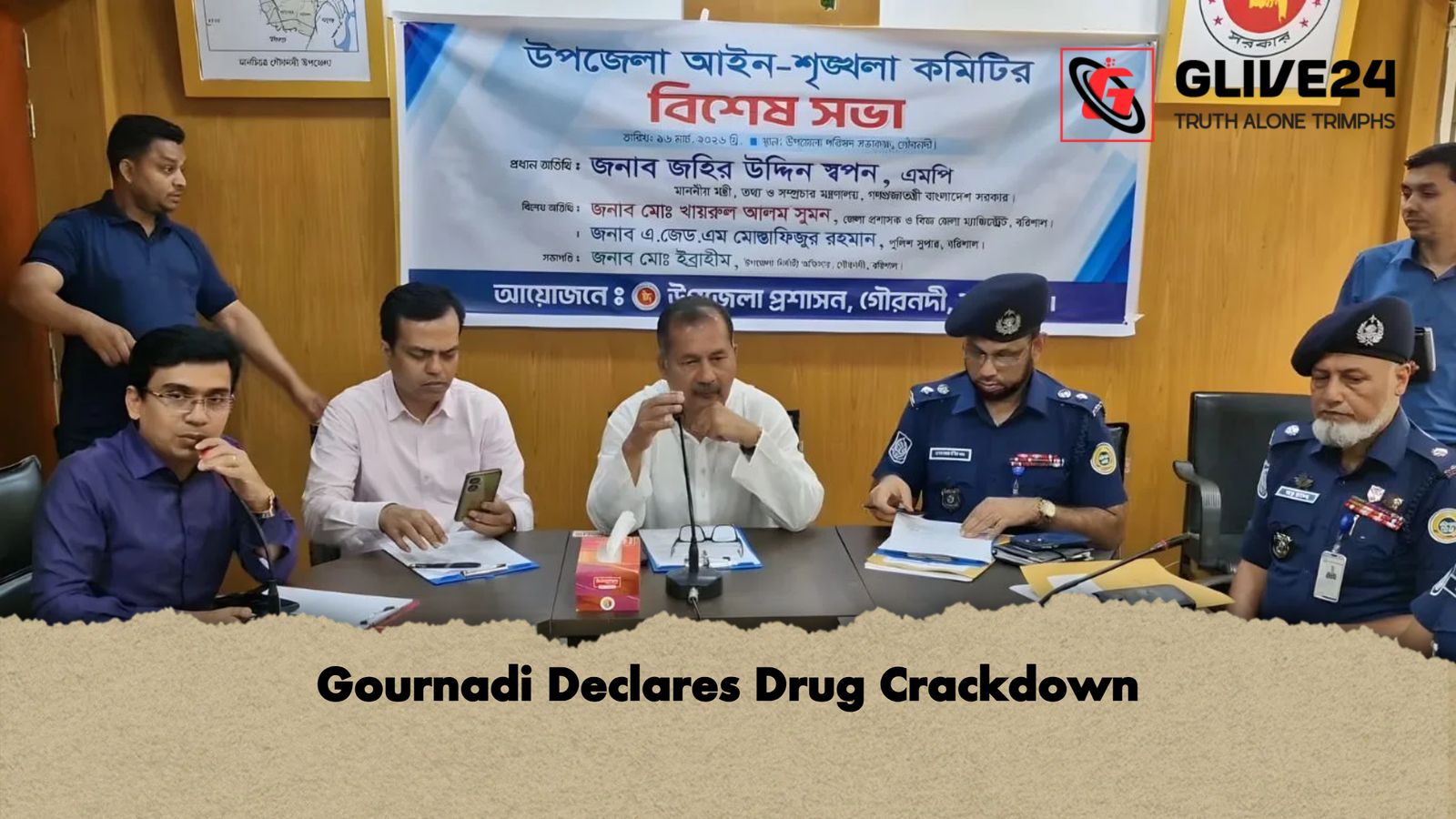
Information and Broadcasting Minister Zahir Uddin Swapan MP has announced a policy of zero tolerance towards drugs in Gournadi upazila of Barishal, declaring that no-one involved in narcotics, terrorism or other dishonest activities would be spared, regardless of political identity or influence. The statement came on Monday, 16 March, during a special meeting of the upazila law and order committee, where the minister signalled a tougher administrative stance aimed at protecting young people from the growing social and personal harm caused by drug abuse.
Addressing the gathering as chief guest, the minister said that any individual found to be connected with the drug trade or other criminal misconduct must be brought within the reach of the law, even if that person is a political leader or activist. His remarks were widely viewed as a warning against impunity and an attempt to reinforce public confidence in law enforcement at a time when concerns about narcotics and youth vulnerability remain high across many parts of the country.
The minister also turned attention to the approaching Eid travel period, stressing that passenger movement must remain safe, orderly and convenient. He instructed the officers in charge of both Gournadi Model Police Station and the Highway Police Station to maintain close vigilance so that holiday travellers do not face avoidable disruption, congestion or security risks. The dual emphasis on anti-drug enforcement and transport safety suggested that the administration is seeking a broader improvement in public order rather than limiting the discussion to one issue alone.
The meeting was chaired by Upazila Nirbahi Officer Md Ibrahim. Among the special guests were Deputy Commissioner Khairul Alam Sumon and Superintendent of Police A.Z.M. Mostafizur Rahman. Others in attendance included Additional Superintendent of Police for the Gournadi Circle Abu Saleh Md Ansar Uddin, Upazila Livestock Officer Palash Sarkar, Upazila Health and Family Planning Officer Dr Fakhrul Islam Mridha, Officer-in-Charge (Investigation) of Model Police Station Md Mahbubur Rahman, Highway Police Officer-in-Charge Md Shamim Sheikh, and several local political, civic and media representatives.
The participation of officials from administration, policing, health, livestock services, politics and journalism underscored the cross-sector nature of the challenge. Drug abuse is not merely a policing issue; it also affects public health, family stability, education, local commerce and long-term community safety. For that reason, the significance of the meeting lies not only in the strong language used by the minister, but also in the signal that coordination between agencies will be expected in the coming weeks.
Local leaders and social figures have welcomed the announcement, particularly because of its focus on safeguarding the younger generation. In many communities, narcotics are seen as both a law and order concern and a social threat that erodes educational prospects, fuels petty crime and weakens family structures. Against that backdrop, the declaration in Gournadi is being interpreted as an effort to frame anti-drug action as a matter of public welfare and national priority, rather than a narrowly punitive campaign.
Key Decisions from the Meeting
| Subject | Decision | Responsible authority |
|---|---|---|
| Anti-drug policy | Zero tolerance; no exemptions for offenders | Ministry of Information and Broadcasting, local administration |
| Political involvement in crime | Any leader or activist implicated must face legal action | Police and local administration |
| Eid travel safety | Ensure smooth and secure movement of passengers | Gournadi Model Police Station and Highway Police |
| Monitoring and coordination | Strengthen oversight through administrative cooperation | Upazila law and order committee, UNO, Deputy Commissioner |
Taken together, the decisions adopted at the meeting point to a tougher and more coordinated local response. The minister’s message was clear: the campaign against drugs should not be selective, symbolic or politically convenient. Instead, it must be pursued as part of a wider commitment to a healthier, safer and more secure future for the people of Gournadi.


Comments