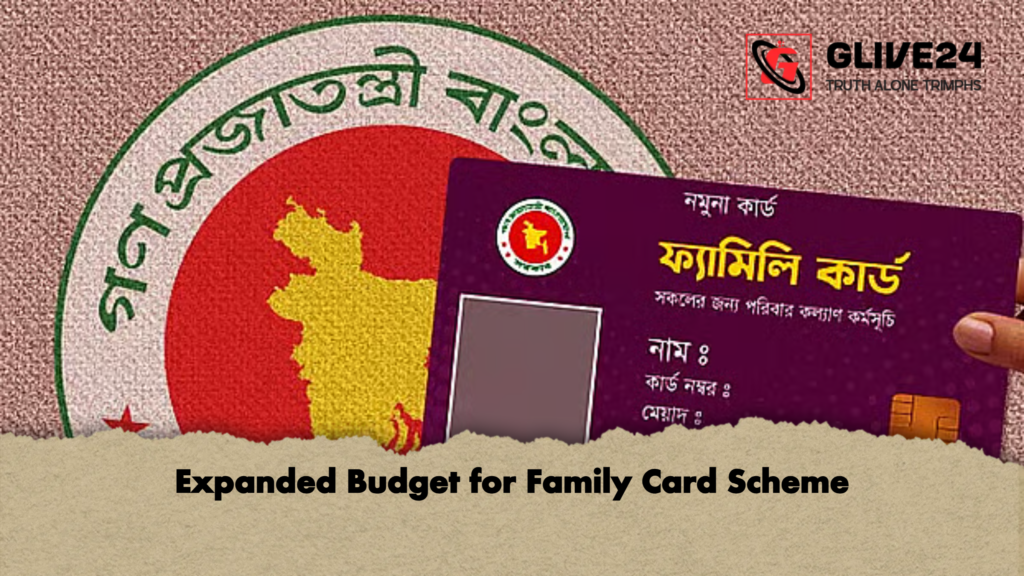
The Government’s proposed Family Card programme, designed to strengthen social protection for female-headed households, is projected to cost approximately Tk 1,33,616 crore over the next five years, according to official planning documents. The initiative, a key pledge in the ruling party’s election manifesto, will provide monthly cash assistance of Tk 2,500 to each eligible household, with gradual expansion in both coverage and budget allocation over time.
Officials from the Ministry of Finance and the Ministry of Social Welfare confirmed that the programme has already entered its pilot phase in the 2025–26 fiscal year. Around 37,000 households have so far received the card, while an additional 48,000 families are currently being brought under the scheme in phases. By June of the current fiscal year, total beneficiaries are expected to reach 86,000 households, requiring an allocation of Tk 86 crore.
The government plans to identify eligible recipients through a nationwide survey covering approximately 4.10 crore households. Authorities aim to collect data on at least one crore households annually to ensure proper targeting and reduce inclusion errors.
Five-Year Financial Projection
| Fiscal Year | Beneficiary Households | Allocation (Tk crore) |
|---|---|---|
| 2025–26 | Initial phase (86,000) | 86 |
| 2026–27 | 41 lakh | 13,740 |
| 2027–28 | 81 lakh | 26,730 |
| 2028–29 | 1.21 crore | 39,930 |
| 2029–30 | 1.61 crore | 53,130 |
| Total | — | 1,33,616 |
According to planning officials, the total expenditure will be divided into two major components: direct cash transfers and administrative or technological costs. Approximately 66 per cent of the budget will be allocated to direct financial assistance, while the remaining 34 per cent will be spent on data collection, digital infrastructure, and card management systems.
The Finance Adviser has described the programme as a cornerstone of the government’s social protection strategy, assuring that funding will be secured without disruption. However, he also acknowledged that the initiative remains at an early stage and will require continuous coordination across ministries to ensure smooth implementation.
The Ministry of Social Welfare has stated that beneficiary selection will be overseen with strict transparency mechanisms. A committee led by Upazila Nirbahi Officers (UNOs) will supervise local-level identification and verification. Emphasis is also being placed on training field officials, strengthening administrative capacity, and improving data accuracy.
Economists have welcomed the initiative as a potentially significant step towards targeted social welfare, but caution that its long-term sustainability will depend on increased revenue generation and improved efficiency in existing welfare programmes. They further emphasised that effective implementation, minimising duplication, and ensuring that only genuinely eligible households are included will be critical to achieving the programme’s intended impact.