
Khabor Wala Desk
Published: 19th May 2026, 1:03 AM
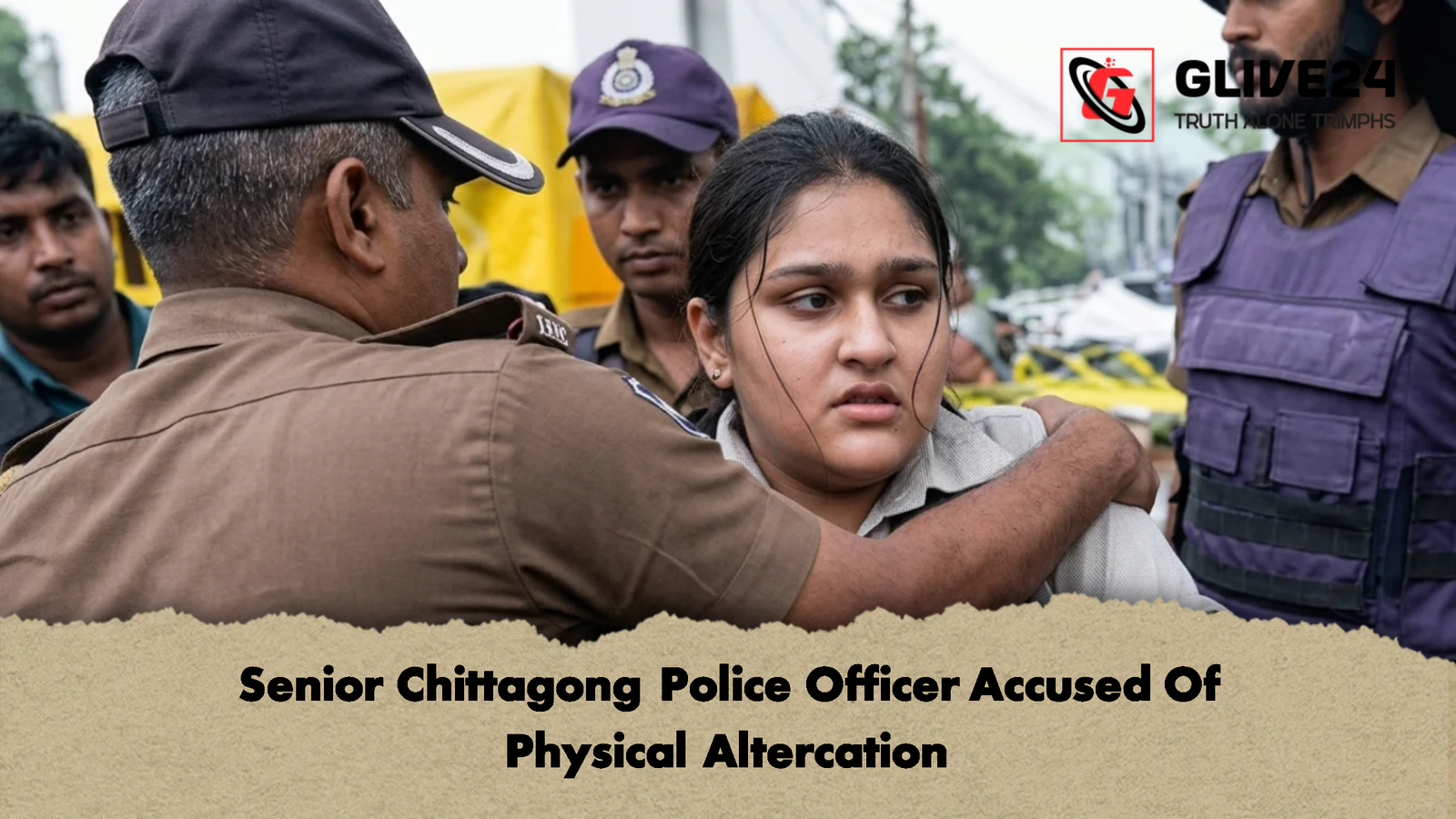
A senior officer of the Chittagong Metropolitan Police (CMP) has become the subject of fresh controversy following allegations of physical altercations during a political demonstration. Deputy Commissioner (DC) Amirul Islam, who oversees the Northern Zone of the CMP and already faced prior allegations regarding the mistreatment of media personnel, has been accused of physically handling a female political activist representing the National Citizen Party (NCP).
The incident occurred at approximately 1:45 pm on Monday, 18 May 2026, in the Tigerpass area of Chittagong. The confrontation arose regarding the painting of graffiti on the supporting pillars of the Shahid Wasim Akram Expressway. According to eyewitness accounts and political representatives, a physical scuffle ensued when police personnel intervened to stop the painting. During this altercation, DC Amirul Islam reportedly pushed and physically handled a female NCP activist, identified as Nusrat Akhter, in an attempt to clear the site. The incident has triggered widespread indignation amongst the leadership and general membership of the political organization.
The confrontation on Monday followed an earlier demonstration on Sunday evening, during which members of the Chittagong metropolitan branch of the NCP initiated a “July Graffiti Painting” programme at the same location. The activists asserted that mural artwork commemorating the July mass uprising was being systematically painted over and erased under explicit orders from the Chittagong City Corporation. The political group directed criticism towards the newly appointed City Mayor, Shahadat Hossain, who also previously served as the president of the city branch of the Bangladesh Nationalist Party (BNP).
In response to the growing tensions and to prevent further unapproved public gatherings, the CMP higher management issued a formal regulatory order on Monday morning. The police directive strictly prohibited all public meetings, rallies, and processions along the arterial road stretching from the GEC Intersection to Dewanhat, including its adjacent localities.
Despite the operational ban, a group of NCP activists gathered in the Tigerpass area during the afternoon to repaint the disputed murals. When field-level police officers moved to enforce the administrative ban and halt the drawing, a chaotic standoff developed between the law enforcement personnel and the political demonstrators, resulting in significant pushing and shoving from both sides.
When questioned by reporters regarding the specific allegations of physical misconduct against a female demonstrator, Deputy Commissioner Amirul Islam categorically denied the claims. The senior officer stated that his actions were strictly confined to tactical crowd control.
“I merely cordoned off the young women to manage the crowd. I did not physically touch or place my hands on anyone,” DC Islam stated.
Conversely, the Member Secretary of the Chittagong metropolitan unit of the NCP, Arif Moinuddin, presented a fundamentally contrasting narrative of the event. He maintained that the students and political activists who aligned themselves with the spirits of the July movement were merely exercising peaceful expression.
“The students went there to paint the graffiti, but the police unlawfully obstructed them. During the ensuing scuffle, DC Amirul Islam deliberately placed his hands on our activist, Nusrat Akhter, to physically remove her,” Moinuddin asserted.
This latest accusation has revived public scrutiny regarding the professional conduct of the Northern Zone Deputy Commissioner. On 12 October 2025, DC Amirul Islam was implicated in a widely publicised assault involving media professionals within the jurisdiction of the Khulshi Police Station in Chittagong. During that incident, he was accused of physically assaulting a reporter from Jamuna Television, Jobaid Ibn Shahadat, alongside camera operator Asaduzzaman Limon.
Digital video footage detailing the physical assault on the journalists was extensively circulated across social media platforms, eliciting severe condemnation from nationwide journalistic unions and civil rights groups. Following the public outcry, the then-CMP Commissioner formalised an executive inquiry committee to probe the operational high-handedness. The investigation was officially assigned to the then-Additional Commissioner of the CMP, Mohammad Humayun Kabir. However, despite the lapse of several months, the formal findings of that institutional probe have yet to be made public or released to the community.
Comments