Amidst heightening geopolitical tensions, a series of mass weddings was organised across Iran on Monday, 18 May. These events carried a distinct nationalist theme, with hundreds of brides and grooms demonstrating their willingness to sacrifice their lives for the nation in the event of a military conflict involving the United States or Israel.
The ‘Janfada’ Initiative and Strategic Motives
The state-sponsored mass weddings were arranged by the Iranian government on Monday night. This initiative was launched in response to recent threats made by US President Donald Trump, with the primary objective of bolstering morale among the nation’s youth.
The special government programme has been officially named ‘Janfada’, a term which translates to ‘self-sacrifice’. Participants of this scheme pledge their readiness to defend Iranian interests and lay down their lives under any circumstances. For instance, should the United States or Israel target Iran’s power stations or critical strategic installations, these young individuals have committed to positioning themselves outside the facilities to act as human shields.
According to claims made by the Iranian government, millions of citizens have already registered for this nationalist programme. High-profile figures among the registrants reportedly include the Iranian President, Masoud Pezeshkian, and the Speaker of the Parliament, Mohammad Bagher Ghalibaf. Following the onset of the current wartime conditions, the Iranian authorities have been organising large-scale pro-government rallies on a near-daily basis to consolidate public backing for the administration and to maintain national unity.
Ceremonies Across Tehran
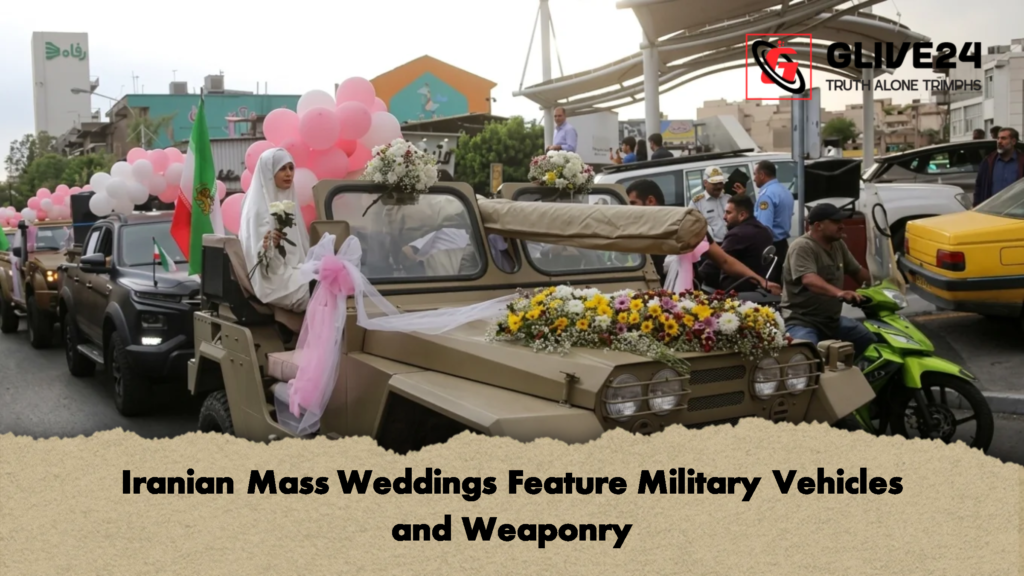
The mass weddings took place simultaneously in various districts of the capital city, Tehran. Hundreds of couples participated in the collective ceremonies, with more than one hundred men and women getting married at Imam Hossein Square alone. The entire proceedings were broadcast live across the country on Iranian state television.
The logistics and visual presentation of the event at Imam Hossein Square directly reflected the military undertones of the programme. Rather than utilising conventional wedding transport, the brides and grooms arrived at the venue seated in military jeeps equipped with machine guns. Despite the explicit wartime atmosphere, the primary stage of the ceremony was decorated conventionally with balloons.
Speaking to the media on the condition of anonymity, one young woman dressed in her bridal attire remarked:
“Certainly, the country is currently at war, but even amidst this, young men and women retain the right to marry.”
National and Global Context
The combination of marital celebrations and overt military readiness has drawn widespread international attention. This domestic strategy by the Iranian leadership is aimed at countering external diplomatic and military pressure by projecting an image of absolute civilian resilience and ideological alignment with the state. By integrating traditional life milestones like marriage with state defence pledges, the government continues to foster a heightened sense of national solidarity during this period of geopolitical confrontation.