Six representatives of the student movement entered Bangladesh’s Secretariat on Wednesday afternoon to hold discussions with government officials, shifting the focus of the ongoing protests towards a six-point set of education-related demands while temporarily setting aside the earlier call for the Education Minister’s resignation.
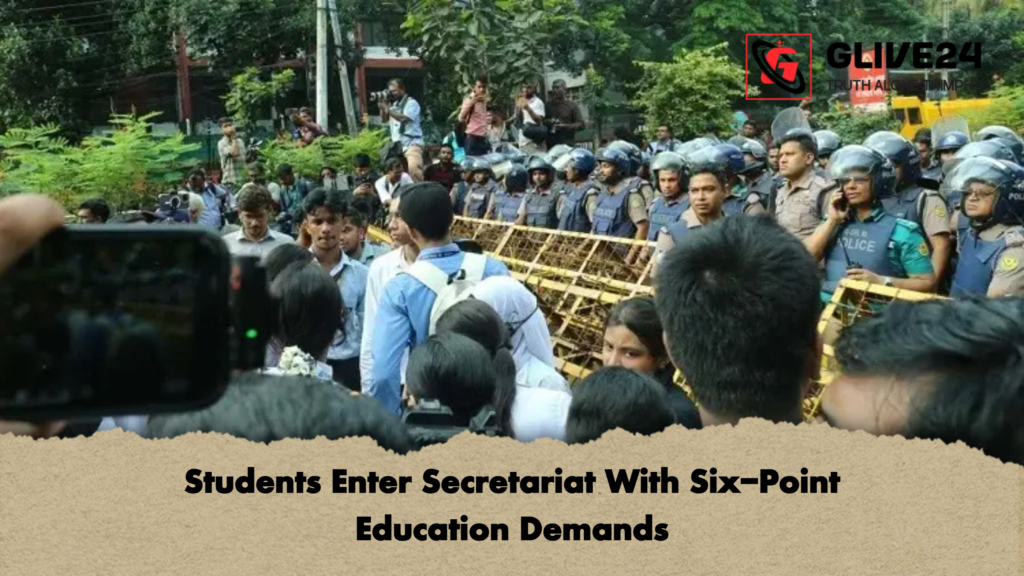
The delegation left the area in front of the Directorate of Secondary and Higher Education building for the Secretariat at around 4:45 pm. Earlier in the afternoon, at approximately 4:00 pm, police had prevented protesting students from advancing after they gathered outside the education offices. Following negotiations, authorities permitted six representatives to proceed into the Secretariat for formal talks.
The development marked a significant new phase in the movement. While the protests initially centred on a three-point agenda that included the resignation of the Education Minister, the representatives attending the meeting chose not to include that demand in their official submission. Instead, they presented six specific proposals concerning public examinations, assessment procedures and the overall protection of students’ interests.
Outside the Secretariat, however, many demonstrators continued chanting slogans demanding the minister’s resignation. The contrasting positions highlighted a tactical distinction between the negotiating delegation and sections of the protesters remaining on the streets, with the representatives prioritising immediate examination-related concerns during the official discussions.
The first demand calls for students who sat examinations under severe weather or other adverse conditions to be given the opportunity to retake those examinations if they wish. According to the representatives, many candidates were unable to perform to the best of their abilities because of circumstances beyond their control, making an alternative opportunity both reasonable and necessary.
Their second proposal seeks to ensure that students choosing to retake an examination are not disadvantaged. They urged the authorities to count whichever score is higher between the original examination and the resit as the student’s final mark, arguing that no candidate should risk losing marks simply for attempting to improve a result affected by exceptional circumstances.
The third demand concerns errors in examination papers. The representatives argued that whenever a question contains a confirmed mistake, full marks should be awarded for that question, maintaining that candidates should never bear the consequences of errors made during the question-setting process.
The fourth proposal focuses on students’ mental well-being. The delegation said the prolonged uncertainty and instability surrounding the examinations had created considerable psychological pressure on candidates. They therefore called on the authorities to allow sufficient time for students to recover emotionally before arranging any rescheduled examinations.
In their fifth demand, the students criticised what they described as an unexpected change in the format of examination questions without prior notice. They argued that the revised question pattern differed from previous years and left many candidates inadequately prepared. They requested that this issue be taken into account during the marking and evaluation process to ensure fairness.
The sixth and final demand addresses conduct inside examination halls. The representatives alleged that some invigilators, acting under the banner of heightened vigilance, had behaved in an unnecessarily strict and confusing manner during examinations. They said such behaviour created an intimidating atmosphere that negatively affected candidates’ concentration and confidence, and called for these practices to be stopped.
Taken together, the six-point proposal places strong emphasis on making examinations, assessment procedures and examination-centre environments more student-friendly while safeguarding fairness for all candidates. The representatives’ entry into the Secretariat opened the door to formal discussions between the protesters and the authorities.
No immediate decision or outcome from the meeting was announced. Meanwhile, students gathered outside the Secretariat continued their demonstrations, maintaining pressure through parallel protest activities and continuing to raise slogans demanding the Education Minister’s resignation, even as negotiations proceeded inside.