23 June marks a sombre and defining moment in the history of Bengal and the wider subcontinent. On this day in 1757, the historic Battle of Plassey (Battle of Plassey) was fought on the banks of the Bhagirathi River. What unfolded, however, was far more than a conventional battlefield encounter between equal forces; it was a calculated convergence of conspiracy, betrayal, and colonial ambition that altered the destiny of an entire region.
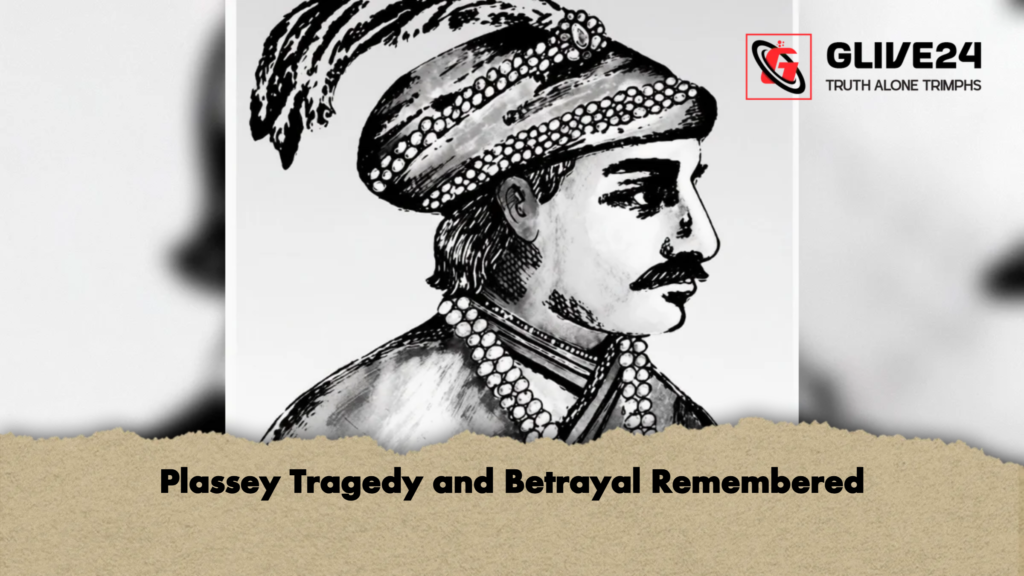
The last independent Nawab of Bengal, Bihar, and Orissa, Siraj-ud-Daulah (Siraj-ud-Daulah), confronted the advancing forces of the English East India Company. Yet the outcome of the conflict was not determined solely by military strength. Instead, it was decisively shaped by internal treachery. Key figures within the Nawab’s own court—including Mir Jafar, Rai Durlabh, Yar Lutuf, and influential banking houses such as the Jagat Seths—entered into secret agreements with the Company.
This betrayal enabled Robert Clive (Robert Clive) to secure a swift and decisive victory. The battle itself lasted only a few hours, but its consequences extended across centuries. With Siraj-ud-Daulah’s defeat and eventual death, the political independence of Bengal effectively collapsed, paving the way for nearly two hundred years of British colonial domination over the Indian subcontinent.
Key figures in the Battle of Plassey
| Name | Role | Historical significance |
|---|---|---|
| Siraj-ud-Daulah | Nawab of Bengal | Last independent ruler resisting Company expansion |
| Robert Clive | East India Company commander | Led Company forces to victory |
| Mir Jafar | Commander of Nawab’s army | Allegedly conspired with the British and replaced Siraj as Nawab |
| Rai Durlabh | Court noble | Part of internal faction opposing Siraj |
| Jagat Seths | Banking house | Provided financial and political backing for conspiracy |
The aftermath of Plassey was catastrophic for Bengal. The region, once renowned for its prosperity and thriving trade, gradually became a centre of systematic economic extraction. Wealth was transferred abroad, agricultural communities were burdened by oppressive taxation, and local industries declined under colonial policies designed to serve imperial interests.
Historians often emphasise that the tragedy of Plassey was not merely a military defeat but a moral and political collapse from within. The notion of internal division proved more destructive than external aggression. In this sense, Mir Jafar (Mir Jafar) has come to symbolise more than an individual; he represents a recurring archetype of betrayal driven by ambition and personal gain at the expense of collective destiny.
The legacy of 23 June is therefore not confined to historical remembrance. It stands as a warning about the dangers of disunity, greed, and the erosion of national cohesion. It is a call for reflection on how internal fragmentation can render even the most prosperous societies vulnerable to external domination.
As the day is observed, it serves both as a tribute to those who resisted colonial subjugation and as a reminder of the lessons embedded in history. The fall of Plassey underscores a timeless truth: a nation’s strength lies not only in its defences against external forces, but in its unity, integrity, and shared sense of purpose.