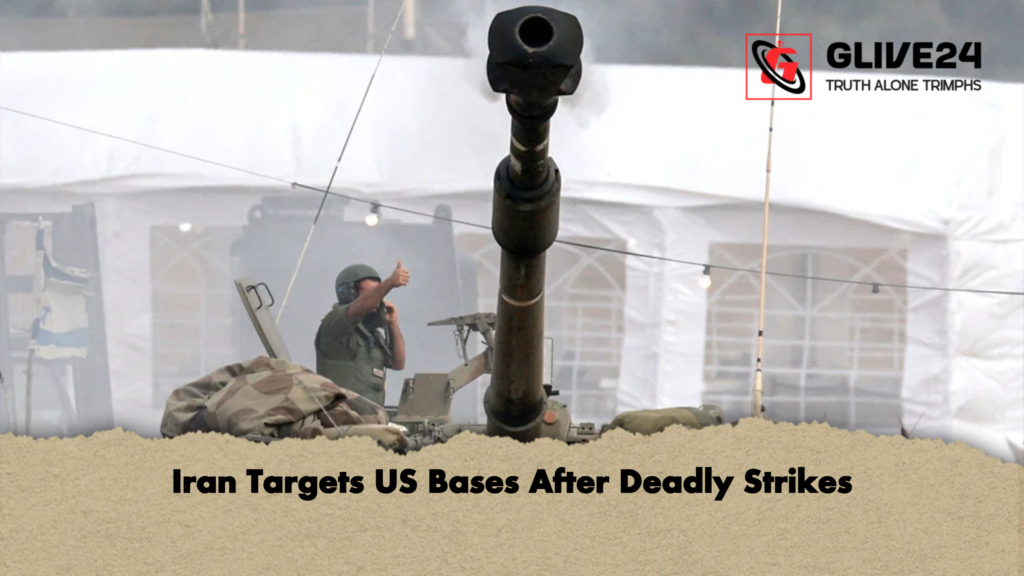
Tensions between the United States and Iran have escalated sharply, with Tehran claiming to have launched ballistic missile and drone attacks on American military facilities in Jordan in retaliation for recent US air strikes. Iran said the operation was carried out after at least eight people were killed in overnight American attacks, further deepening fears that the confrontation could expand into a wider regional conflict.
The Islamic Revolutionary Guard Corps (IRGC) said in a statement that its forces had struck US military positions and destroyed several aerial refuelling aircraft and fighter jets, while causing serious damage to other military aircraft. The claims have not been independently verified, and the US military has not immediately confirmed the extent of any damage.
Following the reported strikes, the IRGC issued a message directed at the people of Jordan, calling on them to oppose what it described as American interests in the country. Jordan’s military, however, said its air defence systems intercepted three missiles launched from Iran that entered its airspace. According to Jordanian authorities, the incident caused no casualties or damage to infrastructure.
Iran has also claimed responsibility for an attack on a US special operations facility in Al-Tanf, located near the Syria-Jordan-Iraq border. The IRGC said the strike was carried out in response to the deaths of Iranian military personnel in Iran’s southeastern city of Iranshahr. There has been no immediate official confirmation from either the Syrian government or the US military regarding the reported attack. Earlier this year, Washington had announced that it had completed the withdrawal of its forces from the Al-Tanf base, though details surrounding the current status of the facility remain unclear.
The confrontation has also widened to include other US allies in the region. Iran claimed that missile strikes were carried out against strategic targets and military facilities linked to the United States in Qatar, Kuwait and Iraq. Explosions were reported in the northern Iraqi cities of Erbil and Sulaymaniyah. Local officials said an attack targeting the anti-Iran Kurdish group Komala resulted in at least nine deaths and several injuries, although Tehran has not officially claimed responsibility for that operation.
Kuwait reported damage to a power generation facility and a seawater desalination plant following the attacks. Both facilities are considered essential components of the country’s energy and water supply networks, prompting authorities to closely monitor the situation.
The latest escalation comes amid growing military tensions surrounding the Strait of Hormuz, one of the world’s most important energy transit routes. After the collapse of a temporary ceasefire agreement last month, both sides have continued exchanging strikes. Iran has accused the US of targeting key infrastructure, including bridges, electricity facilities and a major port.
Iranian state media reported that American strikes hit several locations across southern Iran, including Ahvaz, Qeshm, Bushehr, Dashti, Bostan, Sirik and Bandar-e Lengeh. Reports also said three bridges in Bandar-e Khamir were damaged, while explosions were heard in areas including Tapeh Allah Akbar in Bandar Abbas.
In Hormozgan province, Iranian state television reported that attacks on road and railway infrastructure killed at least seven people. Authorities also said the airport in Iranshahr was damaged in an air strike, disrupting electricity supplies in surrounding areas. On Kish Island, temporary power outages were reported following further aerial attacks.
Iranian officials have claimed that dozens of people have been killed and hundreds injured in recent US operations, including casualties from the latest strikes on Friday. However, the figures have not been independently verified.
The exchange of attacks has raised international concern over the possibility of a broader regional crisis. Analysts warn that prolonged hostilities between Washington and Tehran could affect not only Middle Eastern security but also global energy markets and international trade. Any disruption in the Strait of Hormuz, through which a significant share of the world’s oil shipments passes, could have consequences far beyond the region.
With both sides continuing military operations and issuing warnings against further escalation, governments around the world are closely monitoring developments as uncertainty grows over whether diplomatic efforts can prevent the conflict from spreading further.