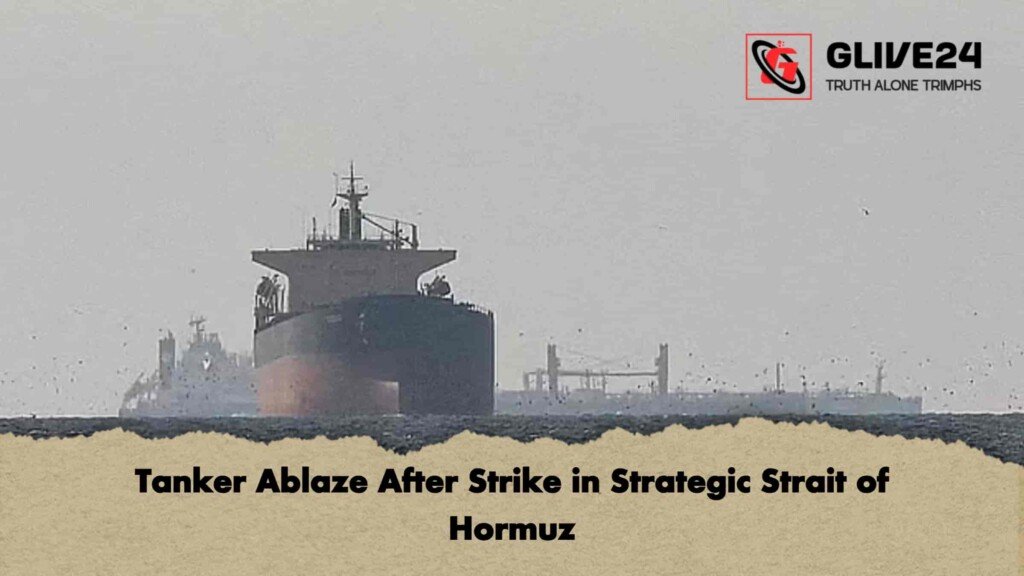
A fresh wave of anxiety has rippled through global energy markets following a technical report from the United Kingdom Maritime Trade Operations (UKMTO) confirming that an oil tanker caught fire in the Strait of Hormuz after being struck by an “unidentified object”.
The incident occurred on Monday, approximately 8 nautical miles east of Limah, a coastal village in Oman. According to a statement released by the UKMTO on the social media platform X (formerly Twitter), the projectile impacted the port side of the vessel, instantly igniting a fire. While investigations into the origins and nature of the strike remain ongoing, maritime authorities confirmed that no casualties have been reported, and there is currently no evidence of environmental degradation or oil spillage in the surrounding waters.
A Fragile Peace Threatened
This latest aggression comes at an incredibly delicate geopolitical juncture. Washington and Tehran are currently maintaining a fragile ceasefire, with active diplomatic channels working towards a permanent peace treaty. The escalation serves as a stark reminder of the volatility inherent to the Strait of Hormuz—a narrow chasm of water separating Oman and Iran that acts as the world’s primary artery for oil and gas transit.
Historically a geopolitical flashpoint, tensions in the strait reached a zenith during the recent conflict involving Iran. Within days of hostilities breaking out, Tehran enforced a naval blockade, leading to targeted strikes on commercial shipping vessels that effectively paralysed the corridor. The resulting disruption sent shockwaves through the global economy, causing crude oil prices to spike exponentially.
In a retaliatory bid to force Iran’s hand and secure the shipping lanes, the United States imposed a comprehensive naval blockade on major Iranian ports and launched a series of retaliatory military strikes. It was only last month that a breakthrough occurred, with Washington and Tehran signing a Memorandum of Understanding (MoU) aimed at cessation of hostilities and the restoration of commercial maritime traffic.
The New Maritime Paradigm
While shipping volumes had begun to stabilise over recent weeks, complete normalcy remains elusive. Tehran has explicitly stated that a return to the pre-war status quo—where commercial vessels enjoyed unrestricted navigation—is off the table.
Under the new directives enforced by the Iranian regime, all commercial vessels navigating the strait are strictly mandated to stick to authorised, predetermined corridors running parallel to the Iranian coast. Deviations from these tightly monitored routes are met with severe warnings, adding layers of bureaucratic and operational friction for international shipping firms.
The Economic Significance of the Strait
The Strait of Hormuz is undisputedly the most vital maritime transit route for hydrocarbons globally. Data underscores the sheer scale of dependence that the international community has on this narrow passage:
-
Global Supply Hub: Approximately 20% of the world’s total consumption of petroleum and Liquefied Natural Gas (LNG) transits through this chasm.
-
Multilateral Reliance: The route is not merely an Iranian asset; it is the primary economic gateway for major Persian Gulf exporters including Saudi Arabia, the United Arab Emirates (UAE), Kuwait, Qatar, and Iraq.
-
Volume and Valuation: Figures from the US Energy Information Administration (EIA) reveal that in 2024, an average of 20 million barrels of oil passed through the strait daily. Annually, this trade is valued at a staggering $600 billion.
-
The Asian Conundrum: The reliance on this route is heavily skewed towards Eastern economies. According to the EIA, roughly 82% of the crude oil and fossil fuels transiting the strait in 2022 were destined for Asian markets. China remains uniquely vulnerable to disruptions here, as it is estimated to purchase nearly 90% of Iran’s total oil exports.
Despite the recent MoU, overall shipping volumes through the strait remain significantly lower than pre-war baselines. The UKMTO has issued an urgent advisory to all mariners operating within the region, urging extreme caution and requesting the immediate reporting of any suspicious maritime activity as investigations into Monday’s strike continue.